








Last summer, as part of the debt-ceiling crisis, Democrats and Republicans agreed to spending levels for the upcoming year, suggesting the budget process would go relatively smoothly in 2012. After all, with the figures already locked in, the most contentious part of the process was already addressed. As far as everyone was concerned, a deal’s a deal.
And then GOP officials started whispering that they didn’t much like the deal anymore.
Senate Majority Leader Harry Reid (D-Nev.) told reporters earlier this week, “This wasn’t a handshake, it was a law we passed…. I guess [House Republicans] love government shutdowns, or at least the threat of them.”
That threat is becoming increasingly real. Reuters reports that House GOP leaders are “ready to break a hard-fought budget deal,” in large part because rank-and-file Republicans are insisting upon it. House Speaker John Boehner (R-Ohio) and Majority Leader Eric Cantor (R-Va.) are now reportedly seeking a compromise on the compromise, asking Dems to accept an additional $19 billion in cuts, on top of the cuts Democrats already agreed to swallow.
How would congressional Republicans justify reneging on a deal they struck just seven months ago? To hear them tell it, there’s room for a semantics debate — both sides agreed to a $1.047 trillion cap on discretionary spending for fiscal 2013. GOP officials are now arguing that the cap is simply a ceiling, and that there’s nothing wrong with pushing a budget that’s lower than the agreed-upon maximum.
While I’ll gladly give Republicans credit for creativity, the argument is dishonest to a jaw-dropping degree. Greg Sargent set the record straight by reminding us what GOP leaders were saying before they changed their minds.
…Dems and the White House will argue that even Mitch McConnell himself recently acknowledged that what was actually agreed upon were “discretionary spending levels.” Eric Cantor also has described the deal as one that set a “level of spending.”
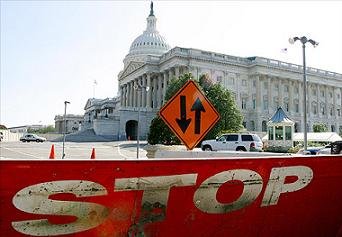
Get ready for a rerun of a very bad movie. We’re hurtling towards another government shutdown fight, in which the House GOP leadership will be dealing with a Tea Party wing that prioritizes shrinking government above all else — this time, in the lead up to the elections.
That’s exactly right. The next question is how serious this situation really is.
The divisions are getting increasingly messy. Democrats want Republicans to honor the bipartisan deal; House Republicans want an additional $116 billion in cuts; the GOP leadership wants rank-and-file members to settle for $19 billion in cuts. But the Boehner/Cantor request won’t work for anyone — their cuts aren’t deep enough for right-wing members, and their willingness to renege on their own compromise guarantees Democratic rejection. The crisis, at this point, is still on the horizon, and cooler heads may yet prevail. Indeed, given Congress’ record-low approval rating, and the severe unpopularity of the Republican Party, it’s hard to imagine even the most unhinged GOP members risking their majority in an election year, forcing a government shutdown. Then again, it was also hard to imagine literally every Republican in Congress last summer agreeing to destroy the economy on purpose unless Democrats accepted significant spending cuts — but that’s exactly what the GOP did during the debt-ceiling fiasco. I’d bet against a shutdown, but the circumstances at this point are unpredictable. Sen. Patty Murray (D-Wash.) said last week, “Republicans are playing with fire here.” As of this week, they’ve already lit the match.
The place for in-depth analysis, commentary and informed perspectives. Recommended


