








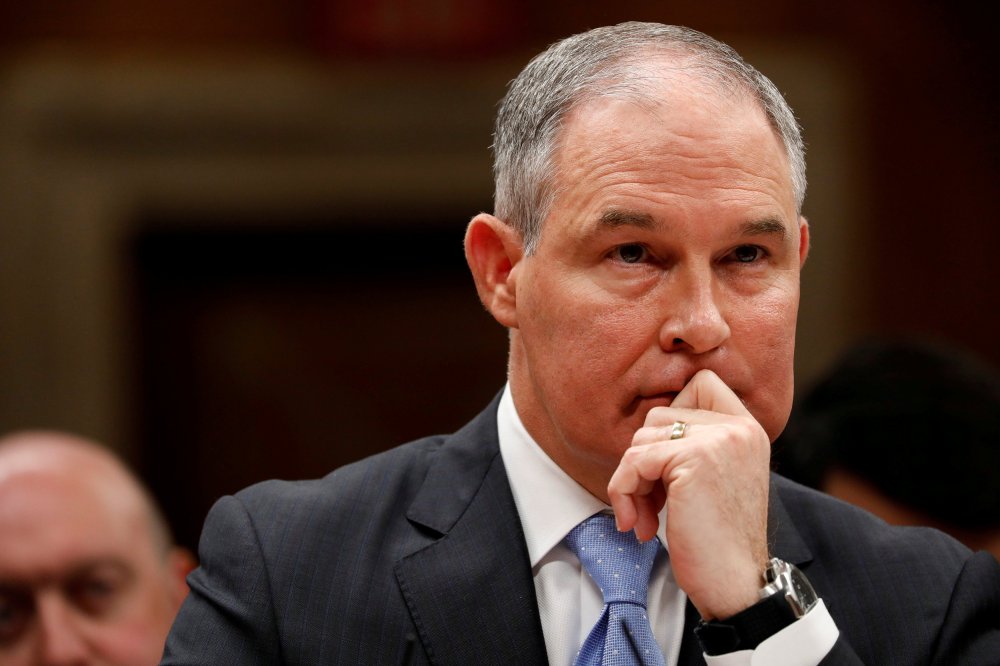
In a cabinet filled with scandal-plagued members, EPA Administrator Scott Pruitt manages to stand out. In recent weeks, the corruption controversies surrounding the Oklahoma Republican have reached crisis levels, and even Donald Trump’s White House has begun “cautioning” its allies about defending him.
Sen. John Thune (R-S.D.), the Senate’s third-ranking Republican leader, conceded to reporters yesterday, “Obviously, Scott Pruitt has got some serious questions to answer.” Thune added that while GOP lawmakers like the EPA chief’s efforts to undermine environmental safeguards, the allegations Pruitt is facing make it “harder to be effective in his job.”
The question of efficacy is an important one, and it’s more difficult to answer than it may appear. On the one hand, when it comes to dismantling safeguards, Pruitt has a reputation for being ruthlessly effective, but his record reflects a clumsy and careless administrator.
But on the other hand, the EPA chief is proving to be quite effective in going after science. Mother Jones reported on Pruitt’s announcement yesterday — at an event closed to the press, but well attended by his ideological allies — intended to “restrict the kinds of scientific studies the agency can use in developing its regulations.”
For years, EPA critics have pushed Congress to forbid the agency from relying on the studies that comprise the bulk of the independent research on fossil fuels on public health. Their strategy aims to sow doubt about the health effects of air pollution, while slowing down or weakening future rules targeting particulate matter and ozone. The proposed rule is modeled after bills introduced by Smith in the House, which Pruitt described as the “codification of an approach.” Under the new approach, the Environmental Protection Agency will only consider research with publicly available underlying data. And while Pruitt pretends this is about “transparency,” the practical implications are dramatic. The Mother Jones piece added, “It would drastically limit the kinds of studies available to regulators crafting the agency’s air and water regulations, because many of these studies rely on sensitive medical records that cannot be made public, or may be owned by private institutions not keen on publishing proprietary information.” The move comes six months after Pruitt removed the EPA’s science advisers and replaced them with “researchers from industry and from states that have previously sued to block environmental regulations.” How is it possible that only five Republican members of Congress have called for Pruitt’s resignation? It’s probably because of efforts like these.
Steve Benen is a producer for "The Rachel Maddow Show," the editor of MaddowBlog and an MS NOW political contributor. He's also the bestselling author of "Ministry of Truth: Democracy, Reality, and the Republicans' War on the Recent Past." Recommended


