








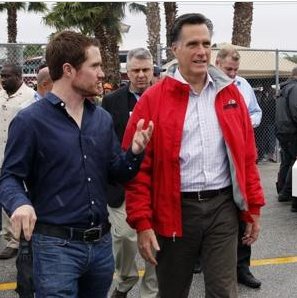
At Mitt Romney’s press conference this morning, before taking a shot at his own party’s base, the Republican candidate was asked whether his recent rhetoric regarding his wealth had taken a toll on his campaign.
“Yes,” Romney said. “Next question.”
The former governor’s reluctance to expound on the subject is understandable; he’s made some inexplicable gaffes recently. But the “next question” is the extent to which Republicans are starting to genuinely worry about Romney’s troubles in this area.
It was, after all, Romney’s perceived electability that made him the GOP frontrunner in the first place. Michael Gerson argues today that the candidate’s missteps “confirm a damaging stereotype” and may be “potentially fatal.”
These blunders not only reinforce a traditional Republican weakness, they threaten to diminish a large Republican advantage — Barack Obama’s dramatic disconnect with blue-collar whites. The candidate who talked of small-town Americans as clinging “to guns or religion” lost white working-class voters by 18 points in 2008. In 2010, congressional Democrats lost the same group by 30 points. A similarly dismal performance by Obama in 2012 would open vast blue portions of the electoral map to Republican raids.
Romney may be the only candidate capable of herding working-class voters back toward the president.
It’s worth emphasizing that Gerson believes this is not an unsolvable problem. “Patronizing empathy” — such as Romney claiming to be “unemployed” — won’t help, but directing “some of his economic attention to the specific needs of struggling Americans” might. Indeed, Gerson points to Bobby Kennedy’s tour of Appalachia as an example of a politician of means “at least witnessing the struggles he has not shared.”
That’s not a bad idea, at least in theory. The problem then becomes Romney’s policy platform.
Specifically, RFK didn’t make budget proposals like these.
Money comes into the federal government through taxes and bonds. The vast majority of it is then spent on old-people programs, poor-people programs, and defense. Mitt Romney is promising that taxes will go down, defense spending will go up, and old-people programs won’t change for this generation of retirees. So three of his four options for deficit reduction — taxes, old-people programs, and defense — are now either contributing to the deficit or are off-limits for the next decade. Romney is also promising that he will pay for his tax cuts, pay for his defense spending, and reduce total federal spending by more than $6 trillion over the next 10 years. But the only big pot of money left to him is poor-people programs. So, by simple process of elimination, poor-people programs will have to be cut dramatically. There’s no other way to make those numbers work. Right. The surface-level trouble facing Romney is that he comes across as an out-of-touch, plutocratic elitist. The just-below-the-surface trouble is that Romney, if elected, intends to help other out-of-touch, plutocratic elitists, while making life significantly tougher on those working families who are already suffering. When Romney said he’s “not concerned about the very poor,” he wasn’t kidding. Gerson sees the former governor pulling a page from Bobby Kennedy’s 1968 playbook, but Kennedy was deeply concerned about the very poor, in ways that Romney can’t even begin to fake.
The place for in-depth analysis, commentary and informed perspectives. Recommended


