








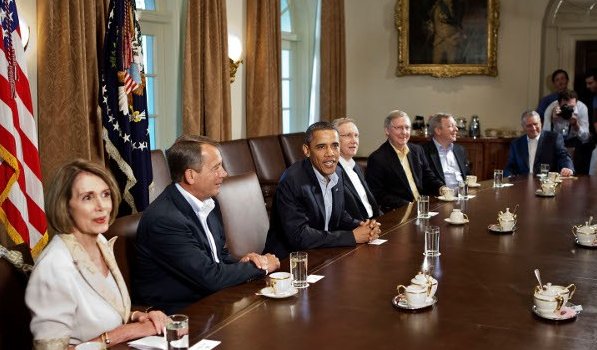
Last year, as part of the fiasco surrounding Republicans’ debt-ceiling hostage crisis, President Obama offered House Speaker John Boehner (R) an overly-generous “grand bargain.” Though some of the details are murky, by all accounts, the Democratic president offered Republicans a $4 trillion deal on debt reduction, which included GOP-friendly entitlement “reforms,” in exchange for modest increases in tax revenue.
Presented with a ridiculously sweet deal on what is ostensibly the party’s top priority, Republicans rejected the offer out of hand. It would have required a fairly small concession on taxes, which GOP lawmakers simply were unwilling to make. It was, in retrospect, the best possible outcome for Obama — he offered far too much and was poised to get far too little.
Regardless, the Republican opposition to the compromise scuttled the grand bargain, seemingly for the indefinite future. Oddly enough, there’s renewed scuttlebutt eight months later.
A small, bipartisan group of lawmakers in both the House and Senate are secretly drafting deficit grand bargain legislation that cuts entitlements and raises new revenue.
Sources said that the task of actually writing the bills is well underway, but core participants in the regular meetings do not yet know when the bills can be unveiled.
The core House group of roughly 10 negotiators is derived from a larger Gang of 100 lawmakers led by Reps. Mike Simpson (R-Idaho) and Health Shuler (D-N.C.), who urged the debt supercommittee to strike a grand bargain last year.
That larger group includes GOP centrists like Rep. Steve LaTourette (R-Ohio), who has said Republicans should abandon their no-new-tax-revenue pledge, as well as Tea Party-backed members like Rep. Cynthia Lummis (R-Wyo.).
You’ll notice those paragraphs mention three conservative Republicans and one conservative Democrat as participating in the talks. I’d add that there’s no evidence of any progressive Democrats playing any role whatsoever in these negotiations.
The result, if there is a result, will almost certainly be a bargain that’s very favorable to Republicans.
As much as I’d love to offer a substantive critique of the plan, there are no details to scrutinize, at least not yet. A package that “cuts entitlements and raises new revenue” could mean practically anything. Talk of revenue suggests some kind of tax increases would be in the mix, but much of that would depend on baselines. While we wait for the policy to advance, the political considerations are just as murky. House Minority Whip Steny Hoyer (D-Md.), not exactly a liberal champion, is reportedly supportive of the talks, but no other Democratic leaders have extended their imprimatur to the process. Republican leaders, meanwhile, haven’t said a word. And what of the White House, which wanted some kind of grand bargain to begin with? Brian Beutler reports that the president and his team do not have high expectations. A senior administration official says the White House could support balanced deficit reduction legislation if Congress passes it before the end of the year — but sees no evidence that Republicans have moved off their no higher tax revenue position, and thus doubt policymakers will be able to reach an agreement that President Obama can sign. […] The official said the President still supports balanced deficit reduction — i.e. cuts to popular federal programs and higher taxes on the wealthiest Americans — and could support such a package if it passes before the election. But the administration hasn’t been involved in recent efforts, and sees nothing that leads them to believe that Republicans have budged on taxes — the biggest obstacle to addressing medium-to-long-run budget issues. As these talks continue, it’s worth keeping the calendar in mind. Under the debt-reduction plan’s “triggers,” some pretty severe cuts are poised to kick in at the end of the year, and Republicans have said they’ll fight to prevent the cuts they recommended a year ago. Obama has said the only way to prevent the trigger from being pulled is for GOP leaders to reach some other comparable compromise.
The place for in-depth analysis, commentary and informed perspectives. Recommended


