








Donald Trump’s new tariffs on our neighbors and allies have left America’s friends feeling betrayed and insulted. As the latest G-7 gathering gets underway in British Columbia, it’s the United States that finds itself isolated after the American president uprooted 70 years of painstaking effort “to build an international system of trade based on mutually accepted rules and principles.”
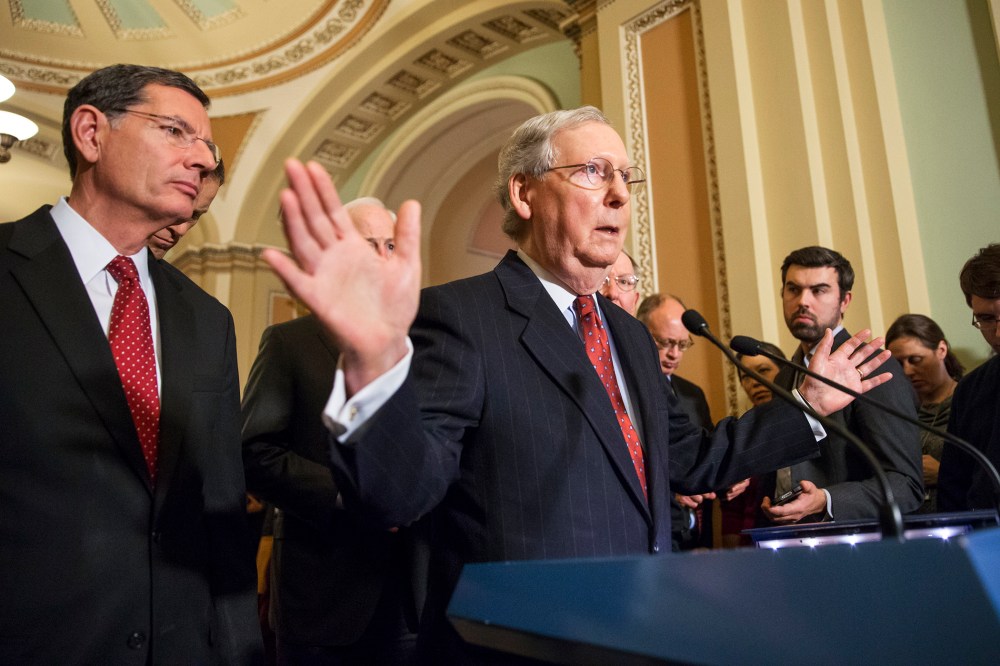
Trump’s Republican allies in Congress aren’t exactly pleased, either. Senate Majority Leader Mitch McConnell (R-Ky.) was among the many GOP officials to offer at least some criticism of the White House’s moves on trade.
But note what happened when a local reporter in Kentucky asked McConnell what he’s prepared to do to put things right.
Asked by Insider Louisville if Congress could do anything to intervene, McConnell answered “not much.”
“Under the trade law, the president has pretty much all the ability to do these things, so there’s not much we can do to impact it,” McConnell said. “It’s really an executive branch activity, and he’s got the authority to do what he’s chosen to do. It’s just that I think many of us feel that it shouldn’t be done.”
In case anyone’s forgotten, the U.S. Constitution empowers Congress to make decisions about “duties, imposts and excises,” and generally to oversee issues related to international trade. There have been subsequent laws, however, that create presidential authority to impose tariffs, without congressional approval, in the name of national security. It’s these laws that Trump is now exploiting.
But while McConnell’s passivity is predictable, it’s not altogether necessary.
When the Obama administration helped negotiate the terms of the international nuclear agreement with Iran, there was “not much” Mitch McConnell could do to stop it — but he nevertheless brought a measure to the Senate floor to undo the deal.
Sure, if the Republican leader tried something similar now, Trump would veto such a bill if it were to pass Congress, but given the scope of the opposition to the president’s policy, such a measure might pass by a veto-proof majority. The only way to find out is to try.
What’s more, there is some precedent in this area: in his final year as president, Jimmy Carter created oil tariffs, which Congress — led by a Democratic majority — quickly overturned. (NBC News’ Andrea Mitchell reported on this at the time.)
There’s no reason this couldn’t happen again. It’s a matter of political will, not institutional constraints.
For his part, Senate Foreign Relations Committee Chairman Bob Corker (R-Tenn.), referring to Trump’s tariffs, said over the weekend that he’s “working with like-minded Republican senators on ways to push back on the president using authorities in ways never intended and that are damaging to our country and our allies.” The Tennessean, who’s retiring this year, wasn’t specific about the nature of the legislative pushback, but Sen. Jeff Flake (R-Ariz.), who’s also leaving Capitol Hill, has had a bill pending since March to block the very tariffs Trump is imposing now. Sen. Mike Lee (R-Utah) has a related bill, which Sen. Pat Toomey (R-Pa.) endorsed late last week. All of which is to say, Mitch McConnell, who says he disagrees with the White House on this, doesn’t have to take Trump’s move lying down. The GOP leader may think there’s “not much” he can do, but there are meaningful policy options available. The Associated Press reported this morning, meanwhile, that some Republicans are “hoping Trump simply changes his mind” about tariffs “and doesn’t follow through” with his plan. Since that’s exceedingly unlikely, it’s up to lawmakers to try governing for a change.
Steve Benen is a producer for "The Rachel Maddow Show," the editor of MaddowBlog and an MS NOW political contributor. He's also the bestselling author of "Ministry of Truth: Democracy, Reality, and the Republicans' War on the Recent Past." Recommended


