In Friday’s opening segment, Rachel talked about changing regulations to do with gas pump nozzles and vapor recovery.
From the transcript:
But now, because auto manufacturers are taking account of it, they are taking care of that problem inside the car. They have rebuilt gas tanks so the gas tanks themselves, in the car, actually deal with most of the problem. Because of that, those big, black, plastic, rubbery hood things that go over the gas pump nozzle … are going to go away.
Like Ms. Jacobson above, I figured vapor recovery was all about the gas coming out of the pump and didn’t see how a change in the tank (Rachel didn’t actually say “engine” but I think we’re on the same page) would help anything. After digging around a little I have a new idea of what the answer is, but I’m going to need some help from any motorheads out there who know for sure.
The EPA site has a lot of explanation of the regulations (including implementation dates that make clear why the regulation is changing now), but not so much about the mechanics. Presumably that was left up to the individual car makers.
I got this diagram of an On-board Refueling Vapor Recovery System from a Subaru Impreza discussion forum:
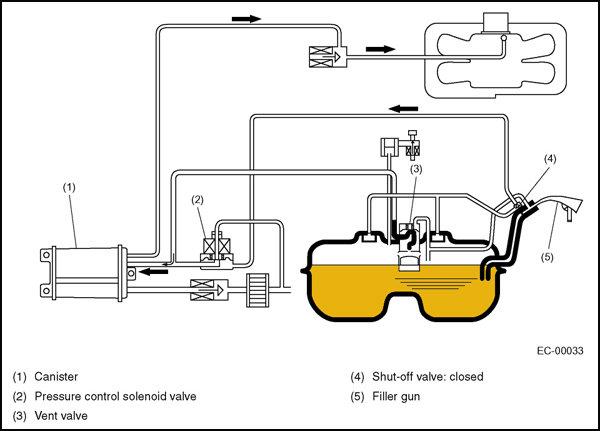
I added the color to show where the gas is. For me, adding the color helped me realize what’s not in color. That is to say, where there’s no gasoline in the tank, that empty space is fuel vapor. “Running on fumes,” right? When you fill the tank, all of that air has to be displaced to somewhere else. I’m guessing (this is where I need help) that on old model gas tanks, that displaced air came right out the pump hole. Putting the sleeve on the nozzle so that it covers the hole would catch the vapor being displaced by the fuel. Not a bad idea if you consider how many empty gallons are replaced on any given day in the U.S.
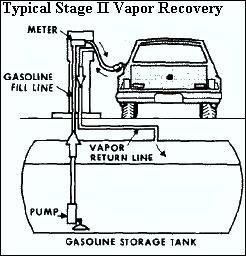
From what I can tell, that recovered vapor was sucked back into the big tank under the gas station to replace the liquid fuel being pumped into your vehicle. See the diagram to the right.
Before I digress to gas pump design, let’s go back to that Subaru gas tank diagram. Way over on the left (1) is labeled “canister.” I’m not clear on the chemistry, but it has activated charcoal in it that somehow cleans that vapor. Depending on the system, the cleaned (but probably still at least a little fuelly) air can be sent into the engine’s air intake system.
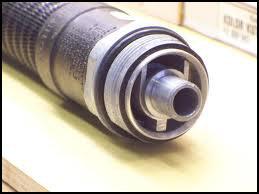
The rest is a network of valves, vents and pressure sensors to make sure nothing goes down the wrong tube and everything flows in the right direction. (Fuel vapor under high pressure will combust, so there’s probably something in the design to make sure that doesn’t happen, for example.) So there you go. With the tank reprocessing the displaced air when the tank is filled, there’s less displaced vapor coming out at the input. Just one more thing about gas nozzles that I didn’t realize that maybe you’ll find interesting. That pipe that you stick into your car is actually a tube within a tube. The way the no-longer-required sleeve worked was that while fuel was coming out of one tube, another tube was sucking out the vapor. Even without the sleeve, I think that’s still the case. Y’know those holes around the outside at the end of the nozzle? That’s for vapor capture. While poking around I found this eBay listing for gas pump parts, which lists one vapor recovery hose. I’m pretty sure the “send” and “return” are what we’re seeing in the cross-section image here:Recommended