








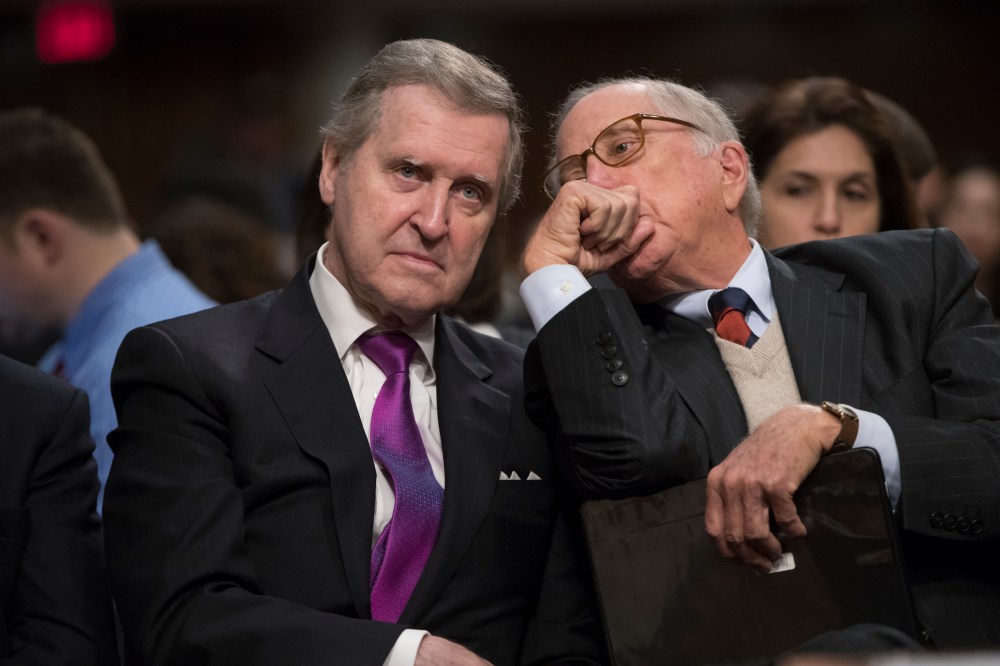
William Cohen had a rather extraordinary political career. He was first elected to Congress in 1972 as a moderate Maine Republican, and he soon after found himself on the House Judiciary Committee during the Watergate impeachment inquiry. He later served nearly two decades in the U.S. Senate, before becoming secretary of Defense in the Clinton administration.
Yesterday, Cohen wrote a piece for the Washington Post on his party’s posture toward Donald Trump’s scandals, which he clearly sees as unacceptable.
With the exception thus far of Rep. Justin Amash (R-Mich.), Republicans have taken the position that Mueller’s redacted report has resolved all issues of alleged presidential collusion with the Russians and obstruction of justice. Case closed.
This is not a tenable position. The Mueller report has raised nearly as many questions as it has answered.
Cohen’s op-ed offered some useful historical context, explaining in some detail that while many Americans were uncomfortable with the idea of impeaching Richard Nixon, public attitudes shifted as the facts came to light.
At the same time, Cohen added, six Republicans om the committee “felt compelled to place loyalty to the rule of law above our political affiliation and political futures.”
He went on to write, “The silence of Republicans today in the face of presidential behavior that is unacceptable by any reasonable standard is both striking and deeply disappointing.” He added that Republican members privately “express their disdain” about Trump, but they’re too afraid to “speak out publicly even in the face of behavior they would find intolerable by any previous occupant of the Oval Office.”
Cohen didn’t literally endorse impeaching the president, but he came awfully close: “Congress should not turn away from the central issue of whether Trump has, in word and deed, engaged in conduct that is fundamentally inconsistent with, and antithetical to, the highest office in the land. If Congress cannot secure the cooperation of executive branch officials in the exercise of its oversight responsibilities, it will have no choice but to enter the temple and remove the fabled sword.”
The Maine Republican joins a very small club of current or former GOP lawmakers who’ve made the case that Trump may have crossed the line into impeachable misconduct. The Washington Post piece, incidentally, was also published in the Bangor Daily News in Cohen’s home state of Maine, which I mention for one reason: it means Sen. Susan Collins (R-Maine) and many of her constituents likely saw it. Indeed, it’s worth noting for context that Cohen was a mentor to Collins, who succeeded him in the Senate. He certainly didn’t single out Collins in his piece, but Cohen nevertheless called on congressional Republicans to step up and take the allegations against the president seriously. Will Collins answer that call?
Steve Benen is a producer for "The Rachel Maddow Show," the editor of MaddowBlog and an MS NOW political contributor. He's also the bestselling author of "Ministry of Truth: Democracy, Reality, and the Republicans' War on the Recent Past." Recommended


