








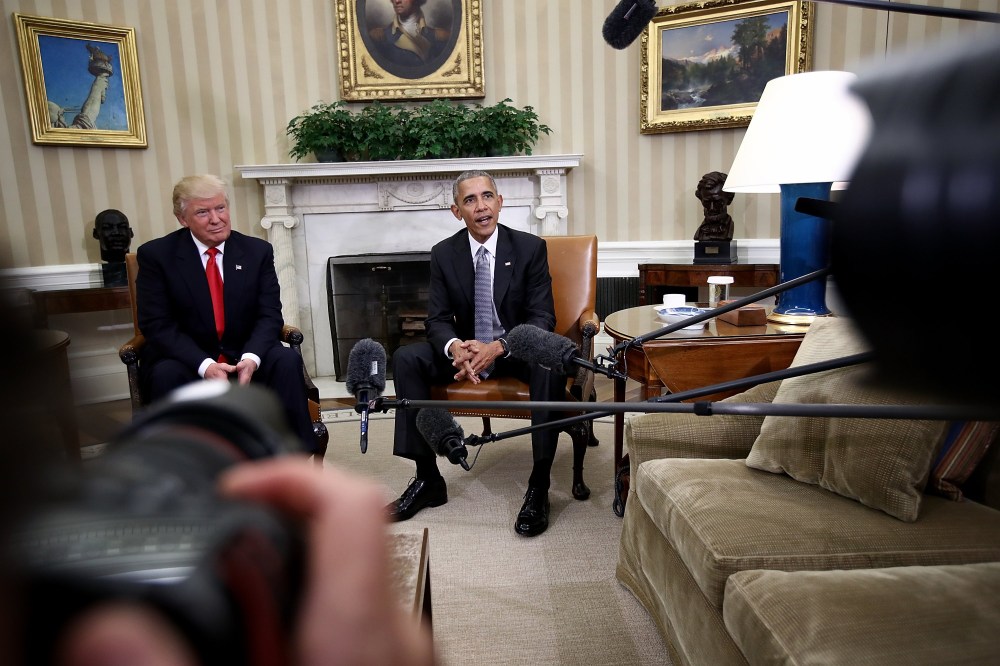
A decade ago, with the United States in the grips of the Great Recession, the American automotive industry — the backbone of the nation’s manufacturing sector — was on the brink of collapse. It wasn’t a popular move, but Barack Obama launched a rescue package to save the auto manufacturers. The price of the bailout: $12 billion.
A decade later, Donald Trump’s trade war has taken a severe toll on many American farmers, prompting the Republican administration to launch two bailouts for the agricultural sector. The combined price of the farmers’ bailouts: $28 billion.
In fact, research from the American Farm Bureau Federation noted last week that nearly 40% of all farm income in the United States this year will come from federal aid. As Garance Franke-Ruta noted the other day, it’s an economic dynamic that, in a rather literal sense, is starting to look like socialism.
It was against this backdrop that Donald Trump headlined a campaign rally in Mississippi on Friday night, where he found all of this worthy of boast. In fact, the president seemed eager to draw a comparison between his record and that of his immediate predecessor.
“I mean think of that: $28 billion…. Not bad, right? Not bad. Do you think Obama would do that? I don’t think so.”
As a substantive matter, Barack Obama wouldn’t have needed to bail out farmers from a trade war because Obama would’ve known not to launch one. But putting that aside, it’s hard not to marvel at the point of Trump’s boast: Obama, in the Republican’s mind, wouldn’t have been eager enough to embrace a socialistic solution.
Indeed, when Obama rescued the American automotive industry, GOP lawmakers were apoplectic, convinced that the Democratic president was waging war on the nation’s free-enterprise system. A decade later, we’re apparently supposed to believe Obama wasn’t hostile enough to the free market?
Stepping back, at the same Mississippi event, Trump referenced Obama by name 14 times — including a not-so-subtle riff on Trump’s belief that “Barack Hussein Obama” was lazy. I’ve long been fascinated by the Republican’s preoccupation with his predecessor, but is it perhaps getting worse?
Actually, yes. CNN’s Daniel Dale approached this is a quantifiable way:
Trump has had a years-long fixation with Obama that predates his presidential campaign. But it has appeared to intensify in recent months, at least judging by the frequency of his public disparagement. October capped a five-month stretch in which Trump talked or tweeted about Obama far more than he did at any other point in his presidency. […] [Between June 2019 and October 2019], Trump mentioned Obama an average of 2.4 times per day. If you add in his 69 mentions of the “previous administration” or “last administration,” it was 2.8 times per day. Through October, Trump had mentioned Obama by name 537 times during 2019 as a whole — an average of 1.8 times per day. That’s a 36% increase from the 395 mentions (1.3 per day) Trump made of Obama in 2018 through October of that year and a 169% increase from the 200 mentions in 2017 (0.7 per day) through October of that year. As we discussed a while back, some of this is understandable. Obama was a successful and popular president, whose support has grown, even after leaving the White House. Obama has what Trump wants but can’t have: respect, stature, and an impressive record of historic weight. But the more Trump obsesses over the former president, the less it helps him.
Steve Benen is a producer for "The Rachel Maddow Show," the editor of MaddowBlog and an MS NOW political contributor. He's also the bestselling author of "Ministry of Truth: Democracy, Reality, and the Republicans' War on the Recent Past." Recommended


