








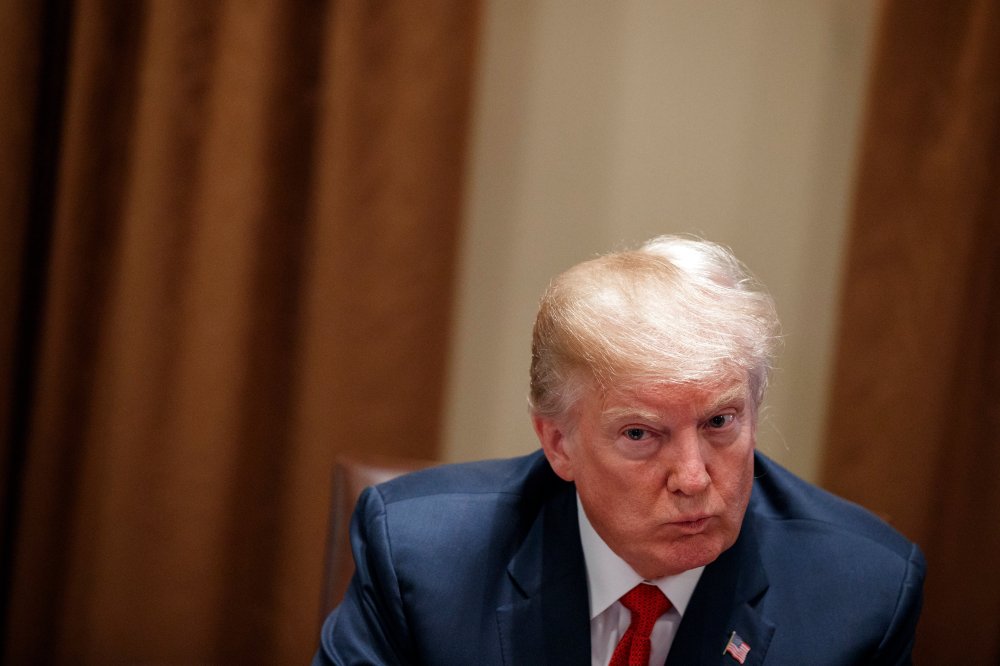
Donald Trump held a narrow card during yesterday’s listening session at the White House on gun violence in schools, which I initially thought might include a series of policy proposals the president intended to talk about. That would hardly have been outrageous: it’s sometimes difficult to remember specific points of an agenda, especially for a political amateur, so I assumed Trump brought a cheat-sheet with him.
But that wasn’t the point of the card. Rather, the president brought with him a five-point guide on how best to interact with the event’s attendees. The Washington Post noted:
[R]ight there at No. 5 is a talking point about telling those present that he was actually listening to them. After what appear to be four questions he planned to ask those assembled, No. 5 is an apparent reminder for Trump to tell people, “I hear you.”
Even No. 1 is basically a reminder that Trump should empathize. “What would you most want me to know about your experience?” the card reads. So two-fifths of this card is dedicated to making sure the president of the United States assured those assembled that he was interested in what they had to say and their vantage points.
In the 1990s, Bill Clinton may have faced years of mockery for having declared, “I feel your pain,” but no one ever accused the Democratic president of lacking empathy.
A generation later, White House aides effectively have to remind the current president to at least try to appear as if he’s interested in others’ pain.
I remember shortly after the massacre in Las Vegas, the Associated Press reported that White House aides felt anxiety over what Trump might say (or tweet) about the mass murders. They were nervous, of course, because of the president’s “troubled track record in such delicate moments.”
The report added at the time, “Trump often has had difficulty embracing a central role of the American presidency: consoling people dealing with intense grief.” As regular readers know, this has been a persistent area of difficulty for the president. In the fall, for example, during a call to Sgt. La David T. Johnson’s widow, Trump reportedly said the sergeant “must’ve known what he signed up for.” It wasn’t the first such incident. After Hurricane Harvey hit Texas, he marveled at the size of the “turnout” of people who wanted to see him in Corpus Christi. After initially ignoring Puerto Rico following Hurricane Maria, the president focused on the island’s debts to Wall Street, feuded with a local mayor, and threw paper towels to locals. With this in mind, perhaps yesterday’s White House event was encouraging: Trump didn’t say or do anything outwardly offensive to his audience. If he had to be reminded to behave this way, so be it.
Steve Benen is a producer for "The Rachel Maddow Show," the editor of MaddowBlog and an MS NOW political contributor. He's also the bestselling author of "Ministry of Truth: Democracy, Reality, and the Republicans' War on the Recent Past." Recommended


