








During his speech on Saturday afternoon, unveiling his latest “plan” to end his government shutdown, Donald Trump declared, “Senate Majority Leader Mitch McConnell has pledged to bring this bill to a vote this week in the United States Senate.”
On this, the president was correct. The White House hasn’t invested much energy in communicating with congressional Democrats — they were left out of the talks that produced Trump’s latest blueprint — but the coordination with congressional Republicans has been fine. The Washington Post reported:
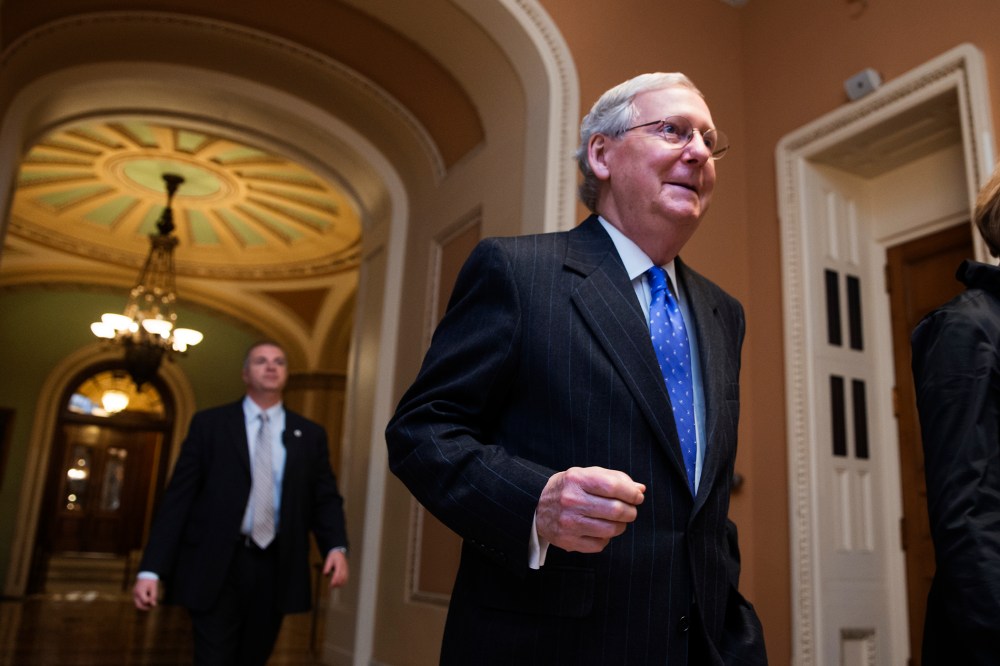
Moving ahead on Trump’s plan, Senate Majority Leader Mitch McConnell (R-Ky.) announced that he would put the legislation on the Senate floor for a vote in the coming week. Trump heralded the package as a bipartisan, “compassionate response” that would offer humanitarian relief on the border and curb illegal immigration — while allowing the government to reopen.
McConnell laid out his plan in a private call with GOP senators late Saturday afternoon, where there was little dissent, according to an official who spoke on the condition of anonymity to discuss private deliberations.
Though there was some talk about Senate action as early as tomorrow, by all accounts, we’re more likely to see a floor vote on Thursday. The New York Times reported that the GOP leadership will tie the president’s immigration package to spending bills that would end the shutdown and re-open the government, apparently to increase the pressure on Democrats to go along with Trump’s demands.
As the vote draws closer, there will be plenty of time for speculation about whether the measure can pass. It’ll need to clear the 60-vote hurdle, which appears unlikely, and before it could become law, it would also need to pass the House, which appears all but impossible.
But before the legislative head-counts begin in earnest, there’s a question that deserves an answer: whatever happened to Mitch McConnell’s principle of denying a vote on any measure that lacks bipartisan backing?
When the Democratic-led House approved several measures to end the shutdown — the same measures that Senate Republicans supported as recently as a month ago — McConnell refused to even consider them. The Senate GOP leader’s explanation was simple: there was no reason to bother with any legislation that didn’t enjoy congressional and White House support.
“We agreed we wouldn’t waste the Senate’s time on show votes related to government funding until a global agreement was reached that could pass the House, pass the Senate, and which the president would sign,” McConnell declared on Jan. 10. He added, “That’s how you make a law.”
I had plenty of concerns with this posture, but it was at least a principle that had a certain internal logic: there’s no reason to vote on any plan that wouldn’t have the support necessary to become law. If only one chamber, or even one branch of government, backed a proposal, that wouldn’t be enough. Except, nine days later, Trump and his partisan allies put together a one-sided blueprint, following one-party talks, at which point McConnell evidently forgot the principles he seemed so fond of on Jan. 10. He knows Democratic leaders in the House and Senate oppose the White House’s latest gambit, but the Kentucky Republican has decided not to care. The president wants a vote on his plan, and McConnell wants to give Trump what he asked for. It’s almost as if the Senate leader’s talk about the importance of “a global agreement” was just a hollow delaying tactic, used as an excuse to deny senators a vote on a bipartisan House bill that could’ve ended the shutdown quite a while ago. This process is already drenched in cynicism. Mitch McConnell is making matters worse.
Steve Benen is a producer for "The Rachel Maddow Show," the editor of MaddowBlog and an MS NOW political contributor. He's also the bestselling author of "Ministry of Truth: Democracy, Reality, and the Republicans' War on the Recent Past." Recommended


