








Given the trajectory of the current fight, congressional Republicans will probably fail in their government shutdown scheme. There are only six days remaining before the deadline, and there’s still a chance for a disaster, but Senate Republicans are abandoning Sen. Ted Cruz (R-Texas) and the smart money says the government will keep its lights on through December.
But in the larger context, the shutdown crisis has never been the crisis that should keep you up at night. If the shutdown threat was the appetizer, the debt-ceiling threat is the main course. If the shutdown was the opening act; the debt ceiling is the headliner.
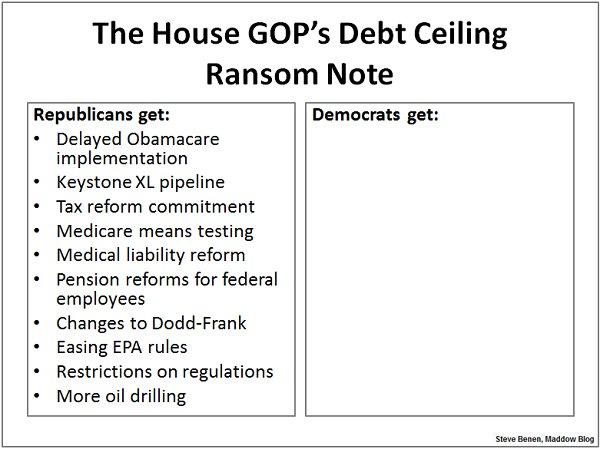
Indeed, late yesterday, we started getting a sense of what congressional Republicans will demand in exchange for doing their duty. I put together this image to help summarize:
You’re probably thinking that I’m exaggerating. I’m really not. The conservative Washington Examiner reported late yesterday:
House Republicans drafting legislation to raise the debt ceiling are intent on forcing President Obama to the negotiating table and satisfying conservatives’ desire to wage a high-stakes battle over Obamacare.
The legislative package, which House GOP leaders will unveil to their members tomorrow and which may get a vote as early as Friday, will agree to raise the debt limit and prevent a default. In exchange, they’ll expect Democrats to “delay for a year further implementation of the Affordable Care Act” and accept “construction of the job-rich Keystone XL pipeline.” The same report added that the bill “could include a variety of GOP-friendly economic proposals, including tax reform, Medicare means testing, medical liability reform, an overhaul of the federal employee retirement system, elimination of the Dodd-Frank bailout, the easing of Environmental Protection Agency rules, restrictions on federal regulators and an expansion of offshore energy production.”
In other words, when it comes to the latest in a series of Republican-imposed crises, Democrats have effectively said, “Don’t bother asking for anything because we’re not negotiating.” To which Republicans are responding, “Don’t bother dismissing us because we’re asking for everything.”
If you’re not worried, it’s probably time to reconsider. Ezra Klein’s analysis this morning rings true: “[T]his isn’t 2011. It’s potentially much worse.”
[This year] the parties don’t agree on anything…. There is, quite literally, no shared ground for a deal. Democrats and Republicans disagree on everything from the principle of negotiations to the potential objective of those negotiations. And “disagree” is almost too light a word. They hold mutually exclusive positions that neither can abandon without sparking an overwhelming backlash from their base and seriously harming their credibility in negotiations going forward. […]
Most in Washington and on Wall Street hold to a serene faith that the two parties will figure something out. And that’s probably right. But in interviews with both Democratic and Republican staff from the House and Senate leadership, as well as the White House, I have yet to hear a plausible story for how they figure something out.
Every time I write about this, I hear from plenty of folks who tell me Republicans are bluffing; Boehner has already told Wall Street he won’t push the nation into default; and the GOP has already shown, just five months ago, that it’s willing to talk tough before backing down on the debt ceiling.
Perhaps. But the deadline is weeks, not months, away and instead of looking for a way out of this crisis, House Republicans are poised to vote on a plan that would make matters much worse.
The Washington Examiner piece added a quote from Rep. Steve Scalise (R-La.) saying, “There’s more leverage on the debt ceiling.” It’s important to understand what that means. A government shutdown would be bad; but a breach of the debt ceiling is likely to be catastrophically bad. When Republicans say, “Meet our demands or we’ll shut down the government,” they think they have some leverage. But when they say, “Meet our demands or we’ll trash the full faith and credit of the United States,” they figure they have lots of leverage. On the former, GOP lawmakers are threatening to do some deliberate harm to some Americans. On the latter, Republicans are threatening to do overwhelming harm to nearly every American. This, in Scalise’s mind, gives the party “more leverage.” It also helps explain why the ransom note is so ridiculously one-sided. If unhinged Republicans ask for everything under the sun, they may not get everything, but they figure if Democrats give them anything, they’ll be better off than they are now. All the while, the political world doesn’t see it at all scandalous that so many elected American officials, all from one party, are so willing to hurt the country on purpose.
The place for in-depth analysis, commentary and informed perspectives. Recommended


