








The idea hasn’t been seriously considered in generations, but in the mid-1930s, then-President Roosevelt considered a judicial scheme known as “court packing.” The courts were standing in the way of his New Deal, so FDR considered expanding the number of seats on the Supreme Court, and filling them with like-minded jurists who’d likely be more sympathetic to his agenda.
Roosevelt’s idea didn’t go anywhere — the political blowback was fairly intense — and in time, the courts slowly moved to the left. Indeed, FDR eventually ended up appointing eight new justices to the high court through traditional means.
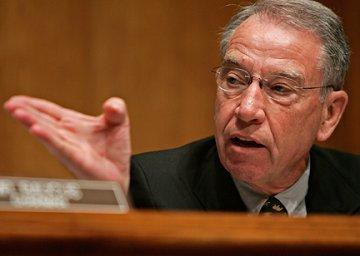
Three-quarters of a century later, Sen. Chuck Grassley (R-Iowa) has a similar idea — he wants to do court packing in reverse (via Ian Millhiser).
“Given this imbalance in workload, today I am introducing the Court Efficiency Act. A number of my colleagues are co-sponsoring the legislation, including Senators Hatch, Sessions, Graham, Cornyn, Lee, Cruz and Flake.
“This legislation is straightforward. It would add a seat to the Second and the Eleventh Circuits. At the same time, it would reduce the number of authorized judgeships for the D.C. Circuit from 11 to 8.”
This would be funny if it weren’t so sad. The D.C. Circuit is widely considered the nation’s second most important federal court, and is often a launching pad for Supreme Court justices. Given its location, it routinely hears most of the litigation challenging federal regulations, offering it great power (which it is currently using to chip away at financial regulatory reform).
This federal bench is supposed to be home to 11 jurists, but thanks to Republican obstructionism, there are currently four vacancies. One of President Obama’s D.C. Circuit nominees was rejected by a filibuster without cause, another D.C. Circuit nominee may soon face the same fate, and Senate Republicans have said they hope to prevent literally all of Obama’s nominee from reaching this federal bench.
And it’s against this backdrop that Grassley and seven of his Republican colleagues effectively argue, “Instead of filling the vacancies, why don’t we just eliminate them?”
According to Grassley, this isn’t as outrageous as it seems because the D.C. Circuit, on average, hears fewer cases, so there’s less of a burden when the court has fewer judges. That may sound reasonable, except as Ian Millhiser explained, the argument is misleading.
While it is true that the DC Circuit’s caseload is relatively small in terms of raw numbers, Grassley’s statistics are highly misleading. Unlike other federal courts of appeal, the DC Circuit hears an unusually large number of major regulatory and national security cases, many of which require very specialized legal research, involve intensely long records, and take more time for a judge to process than four or five normal cases of the kinds heard in other circuits. The caseloads outside of the DC Circuit include many routine sentencing, immigration and other cases of the kinds that are often dispatched with in brief orders drafted by staff attorneys (who then have these orders approved by judges). The DC Circuit, by contrast, hears far fewer of these easy cases that require very little work on the part of judges. Indeed, it’s likely that even Chuck Grassley understands that Chuck Grassley’s numbers are misleading. In 2005, Grassley voted to confirm Judge Janice Rogers Brown, a Bush appointee to the DC Circuit. Brown was the tenth active judge on the DC Circuit when she took her seat. Shortly thereafter, Grassley voted to confirm Judge Thomas Griffith. Griffith was the eleventh active judge on the DC Circuit at the time of his confirmation. Now that President Obama is naming judges, however, Grassley suddenly thinks the DC Circuit is so underworked that it needs just eight judges. This isn’t credible. The timing of the push is not coincidental. The Senate Judiciary Committee held a hearing yesterday on Srikanth (“Sri”) Srinivasan’s nomination to the D.C. Circuit, and it went very well — making it that much more difficult for Republicans to justify another filibuster. It’s why Grassley’s scheme may look like the next best thing for his party, since they won’t have to filibuster more judicial nominees if there are fewer judicial seats to fill. Constitutional Accountability Center President Doug Kendall, referencing the proposal from Senate Republicans, said in a statement, “The legislation they proposed today is just a smokescreen to justify a future blockade of any nominees — however qualified — to this critical court. This legislation is just a mass filibuster by another name.”
The place for in-depth analysis, commentary and informed perspectives. Recommended


