








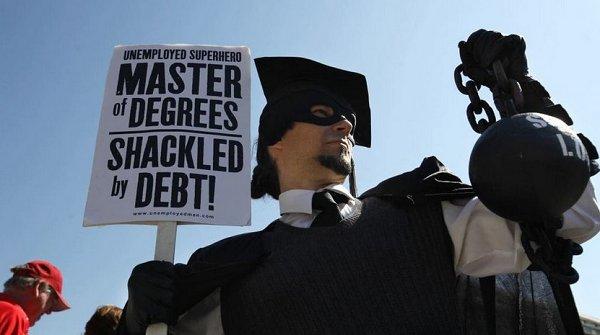
About two weeks ago, Secretary of Education Arne Duncan sounded an optimistic note, arguing that congressional leaders were moving toward a deal to prevent student-loan interest rates from doubling. Alas, his optimism was misplaced.
For those just joining us, let’s briefly recap. Congress passed a law in 2007 that kept the interest rate for federal Direct Stafford Loans at 3.4%. Last year, that law was set to expire, and without congressional action, the rate would have doubled, affecting more than 7.4 million students, who would have faced, on average, an additional $1,000 in debt.
Policymakers eventually reached a deal and the lower rate was locked in, but it was temporary. On July 1 of this year — which is to say, Monday — the rates are set to double again.
As of early June, it seemed likely that lawmakers would work out another agreement, but on June 6, the process imploded. And now, with the deadline about 60 hours away, it would take a minor miracle to get a deal done, and by all accounts, that’s not going to happen.
Federal student loan rates are set to double next week after the Senate failed to coalesce behind a solution to the vexing problem.
Sen. Tom Harkin (D-Iowa), the chairman of the Health, Education, Labor, and Pensions Committee, said in an interview Thursday afternoon that the best solution now is to advance a one-year extension of the current rate of 3.4 percent — which will jump to 6.8 percent on July 1.
But that solution will come retroactively.
Right. The deadline is Monday, so unless the Senate acts today or over the weekend, and somehow convinces House Republicans to go along, the higher rates will kick in. That’s highly unlikely — no one is even trying today. Harkin and others instead hope to return to the issue after the July 4th holiday, pass a one-year extension of the status quo, and have it apply retroactively to minimize the impact on young people.
But even that might not be as easy as it sounds — lawmakers would have to agree on how to pay for a one-year extension of the lower interest rates. You’ll recall, for example, that last year at this time, House Republicans said they’d consider accepting the lower student-loan rates, but they wanted to pay for it by cutting access to breast cancer and cervical cancer screenings — because, you know, the GOP loves outreach to women. This year, Sens. Kay Hagan (D-N.C.) and Jack Reed (D-R.I.) hope to pay for an extension by closing a tax loophole on inherited individual retirement accounts and 401(k)s, but Republicans tend to object to these sorts of changes to the tax code, no matter who benefits. Senate action on something related to student-loan interest rates is expected on July 10, but whether it will overcome a possible filibuster and/or move in the House is entirely unclear. Sahil Kapur added, “The battle could carry on for weeks, if not months.”
The place for in-depth analysis, commentary and informed perspectives. Recommended


