








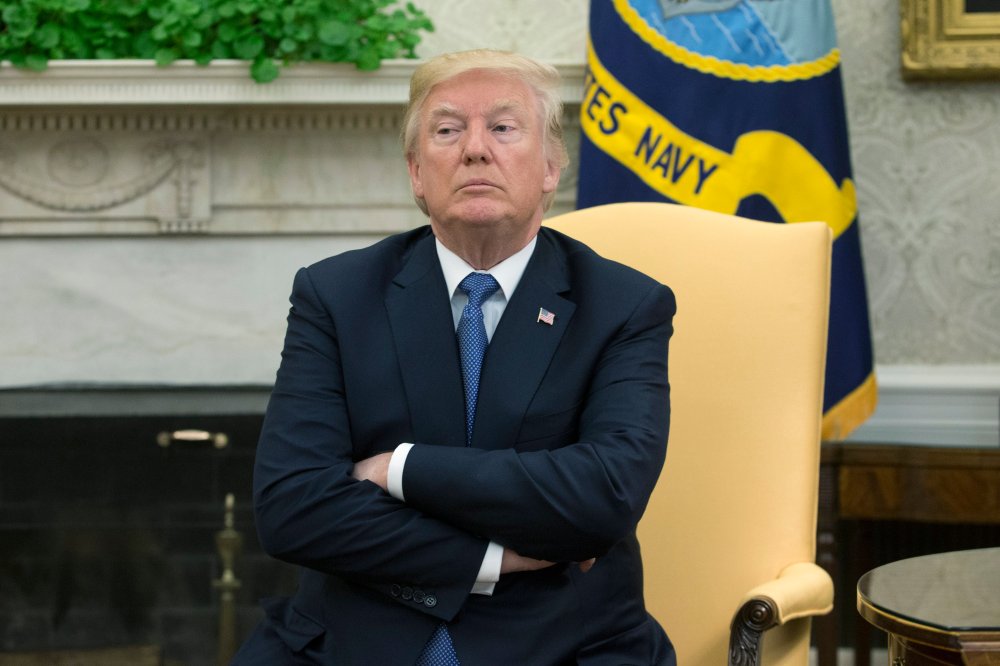
At a White House event this week, Donald Trump reflected briefly on the burgeoning trade war he’s initiating with China.
“We’ve helped rebuild China over the last 25 years, if you take a look at what’s happened. We have helped rebuild China. So we intend to get along with China, but we have to do something very substantial about the trade deficit. And with that, nothing is easy.”
As a factual matter, it’s easy to take issue with nearly all of these claims. China’s economy has grown considerably in recent decades, but the idea that the United States “helped rebuild” the country is dubious. For that matter, the president’s insistence that “we have to do something very substantial about the trade deficit” is problematic, since we don’t actually have to do anything at all.
But it’s that last line that stood out for me: “Nothing is easy.”
There’s certainly some truth to that, though I’d love to hear the White House explain when, exactly, the president came to this realization — because in the recent past, Trump was under the impression that these issues were quite easy, indeed.
In June 2016, for example, then-candidate Trump promised to target China with tariffs and assured voters his tactics would succeed with little effort. “This is very easy,” he said at the time. “This is so easy!”
Just last month, he was at it again. After his initial moves on tariffs, the president declared, “[T]rade wars are good, and easy to win.” It apparently took a month for Trump to switch gears and discover that “nothing is easy.”
One of the amazing things about Trump’s presidency has been watching the process of presidential discovery, in which he’s surprised by complexities the rest of us already recognized.
As regular readers may recall, Trump didn’t realize reforming the nation’s health care system would be “complicated.” He “didn’t realize” the nuances of how Congress works. He thought private-sector deal-making was effectively the same as reaching governmental agreements, and was surprised to discover otherwise. Even on China, it was one year ago next week that Trump admitted that he spoke to China’s Xi Jinping about Beijing getting North Korea under control. The Chinese president tried to bring the American president up to speed on international affairs. “After listening for 10 minutes, I realized it’s not so easy,” Trump conceded. If you wanted to summarize this president’s governing difficulties in one sentence, you could do worse than that quote.
Steve Benen is a producer for "The Rachel Maddow Show," the editor of MaddowBlog and an MS NOW political contributor. He's also the bestselling author of "Ministry of Truth: Democracy, Reality, and the Republicans' War on the Recent Past." Recommended


