








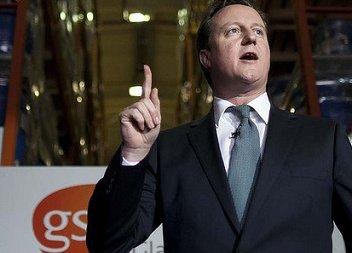
For quite a while, Republicans have looked at the economic austerity agenda that’s dominating Europe and called for the United States to follow the continent’s lead. This is especially true of David Cameron’s British austerity policies, which have drawn enthusiastic praise from Republicans, who wish President Obama would implement parts of the Prime Minister’s plan here in the U.S.
Indeed, it was almost exactly a year ago when Sen. Jeff Sessions (R-Ala.) wrote an op-ed urging U.S. policymakers to follow the lead set by our friends across the pond: “We need a budget with a bold vision — like [the one] unveiled in Britain.”
We’re getting a very good look at the efficacy of the austerity agenda Republicans are so fond of.
Britain’s economy slid into its second recession since the financial crisis after official data unexpectedly showed a fall in output in the first three months of 2012, piling pressure on Prime Minister David Cameron’s embattled coalition government.
The Office for National Statistics said Britain’s gross domestic product fell 0.2 percent in the first quarter of 2012 after contracting by 0.3 percent at the end of 2011, confounding forecasts for 0.1 percent growth.
The last time Britain suffered a double-dip recession was in 1975.
Remember, this is of critical importance here in the U.S., because Republicans are eager — desperate, really — to impose this same kind of austerity agenda here. In fact, perhaps the most frustrating realization about the news out of the UK is that it won’t deter Republicans at all.
At what point is it no longer impolite to suggest the GOP’s economic vision is ridiculous? In 2009, with an economy on the brink of collapse, Democrats wanted Keynesian stimulus, while Republicans pushed for debt reduction. Republicans were wrong and Democrats were right — using the government to pump capital into the economy almost immediately improved job creation and economic growth.
In 2011, austerity’s champions — in Europe and the U.S. — said taking money out of the economy and scaling back investments will lead to stronger growth and lower debts. We’ve now seen the results of this experiment: lower growth and higher debts. Instead of learning anything from these developments, Republicans still expect the American electorate to give them the power to pursue a European-style austerity agenda here at home, despite its abject failures. A year ago, Richard Portes, an economist at the London Business School, argued, “My view is that we are in serious danger of a double-dip recession. This is going to be a cautionary tale.” Twelve months later, we know Portes was exactly right, but American conservatives refuse to learn the lesson.
The place for in-depth analysis, commentary and informed perspectives. Recommended


