








The summer of 2012 has taken its toll on much of the country, as evidenced by the brutal drought we discussed on last night’s show, and compounded by the effects on public health and our agriculture.
But there’s also infrastructure to consider.
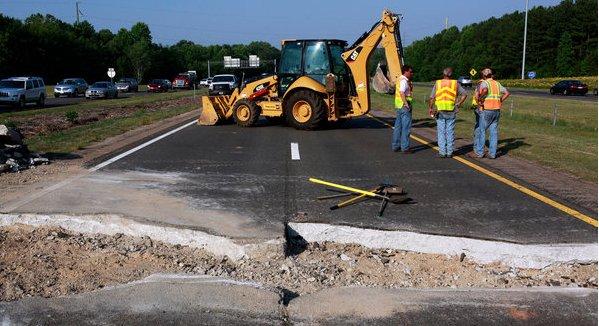
On a single day this month here, a US Airways regional jet became stuck in asphalt that had softened in 100-degree temperatures, and a subway train derailed after the heat stretched the track so far that it kinked — inserting a sharp angle into a stretch that was supposed to be straight. In East Texas, heat and drought have had a startling effect on the clay-rich soils under highways, which “just shrink like crazy,” leading to “horrendous cracking,” said Tom Scullion, senior research engineer with the Texas Transportation Institute at Texas A&M University. In Northeastern and Midwestern states, he said, unusually high heat is causing highway sections to expand beyond their design limits, press against each other and “pop up,” creating jarring and even hazardous speed bumps.
Excessive warmth and dryness are threatening other parts of the grid as well. In the Chicago area, a twin-unit nuclear plant had to get special permission to keep operating this month because the pond it uses for cooling water rose to 102 degrees; its license to operate allows it to go only to 100. According to the Midwest Independent System Operator, the grid operator for the region, a different power plant had had to shut because the body of water from which it draws its cooling water had dropped so low that the intake pipe became high and dry; another had to cut back generation because cooling water was too warm.
Conditions will not improve on their own. Our struggling infrastructure will only get older and less reliable, and our extreme weather will continue to do more damage.
Indeed, those responsible for our roads and highways at the local level aren’t even sure how best to plan for these increasingly-routine extremes. Texas A&M’s Scullion said highways were designed with local temperatures and rainfall in mind. “When you get outside of those things,” he told the NYT, “man, all bets are off.”
It sounds to me there’s a sensible solution. In the short term, America can reduce unemployment and address public needs by hiring workers to rebuild and improve our infrastructure. In the long term, America can help combat the climate crisis by investing in alternative energy and green tech.
Best of all, there’s literally never been a better time to make these investments — global investors are effectively offering us free money.
Paul Krugman tackled this subject the other day.
That’s right: for every maturity of bonds under 20 years, investors are paying the feds to take their money — and in the case of maturities of 10 years and under, paying a lot. What’s going on? Investor pessimism about prospects for the real economy, which makes the perceived safe haven of US debt attractive even at very low yields. And pretty obviously investors do consider US debt safe — there is no hint here of worries about the level of debt and deficits. Now, you might think that there would be a consensus that, even leaving Keynesian things aside, this is a really good time for the government to invest in infrastructure and stuff: money is free, the workers would otherwise be unemployed. But no: the Very Serious People have decided that the big problem is that Washington is borrowing too much, and that addressing this problem is the key to … something. We can, in other words, borrow as much as we need to rebuild our infrastructure — which, again, will need rebuilding eventually anyway — and we’ll pay negative interest rates. Sure, we’ll eventually have to pay back the money, but (a) we really need to make the investments now; and (b) by borrowing the money now, when interest rates are literally below zero, the amount we’ll owe is less the amount we’ll borrow. But Republicans refuse to even consider this. It’s why we can’t have nice things.
The place for in-depth analysis, commentary and informed perspectives. Recommended


