








With Donald Trump poised to replace Supreme Court Justice Anthony Kennedy, Senate Democrats have limited options. To have any chance of success, the minority party and its allies need a plan.
Calling out Republican hypocrisy has the benefit of accuracy, but its potency is limited. Senate Majority Leader Mitch McConnell (R-Ky.) couldn’t care less about appearing unprincipled; his GOP colleagues are already shrugging their shoulders; and conservative red-state Democrats, most of whom are up for re-election this year, aren’t prepared to gamble their careers on this point.
Democrats hoping to at least slow down the process until after the midterm elections will need a stronger pitch, which could credibly serve as the basis for an effective strategy.
They’ll need something like this.
Some Democratic senators and their allies are starting to make the argument that not only should there be no Supreme Court pick until after the November elections, but that there shouldn’t be one at all while the president remains under criminal investigation. […]
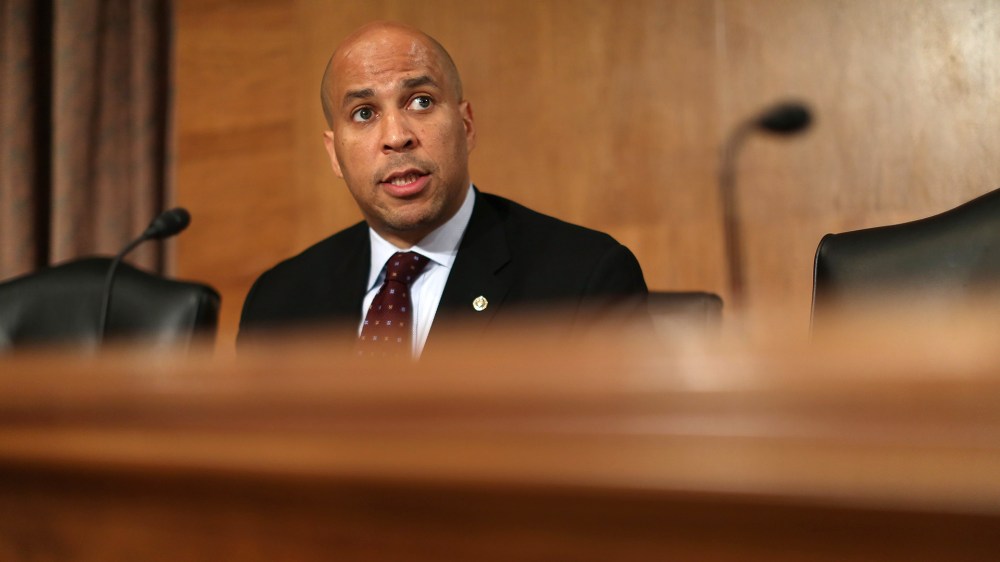
During a judiciary committee hearing Thursday, Sen. Cory Booker (D-N.J.) noted that a challenge to the investigation could very well end up before the Supreme Court at some point — potentially creating a conflict of interest for a president who has asked nonpartisan officials for their loyalty.
“If we’re not going to thoroughly discuss what it means to have a president with this ongoing investigation happening, who is now going to interview Supreme Court justices, and potentially continue with his tradition of doing litmus tests, loyalty tests, for that person, we could be participating in a process that could undermine that criminal investigation,” Booker said yesterday. “I do not believe [the Senate Judiciary Committee] should or can in good conscience consider a nominee put forward by this president until that investigation is concluded.”
The closer one looks at this position, the more sense it makes.

Rachel added on the show last night that as the president prepares to choose a high court nominee, the national discussion of this has not yet “caught up to the possibility that if the president himself is alleged by the special counsel’s investigation to have any significant criminal liability in this Russia scandal, that as a matter of law will almost inevitably end up as a matter before the United States Supreme Court — to which he is about to name a new member.”
There’s no shortage of relevant questions for the justices. Can a sitting president pardon himself? Can he be criminally indicted? What power does a president have to dismiss a special counsel during an investigation? These are lines of inquiry the Supreme Court may soon wrestle with.
And Donald Trump’s political life will depend on how the justices answer those questions — which very likely creates a conflict of interest for Donald Trump. If the special counsel’s investigation ends, and the president — currently a subject of the ongoing probe — faces no allegations of wrongdoing, senators can proceed with the process of considering his Supreme Court nominee. But in the interim, it’s difficult to defend the idea that Trump should be responsible for choosing a justice who may soon decide his legal fate. Call it the Booker Rule: presidents under criminal investigation have to wait until the matter has run its course before picking Supreme Court justices. The HuffPost’s report suggests this argument has growing support among Senate Dems, and Harvard Law School’s Lawrence Tribe, among others, endorsed the tack yesterday. This isn’t about hypocrisy, it’s about a conflict of interest. These are unusual circumstances — American presidents rarely face federal criminal probe — but until they’re resolved, there’s no reason to allow the subject of an investigation to choose a judge who may soon hear his case.
Steve Benen is a producer for "The Rachel Maddow Show," the editor of MaddowBlog and an MS NOW political contributor. He's also the bestselling author of "Ministry of Truth: Democracy, Reality, and the Republicans' War on the Recent Past." Recommended


