









Late Friday afternoon, the Wall Street Journal reported on a striking geopolitical decision out of the White House: Donald Trump is slashing the U.S. troop presence in Germany by nearly 30%. As part of the same directive, the American president is capping the number of American servicemen and women who can be deployed to Germany at 25,000, despite troop levels that are routinely twice as high.
The WSJ had a follow-up report over the weekend, noting that the Republican White House’s decision “surprised allies,” whom Trump hadn’t bothered to consult or inform in advance of the move.
U.S. allies in Europe expressed dismay over President Trump’s plan to slash the number of American troops in Germany by more than a quarter, saying it undermined NATO and boosted adversaries such as Russia…. Mr. Trump’s decision to cut numbers shows “complete disconnection between the NATO trend, where allies are pushed to a robust posture against Russia, and the reality of U.S. priorities,” said one senior European diplomat at NATO.
It’s a familiar foreign-policy dynamic, isn’t it? Trump abandons a long-held, bipartisan commitment to an ally, thumbs his nose at the United States’ friends, undercuts an institution that advances global peace and stability, and makes a decision that delights his benefactors in Moscow.
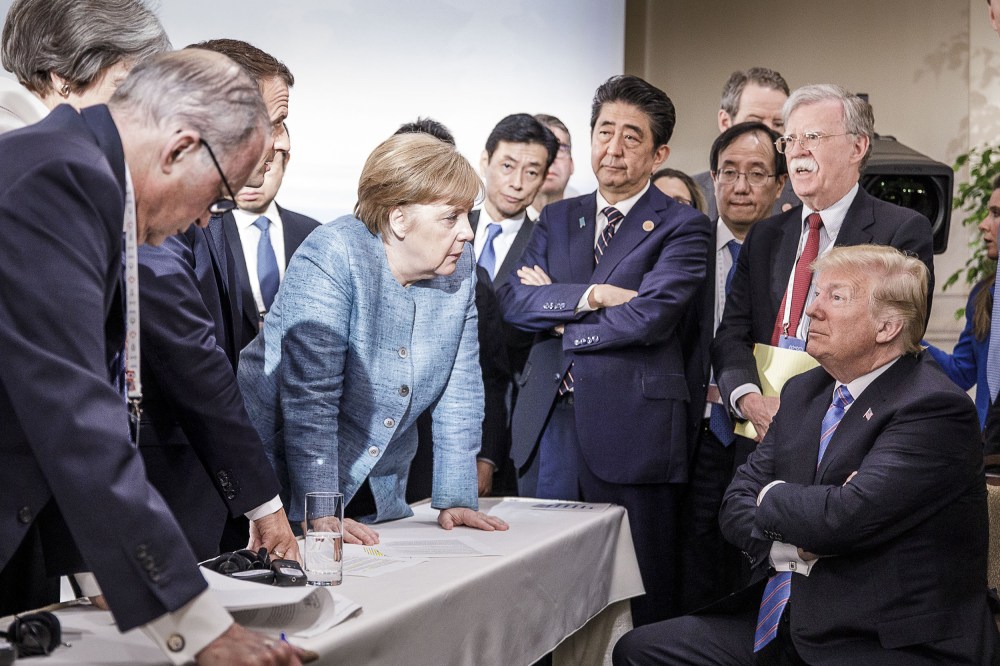
Indeed, all of this came just a week after Trump announced he no longer has any use for the G7 — an international coalition of the world’s largest democracies and economic powers — and insisted that Russia should be rewarded, for nothing in particular, by being readmitted into the alliance.
The New York Times had a related report over the weekend, noting that Trump recently spoke to German Chancellor Angela Merkel, who told the American leader that she could not attend a G7 gathering in person because of the ongoing health threat posed by the pandemic. At that point, the conversation reportedly turned “testy,” with Trump offering “a wide-ranging monologue about his frustrations with the Group of 7 and NATO and the World Health Organization.”
One official said of the two leaders’ conversation, “It was not a nice call.” (Around the same time, Trump had a separate chat with Vladimir Putin. It’s likely that discussion was friendlier.)
It was soon after the “testy” phone meeting with Merkel that Trump decided to scale back the U.S. military commitment to Germany — a commitment that was intended in part to deter Russian aggression toward Europe.
Indeed, the WSJ report added, “The planned cut to U.S. forces in Europe is a boon for the Kremlin, which has long sought to drive a wedge between the Western allies and reduce U.S. influence in Europe.”
Or put another way, if Putin were personally writing a script for the White House to follow, it’d look quite a bit like the one from which Trump is reading, complete with a series of steps to chip away at the trans-Atlantic alliance that both American parties took generations to strengthen.
Asked over the weekend about the state of his country’s alliance with the United States, Foreign Minister Heiko Maas told reporters, “It’s complicated.”
It was a lot simpler before Jan. 20, 2017. Two years ago this month, the European edition of Politico had a report that said, “It’s difficult to overstate just how enraged Germany is about Trump. By questioning and criticizing such bastions of the Western order as NATO, the World Trade Organization and even the EU, Trump has thrust Germany’s leadership into an existential torpor it has yet to escape.” Around the same time, a senior German official told the New Yorker‘s Susan Glasser, “It took Germany the longest of all partners to come to terms with someone like Trump becoming president. We were very emotional, because our relationship with America is so emotional — it’s more of a son-father relationship — and we didn’t recognize our father anymore and realized he might beat us.” The same month, Trump dispatched Ric Grenell, a notorious internet troll, to serve as the U.S. ambassador to Germany — where he failed to make friends and influence people. Two years later, the American president has made matters quite a bit worse, for reasons he hasn’t yet explained.
Steve Benen is a producer for "The Rachel Maddow Show," the editor of MaddowBlog and an MS NOW political contributor. He's also the bestselling author of "Ministry of Truth: Democracy, Reality, and the Republicans' War on the Recent Past."
Latest Post
Recommended


