










As best as I can tell, Dr. Anthony Fauci appears to be a patient man, but we were reminded yesterday that he is not without limits.
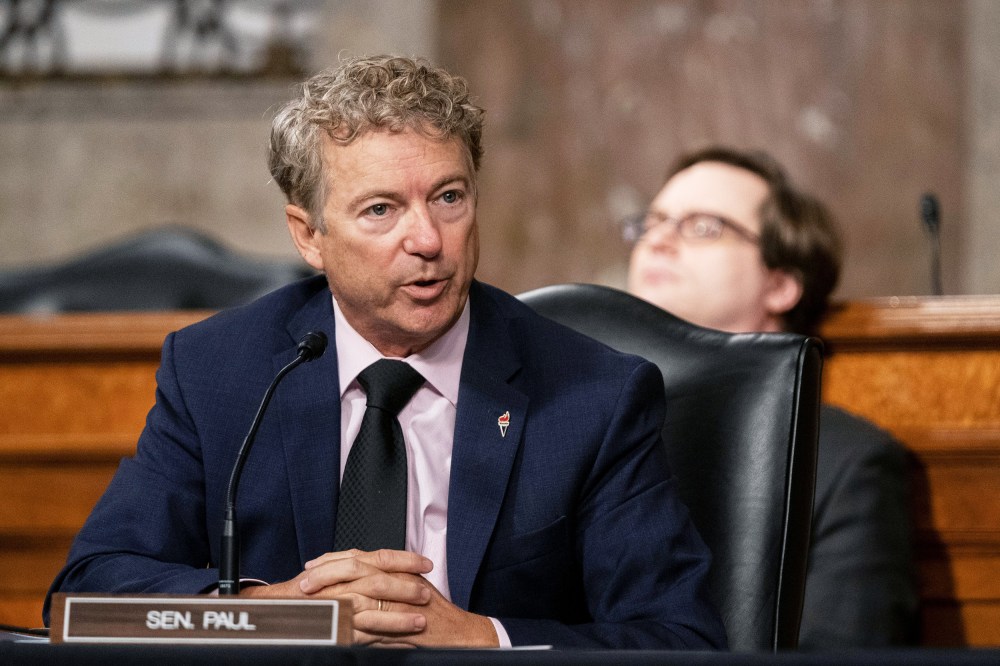
Sen. Rand Paul, R-Ky., and Dr. Anthony Fauci, the nation’s top infectious disease specialist, sparred Wednesday over the country’s efforts to mitigate the spread of Covid-19 and when “herd immunity” from the virus is reached. The unusually testy exchange occurred during Fauci’s testimony in front of the Senate Committee on Health, Education, Labor and Pensions.
Part of the Kentucky Republican’s concerns appeared to be focused on public relations. “New York had the highest death rate in the world,” Paul said during the hearing. “How can we possibly be jumping up and down and saying, ‘Oh, Governor Cuomo did a great job!’”
The senator didn’t say who “we” are, and Fauci neither jumped up and down nor celebrated Gov. Andrew Cuomo (D). The director of the National Institute of Allergy and Infectious Diseases reminded Paul that he’s “misconstrued” relevant details — something the GOP senator has done more than once.
Soon after, the Kentucky Republican, apparently pushing the herd-immunity argument, suggested that New Yorkers have “developed enough community immunity” to beat the pandemic. Fauci was unimpressed.
“I challenge that,” the celebrated immunologist reminded the former ophthalmologist. “You were not listening to what the director of the CDC said, that in New York, it’s about 22 percent. If you believe 22 percent is herd immunity, I believe you’re alone in that.”
The back and forth continued, with Paul sharing his theories, and Fauci doing his best to respond to the senator’s questionable assertions.
And while it was notable to see Fauci’s patience being tested in ways the public rarely witnesses, it was just as striking to see the eagerness with which Paul presented himself as a credible voice, his recent record notwithstanding.
Circling back to our earlier coverage, the first sign of trouble came in early March, when Congress approved a modest $8.3 billion emergency bill to respond to the coronavirus. The bipartisan measure passed the Senate 96 to 1 — and Sen. Rand Paul (R-Ky.) was the lone opponent.
Two months later, the Kentucky Republican said mitigation efforts in New York were not especially effective in saving lives, all evidence to the contrary notwithstanding, before arguing that the crisis has been “relatively benign” outside of “New England.” (We can apparently add geography to the things Paul doesn’t understand as well as he probably should.) But at the same Senate hearing in May, the GOP senator also seemed to take aim at epidemiological expertise, complaining, “I don’t think any of these experts are omniscient.” Paul added, “[W]e have to take with a grain of salt these experts and their prognostications.” In late June, the Kentuckian again questioned the judgment of experts, arguing in support of an alternative approach: “We just need more optimism.” As ridiculous as the senator’s posturing has been in recent months, let’s not forget that this isn’t the first time. As longtime readers may recall, in the fall of 2014, with public anxieties over Ebola growing, Rand Paul started making appearances on right-wing radio programs, questioning Ebola assessments from the experts, blaming “political correctness,” and raising threats that seemed plainly at odds with the facts. At one point, he asserted without proof that the authorities were deliberately misleading Americans about the virus. With a record like this one, perhaps the senator should be speaking less and listening more?
Steve Benen is a producer for "The Rachel Maddow Show," the editor of MaddowBlog and an MS NOW political contributor. He's also the bestselling author of "Ministry of Truth: Democracy, Reality, and the Republicans' War on the Recent Past."
Latest Post
Recommended


