








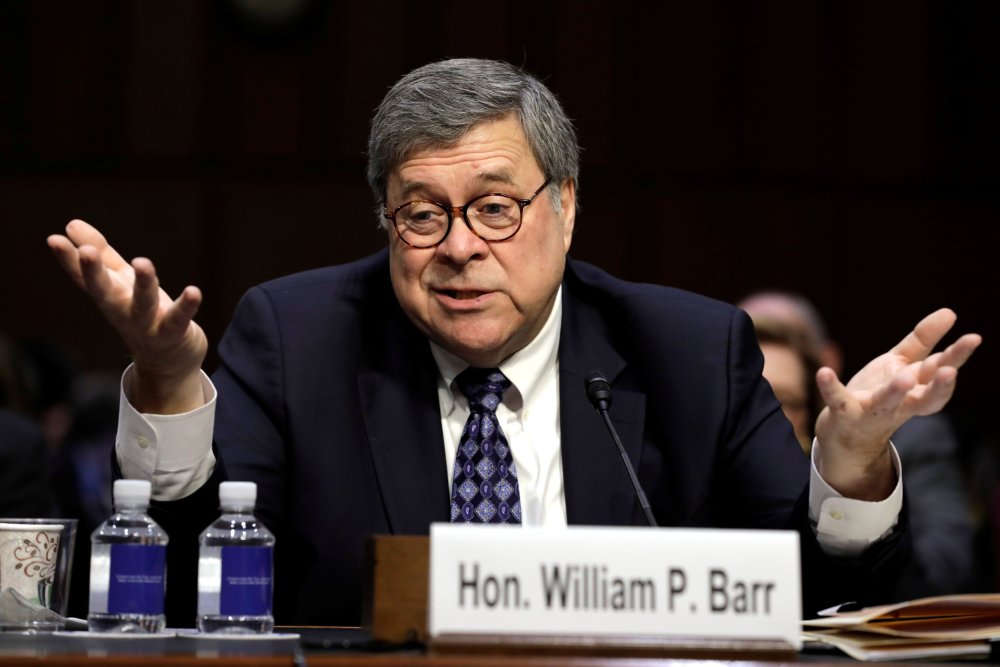
Last summer, in his capacity as a private citizen, William Barr wrote a 20-page memo for the Justice Department, criticizing Special Counsel Robert Mueller for investigating Donald Trump over alleged obstruction of justice. The document was unsolicited — Barr had very strong opinions on the matter, and simply wanted federal law enforcement officials to be aware of his concerns.
The Republican lawyer was unrestrained in his criticisms at the time, insisting that the line of inquiry was based on a “fatally misconceived” theory. Barr added that the special counsel’s efforts were, among other things, “grossly irresponsible” and opened the door to “potentially disastrous implications.”
Six months later, Donald Trump tapped Barr as his new attorney general.
It’s against this backdrop that Barr received Mueller’s report late last week, and according to the attorney general, the special counsel “determined not to make a traditional prosecutorial judgment” on whether the president obstructed justice or not. Mueller instead presented Barr with his findings.
Two days later, it was Barr who decided that the evidence is “not sufficient to establish” that the president crossed the legal line. In other words, Trump’s handpicked attorney general, after having already denounced this specific line of inquiry, cleared the president who appointed him of having obstructed justice.
When Richard Nixon and Bill Clinton were accused of obstruction of justice, it wasn’t their own attorneys general who made the final call about how or whether to proceed.
That’s not, however, the only problem. Barr’s memo made the case that if there was no “underlying crime related to Russian election interference,” then there couldn’t have been obstruction. The Washington Post spoke to some legal experts who suggested otherwise.
“I think this is the weakest part of Attorney General Barr’s conclusions,” said Jessica Levinson, a professor at Loyola Law School in Los Angeles. “You do not need to prove an underlying crime to prove obstruction of justice. Martha Stewart is quite aware of this fact.”
“For example,” added former federal prosecutor David Alan Sklansky, now of Stanford University, “if the President wrongfully tried to block the investigation into Russian interference in the election because he wanted to protect the Russians, or because he didn’t want people to know that a foreign government had tried to hack the election in his favor, that would constitute obstruction.”
Complicating matters, of course, is the speed with which Barr acted.
The timeline couldn’t be more straightforward: on Friday, Mueller presented the attorney general with evidence of possible presidential obstruction. Literally two days later, Barr let Trump off the hook. Neal Katyal, a former acting solicitor general and an MSNBC legal analyst, wrote in a New York Times op-ed: Such a conclusion would be momentous in any event. But to do so within 48 hours of receiving the report (which pointedly did not reach that conclusion) should be deeply concerning to every American. The special counsel regulations were written to provide the public with confidence that justice was done. It is impossible for the public to reach that determination without knowing two things. First, what did the Mueller report conclude, and what was the evidence on obstruction of justice? And second, how could Mr. Barr have reached his conclusion so quickly? […] On the facts, Mr. Barr says that the government would need to prove that Mr. Trump acted with “corrupt intent” and there were no such actions. But how would Mr. Barr know? Did he even attempt to interview Mr. Trump about his intentions? What kind of prosecutor would make a decision about someone’s intent without even trying to talk to him? Don’t be surprised if the House Democratic majority pulls on these threads in the coming weeks and months.
Steve Benen is a producer for "The Rachel Maddow Show," the editor of MaddowBlog and an MS NOW political contributor. He's also the bestselling author of "Ministry of Truth: Democracy, Reality, and the Republicans' War on the Recent Past." Recommended


