








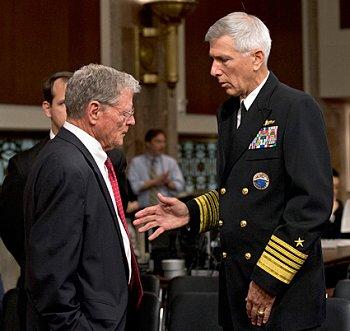
Admiral Samuel Locklear, one of the nation’s top military leaders and the head of the U.S. Pacific Command, was on Capitol Hill yesterday, answering questions about the scope of the threat posed by North Korea. His responses were important, but there was an unrelated part of his testimony that struck me as noteworthy.
When it comes to North Korea, Locklear told the Senate Armed Services Committee that the U.S. military is prepared to address a possible North Korean offensive, including intercepting a missile launch should there be one. The admiral added that North Korea does not yet have the ability to threaten the mainland United States or Hawaii, but Guam may be at risk, and the U.S. has “capability in place” to protect the island.
But then Sen. James Inhofe (R-Okla.), one of the nation’s more strident opponents of climate science, wanted to talk about global warming.
Locklear argued last month that while there are important and ongoing threats in Pacific region, the biggest long-term security threat in the Pacific region is climate change. He spoke at length on the issue, telling the Boston Globe that significant upheaval related to the warming planet “is probably the most likely thing that is going to happen … that will cripple the security environment, probably more likely than the other scenarios we all often talk about.”
Inhofe hoped Locklear would, if given a chance during yesterday’s hearing, walk that back. The admiral did the opposite.
Inhofe pressed Locklear to say his view has been misrepresented by “environmental extremists” who “think we’re spending too much money on defense.” The admiral did anything but that. About 280,000 people died in natural disasters in his Pacific area of responsibility from 2008 to 2012, Locklear said. “Now, they weren’t all climate change or weather-related, but a lot of them were,” he said. And that will only get worse as the population soars and even more people move toward “the economic centers, which are near the ports and facilities that support globalization,” according to the admiral. The far-right senator then interrupted the head of the U.S. Pacific Command, complaining that Locklear had taken up too much of Inhofe’s allotted time.
The place for in-depth analysis, commentary and informed perspectives. Recommended


