








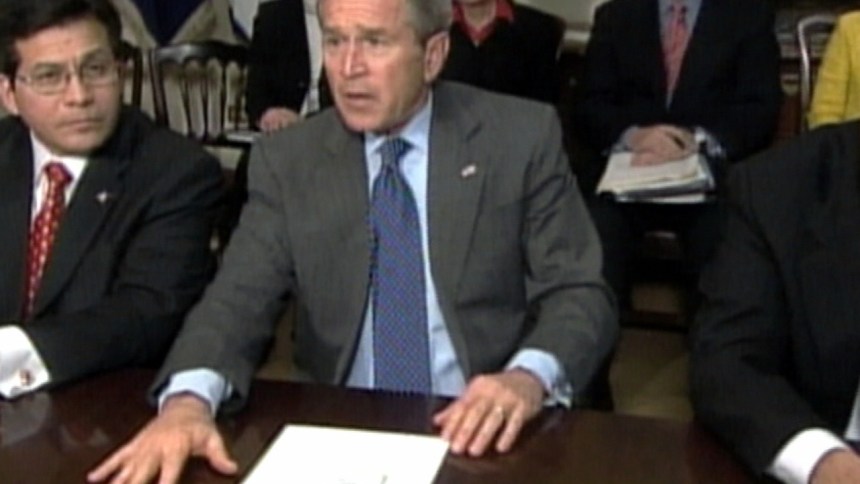
Former President George W. Bush is preparing to unveil his $500 million presidential library next month in Dallas, and it sounds like the former president is hoping he can rewrite history to help rehabilitate his tarnished image.
According to the library’s official website, it will be “a results-oriented institute that will have an effect on our country and, we think, on the world,” focusing on areas including economic growth, human freedom, and education reform. But it’s tough to say what results can be gleaned from the legacy of the president who turned a budget surplus into a deficit, left us into a major recession, permitted the use of “enhanced interrogation” techniques, and instituted the “No Child Left Behind” education policy that is widely criticized even by Republicans today.
But Bush has a plan to distract everyone from the more negative aspects of his legacy. As one Bush acquaintance told the National Journal, “He’s convinced his achievement in keeping the country safe after 9/11 will get the attention it deserves as the years roll on,” which is why the library’s signature exhibit will be “a 17-foot, two-ton twisted piece of steel from the World Trade Center.” (It’s a strange quirk of historical memory–almost a form of intellectual jujitsu–that Bush has successfully branded himself as the leader who kept us safe, when in fact he’s the president who disregarded an August 2001 memo warning that Osama bin Laden was planning an attack on America.)
It’s not the first time Bush has used 9/11 imagery for his political gain. He outraged 9/11 widows and firefighters in 2004 when he ran a campaign ad with 9/11 pictures.
[youtube http://www.youtube.com/watch?feature=player_detailpage&v=s67qaViGNBU]
“It looks like a theme park as much as it is a library,” according to Lou Dubose, co-author of “Bushwhacked: Life in George W. Bush’s America.” Dubose points out the library also includes freedom tower, a freedom plaza, a decision points library, the bullhorn Bush used to talk to first responders from ground zero, and even Saddam Hussein’s pistol.
“It’s kind of a parentheses around one of the greatest foreign policy blunders in our country’s history and they’re pretty shameless about it.”
But from a public relations standpoint, reminding Americans of his role in the wake of those attacks may be a smart move. Bush saw record high approval ratings in the days and weeks following September 11th, reaching 90% approval. Unfortunately, the rest of his presidency slowly diminished that good will. His ultimate low point–25% approval–came a few days before the 2008 election.
Dubose describes the “triumphalist narrative” on display at the library as “a neo-con rehash of all the terms that were used to lead the country into war.” “One would expect a little bit of a modesty from a president who has presided over that sort of failure,” he said. “And from a president who’s competing in the bottom ten in terms of presidential rankings that are done by legitimate historians.” Dubose contrasts Bush’s airbrushed approach with President’s Johnson’s museum, which he describes as contrasting his great achievements like the civil rights movement, with his notable failure, the war in Vietnam. “There’s nothing on the other side for Bush.” In Rev. Sharpton’s words, “I think the lack of balance is the lack of honesty and candor.”
Morgan Whitaker Recommended


