








If House Republicans are interested in patching the Voting Rights Act, they aren’t showing it.
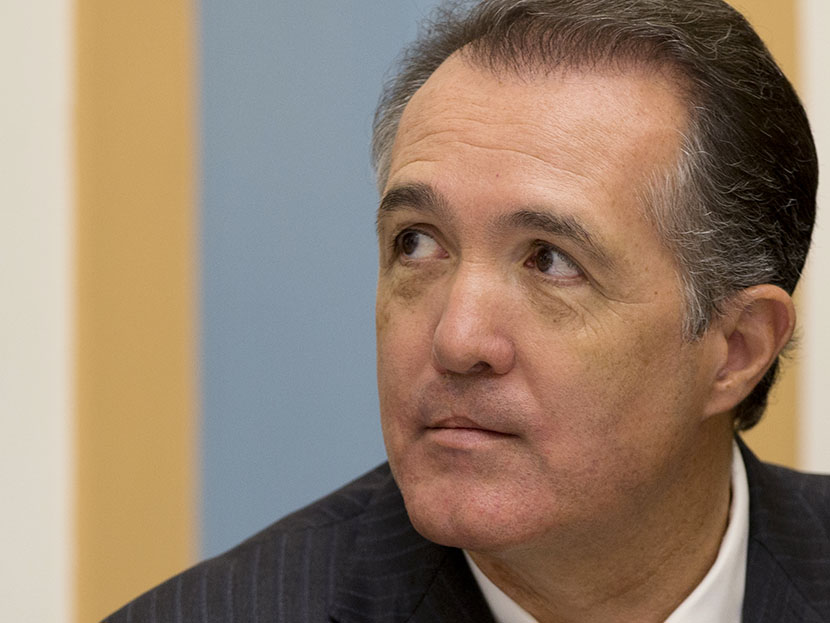
“Historically I fully understand why they addressed the situations they did,” Republican Rep. Trent Franks of Arizona, who chairs the House judiciary subcommittee that would handle new voting rights legislation, said to reporters after the hearing. “I am just of the opinion today that we should do as the court said and that is to not focus on punishing the past but on building a better future.”
The House GOP held their first hearing Thursday on how to handle the Voting Rights Act in the aftermath of the Supreme Court’s ruling striking down Section 4 of the law. Section 4 determines which parts of the country must submit in advance their election law changes to the Justice Department, a process called “preclearance.” Republicans have criticized the Section 4 formula for being based on outdated information, even though when the Republican-held Congress in 2006 reauthorized the Voting Rights Act it looked at data showing that the jurisdictions affected by the formula were more likely to engage in discriminatory election practices. Since the Supreme Court’s ruling, states formerly covered by the Section 4 formula have rushed to implement new voting restrictions.
Initial attendance at the hearing trickled down to just a few legislators, mostly Democrats. When legendary civil rights activist Rep. John Lewis, a Georgia Democrat, walked into the hearing, Franks took a moment to “express our honor that you’re among us here today.”
That cordial tone shouldn’t be mistaken for enthusiasm for new voting legislation. Republicans and Democrats may agree on John Lewis’ heroism, but they don’t agree on what to do with one of his most important legacies, the landmark voting rights legislation that Lewis’ activism helped make possible. At one point, anti-immigration Republican Rep. Steve King of Iowa popped in to say that he thought the entire Voting Rights Act should be revisited, particularly provisions that ensure citizens who don’t speak English can still cast ballots. “There’s no reason ballots should be in anything other than English,” King said.
Republicans don’t have to be like King and vocally oppose fixing the Voting Rights Act—since they control the House they can also just let it die quietly. The two Republican witnesses at Thursday’s hearing were in complete agreement: Even with Section 4 struck down, the Voting Rights Act ain’t broke so there’s no need to fix it. In fact, Hans von Spakovsky, a former Bush-era Justice Department official who is now a scholar with the Heritage Foundation, said that the requirement to submit election law changes in advance had “led to a virtual apartheid system of redistricting,” because it bars changes that would have the effect of diluting minority voting power, not just the intention.
A second witness, former Justice Department official J. Christian Adams, said that voting rights advocates were wrong about the negative impact the Supreme Court’s decision would have. “Reports of the Voting Rights Act’s demise have been greatly exaggerated,” Adams said.
Those who advocate doing nothing about the Supreme Court’s ruling on the Voting Rights Act generally argue that racism is largely a thing of the past and that the remaining authorities in the law are sufficient to deal with whatever racial discrimination is left. But the other experts on the panel pointed out that without the ability to prevent discriminatory voting changes before they happen, the only option left is litigation that can be expensive, slow, and and likely won’t be resolved until after the discriminatory practice has already taken effect.
Von Spakovsky compared the “preclearance” requirement in the Voting Rights Act to arresting someone and forcing them to prove their innocence rather than requiring the state to prove their guilt. As a rejoinder, Spencer Overton, a former Justice Department official who now teaches law at Georgetown University, said “when I came into this building today, I went through a metal detector, that’s not a due process violation.” The point, Overton explained, was that preclearance exists to address voting discrimination where it remains most acute.
When Republicans chose the witnesses for Thursday’s hearing, they knew what they were going to get. Von Spakovsky, part of the political leadership in the Bush-era Justice Department’s civil rights division when they were engaging in politicized hiring, and has since accused the Obama Justice Department of being unwilling to protect white people’s civil rights. The other GOP witness, Adams, was one of the attorneys hired during that era of politicization. Adams left the division in 2010 has since accused the Obama administration of being beholden to the New Black Panther Party, a fringe black separatist group, even suggesting that said that the group was “the spark behind” the decision to open a civil rights inquiry into the death of Trayvon Martin. The choice of witnesses is another sign of where Republicans stand on the issue of a fix for the Voting Rights Act. There are still Republican legislators who remain sincerely committed to passing new voting rights legislation, like Wisconsin Rep. Jim Sensenbrenner, who testified in a Voting Rights Act hearing in the Senate Wednesday. There may not be enough of them left in the House to pass anything meaningful. Thanks to the Hastert rule, the informal guideline that the Republican leadership will not pass legislation that doesn’t have the support of the majority of the Republican caucus, any fix for the voting rights act will face significant headwinds. “You always have to have hope,” Lewis said to reporters after the hearing. When Franks voted against the renewal of the Voting Rights Act in 2006, he was one of only 33 Republicans willing to do so. Now, most Republican legislators may agree with Franks. Speaking to reporters after the hearing, Franks insisted that didn’t mean he wasn’t committed to justice and equality. “My goal has always been this notion of equal justice for all, I know sometimes I’m criticized quite often for having a commitment to trying to bring equal justice to the unborn child,” Franks, who once said abortion is worse for black Americans than slavery, said. “People say they say tomato, I say abortion.”
Adam Serwer Recommended


