








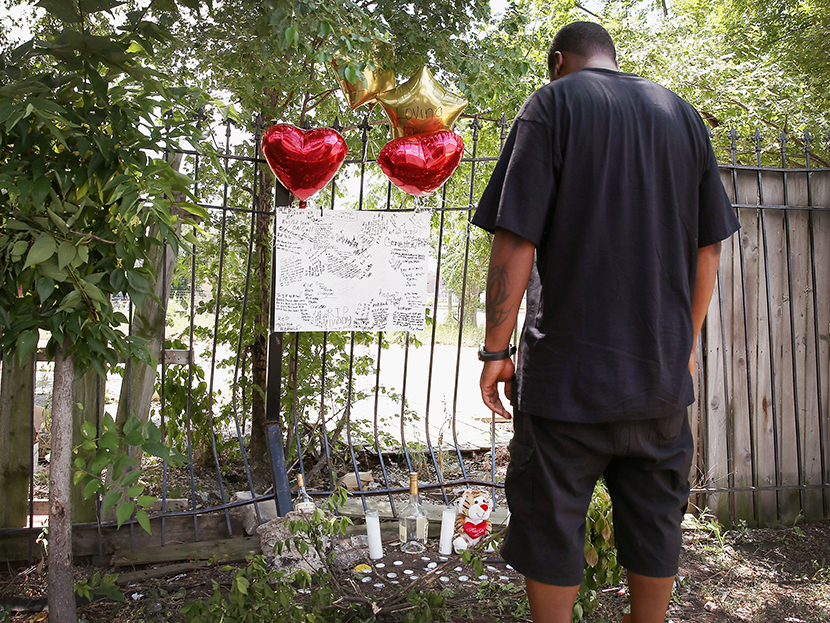
While Congress tangled over gun control legislation earlier this year after the killings in Newtown, gun violence in Chicago went on unabated, taking lives in clips of one, two and three at a time.
“I equate it to when a 747 crashes as opposed to a two-seater,” said Rep. Robin Kelly, a Democrat from Chicago. “In Chicago, every day we have mini-massacres.”
After a particularly bloody Fourth of July weekend, in which 72 people were shot, 12 of them killed, Kelly and a couple of fellow local Democratic members of Congress have convened an “emergency summit” to address the issue of gun violence facing Chicago and so many other cities across the country. The two-day “National Summit on Violence in Urban Communities,” hosted by the Congressional Black Caucus, began on Friday at the Chicago State University Convocation Center in Chicago.
Speakers and attendees from all over the city, region and country, including members of law enforcement, the clergy, politicians, community leaders, and victims of gun violence, attended. Panelists will discuss what approaches have and have not worked. And organizers hope to glean practical strategies that could be applied in Chicago and in other struggling communities.
“We’re not going to save every life or change every life around. But people want to have hope, they want to feel that people care about them,” Kelly told msnbc. “I don’t want it to be just talk. We need to come up with solutions.”
This year, the gun violence in Chicago has been relentless: people have been shot on front porches, young men die on street corners, babies have been shot in their parents’ arms.
Both President Obama and first lady Michelle Obama have come home to Chicago to talk about youth and gun violence and to promote the administration’s gun control efforts. The first lady attended the funeral of Hadiya Pendleton, a 15-year-old majorette who was shot and killed a week after she performed in President Obama’s second inaugural parade. Obama said she saw herself in the dead African-American teen from the city’s south side: “Hadiya’s family was just like mine,” she said. “Hadiya Pendleton was me, and I was her.”
Across the country, from New Orleans to Detroit, activists and politicians have sought to curb the day-to-day gun play that has engulfed so many neighborhoods. In Chicago, police stepped up their efforts by shifting personnel to targeted neighborhoods. The city boasted a 24% decline in murders from last year, with some crediting the new policing strategy and others a cooler than normal spring. But as summer in the city heats up, so has gun violence. As of this Wednesday, there have been 226 murders in Chicago, down from 299 a year ago at this time, according to Chicago police. Shootings are also down this year, from 1,346 last year at this time to 1,020.
After the Fourth of July carnage, Kelly and two other black congressmen, Bobby Rush and Danny Davis, convened a meeting to talk about ways to address the rampant gun violence.
“After the Fourth of July, that was just it,” said Kelly, a first-year congresswoman. “We had to do something.”
The trio cobbled together a plan and reached out to other Congressional Black Caucus members to convene the “emergency summit” on gun violence.
“I’m really hoping that we can come out with a plan of action,” said Kelly, who won a special election in April to replace former Congressman Jesse Jackson Jr. “I’m frustrated by the level of violence and it’s so overwhelming. [But] we can’t become so overwhelmed that we can’t take that first step.”
“We’re seeing television coverage of the disruption in Cairo, but they pale in comparison to the carnage in Chicago,” Rush said while announcing the summit earlier this month.
A day earlier the Black Caucus held a meeting with President Obama where several lawmakers pressed Obama to do more on the issue of gun violence.
It’s about what’s missing, too
Residents of neighborhoods most affected by gun violence are dubious of the latest statistical dip in Chicago murders touted by the police. A handful fewer murders has not meant an increased feeling of safety or a better quality of life. Rallies and meetings haven’t sparked a groundswell against those wielding illegal guns. And the high-profile killings that have gripped the nation and drawn the national spotlight haven’t eased the burden of the harsh realities of city life here in Chicago.
“Hadiaya Pendleton is not an abnormality. Matter of fact, the attention that Hadiya Pendleton got makes some people resent it. Like, nobody paid attention to my friend or my loved one who was killed,” said TJ Crawford, of Chicago’s Black Youth Project, a youth advocacy organization. “That stuff don’t change a thing,” said Jamil Smith, a 21-year-old mentee of Crawford’s. “I don’t think [high-profile killings] raised an eyebrow in the streets. It’s one of those things like, the media pays attention so we’re going to feel something for a second but then it’s somebody else getting killed after that.” Deputy Superintendent Al Wysinger represented the department at the summit along with other police officials, police spokesman Adam Collins said. “While there have been significantly fewer shootings and significantly fewer murders in Chicago this year as the result of our comprehensive policing strategy and our partnership with the community, there’s more work to be done,” Collins said in a written statement to msnbc Congresswoman Kelly, who came into office vowing to fight a war of her own— against illegal guns and the gun lobby–called Chicago’s gun violence issue “multileveled.” “I think it’s everything,” Kelly said. “There’s somewhat of a culture of violence. I think it’s poverty, a lack of jobs, after school programs, mentoring. Neighbors need to be neighborly, it’s all of that. But even if it’s small changes that we can make, that’s progress.” Kelly admitted that she’s frustrated with Congress’ stalled national gun control efforts despite polling that shows most Americans support legislation such as expanded background checks. “On the federal level I’m disappointed. When 90% of America wants universal background checks and we can’t pass it, it’s absolutely ridiculous,” she said. Missing from the broader gun safety debate are voices from urban America, Kelly said, where the burden of gun violence weighs most heavily. “We tend to speak a lot about gun safety in terms of Newtown and Arizona and mass killings,” Kelly said, ignoring the “mini-massacres” that are routine in Chicago and other cities. “I’m going to continue to beat the drum,” she said. “We have our anger and outrage and we need to turn it into action. A month from now we have to be just as passionate.”
Trymaine Lee
Trymaine Lee is an NBC News correspondent. Recommended


