








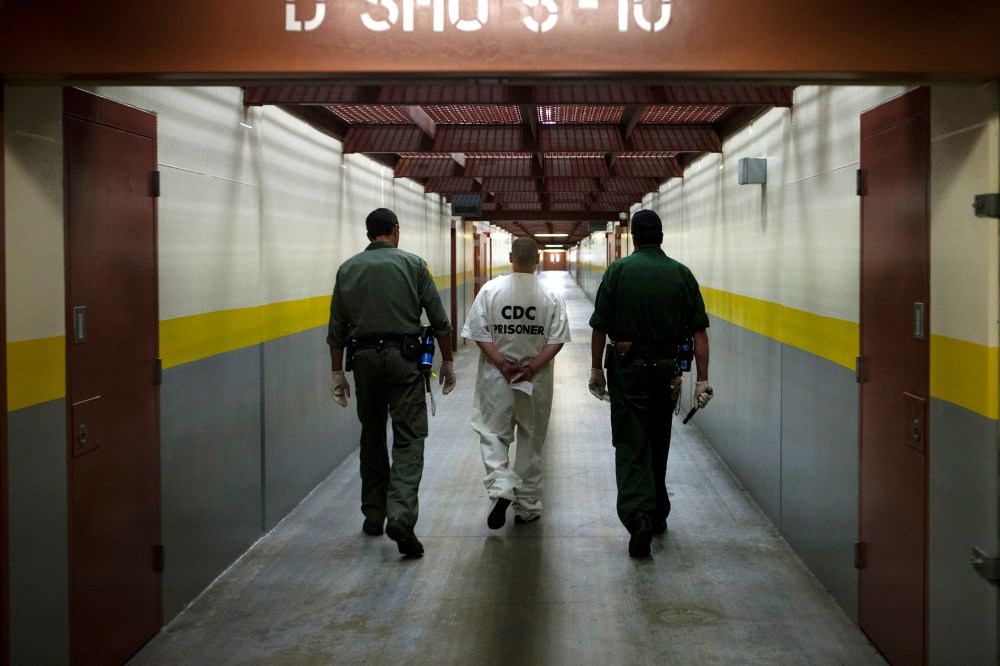
Disenfranchisement of the formerly incarcerated is unnecessary, unjust and counterproductive, Attorney General Eric Holder told an audience at the Georgetown University Law Center on Tuesday.
“At worst, these laws, with their disparate impact on minority communities, echo policies enacted during a deeply troubled period in America’s past – a time of post-Civil War discrimination,” Holder said. “And they have their roots in centuries-old conceptions of justice that were too often based on exclusion, animus and fear.”
Holder’s remarks were made at a bipartisan criminal justice symposium held by the Leadership Conference for Civil and Human Rights. The event is part of a renewed push for criminal justice reform from civil rights groups to find common ground between right and left over rolling back tough on crime policies that have lead to an age of mass incarceration, where more than 1.5 million Americans are behind bars. Nearly six million cannot vote because of laws stripping the formerly incarcerated of the right to cast a ballot, according to the Brennan Center.
In Congress, legislators from both parties are collaborating on legislation to lower federal mandatory minimum sentences and give judges more discretion over imposing harsh punishments. State governments, including those dominated by conservative leadership, have looked to reducing their prison populations when seeking to trim state budgets. With crime rates low, civil rights groups hope that the time is ripe for significant changes to the criminal justice system.
Criminal justice is one of the few policy areas where evidence of a thaw in chilly relations between Republicans and Democrats isn’t hard to find. At the Georgetown event, Holder praised Kentucky Republican Sen. Rand Paul for having been a “leader” on criminal justice matters, and in a moment of optimism, declared that “criminal justice reform is essentially not a partisan issue.”
It may seem that way. In late January, the Senate Judiciary Committee passed the Smarter Sentencing Act, a bill sponsored by Illinois Democrat Dick Durbin and Utah Republican Mike Lee. The bill would lower the federal mandatory minimum sentences for certain nonviolent drug crimes from 20, 10 and five years to 10, five and two years, allow certain offenders to qualify for reduced sentences, and make the law reducing the disparity in sentencing for crack and powder cocaine retroactive, which could mean sentence reductions for around 8,000 people sentenced before the change. Prior to 2010, crack offenses carried penalties a hundred times harsher than those associated with powder cocaine–a policy that lead to black offenders being sentenced much more harshly than white offenders, despite crimes associated with the same drug.
The ACLU called the Smarter Sentencing Act “the most significant piece of criminal justice reform to make it to the Senate floor in several years.” But if the passage of the bill out of committee showed that Democrats and Republicans can find places to work together in an age of partisan polarization, it also showed that the old tough-on-crime politics aren’t as dead as some may think.
Although the original version of the bill reduced mandatory minimums for certain drug offenses, Iowa Republican Sen. Chuck Grassley, who mocked the administration’s support of criminal justice proposals by saying in September that “For the first time in five years, this administration finally found one area of federal spending that it wants to cut,” successfully attached amendments to the bill that would increase mandatory minimums for domestic abuse, sexual assault, and terrorism. Not wanting to look soft on wife beaters and terrorists, only three committee members–Lee, along with Democrats Patrick Leahy of Vermont and Mazie Hirono of Hawaii–voted against Grassley’s proposals.
“The message that the Grassley amendments send is bizarre in the face of reducing mandatory minimums for drug offenses,” says Julie Stewart of Families Against Mandatory Minimums.
Even stranger is that Grassley, who in 2012 helped lead Republican opposition to the once-bipartisan Violence Against Women Act, was pushing for increases in mandatory minimums for crimes of sexual assault and domestic violence over the objections of groups who advocate for the targets of sexual and domestic violence. The National Task Force to End Sexual and Domestic Violence Against Women, an umbrella group composed of women’s and civil rights organizations, opposed increases in mandatory minimums when Republicans proposed them during the Violence Against Women Act reauthorization. After the Smarter Sentencing Act passed out of committee in January, the task force sent a letter to the committee reemphasizing its opposition to increasing mandatory minimums. William Treanor, the Dean of Georgetown University Law School, said Tuesday that this was “an opportunity for change that we haven’t seen in decades.” It’s easy to see why Treanor is optimistic. At Tuesday’s event, both Republican legislators spoke of offenders and their families in humane and understanding language used by criminal justice reform activists. Sen. Lee warned that the number of American children with an incarcerated parent would be comparable to the population of Chicago. Sen. Paul praised Michelle Alexander, the Ohio University law professor who wrote The New Jim Crow a book positing that the American criminal justice system is morally and functionally comparable to segregation. It’s one thing, however, for Paul and Lee to extend their liberaltarian flirtation with Democrats from surveillance to criminal justice policy, and quite another for them to bring the rest of the GOP along for the ride. The sparring over the Smart Sentencing Act shows how delicate and fragile the current bipartisan truce on criminal justice issues actually is. Saying criminal justice reform isn’t a partisan issue might be true for now–but issues tend to get partisan the closer Congress gets to doing something about them. John Malcolm, a criminal justice expert with the Heritage Foundation, said during a panel discussion Tuesday that not everyone who supports felony disenfranchisement laws is motivated by nefarious reasons. “Not all of those people are racist or unfeeling,” Malcolm said. Then he offered a warning. “The biggest land mine is that we will miss this moment,” Malcolm said, by “using rhetoric that will divide us.”
Adam Serwer Recommended


