








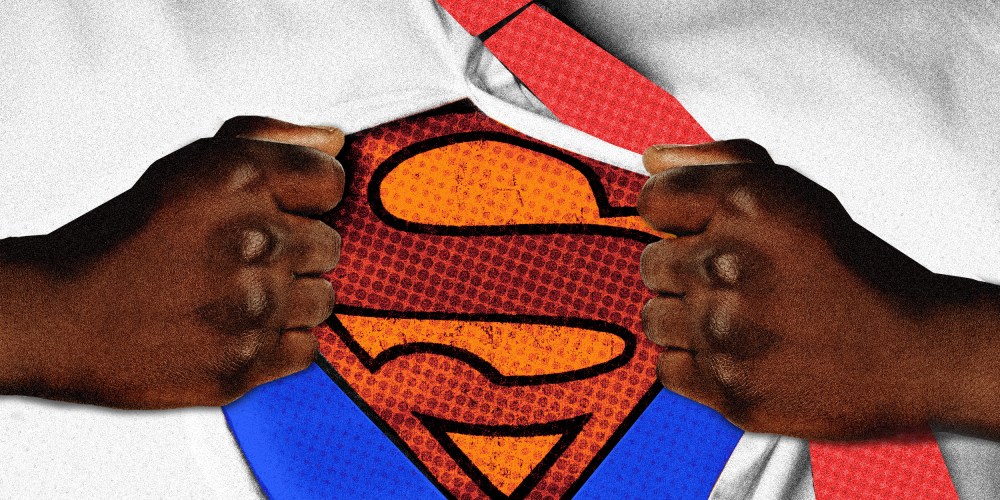
Superman is an American legend. At this point, it may not be too much of a stretch to call him the American legend, an archetype from which all iterations of the superhero mythos flow. He is a homegrown demigod, a character whose emblem is iconic and recognizable across cultures. His origin story is Mosaic, his mission messianic: an immigrant sent from beyond the stars, here to provide for the weak and save a world that isn’t his own.
Superman fights for truth, justice and the American way. He is also white.
His whiteness has been inseparable from the suspension of disbelief required to believe a man can fly. When Christopher Reeve first put on the blue tights and red trunks in 1979, he perfectly embodied a character who at the time could only be white. In the America of 1938, when the creation of two Jews made his debut on the cover of Action Comics #1, a world with a selfless hero, more powerful than any mortal, with anything other than white skin was beyond the scope of most mainstream minds to process.

That’s set to change, finally, as the world will soon see a Black Superman on the big screen. Warner Bros. announced in February that Ta-Nehisi Coates, the author and essayist who also penned a much-hailed run of “Black Panther,” will write the screenplay. The Hollywood Reporter reported Wednesday that the hunt is on for the director to help bring this new vision to life. And while J.J. Abrams is set to produce and has a whole slate of DC Comics-related projects on deck already, it’s unlikely that he’ll be in the director’s chair.
Insiders say Warner Bros. and DC are committed to hiring a Black director to tackle what will be the first mainstream cinematic incarnation of Superman featuring a Black actor, with one source adding that putting Abrams at the helm would be “tone-deaf.”
Call me biased, but this feels bigger to me than most superhero movies, even compared to the titanic juggernaut that is the Marvel Cinematic Universe. It has the potential to be even bigger, in my opinion, than 2018’s “Black Panther” — and that’s saying something, considering it was nominated for best picture. Because while the Ryan Coogler-directed film had the MCU’s cultural heft to boost its appeal, well, this is Superman we’re talking about.
And while we’ve had other Black superheroes before and since King T’Challa — played by the late Chadwick Boseman — in movies and on television, they’ve touched on only parts of Superman’s place in our culture in relation to race. None of them have grappled with the significance of what it would mean to have a savior with melanin-rich skin.
What does it mean for a country built on the notion of Black inferiority to have a Black man as its protector?
When I was growing up in the 1990s, a slow acceptance toward bringing Black superheroes to life in film was just beginning. I loved Robert Townsend’s “The Meteor Man,” a comedy that kept its hero local, strictly interacting with Black neighbors and facing down a Black villain in what was clearly intended for a niche audience. “Steel,” starring Shaquille O’Neal, was the direct opposite: The script almost entirely divorces itself from the race of its lead in a way that feels extremely apt for the era, in retrospect. (Despite the title character’s originally intending to replace Superman during the character’s brief death in the early ’90s, the movie also separates itself from the Superman narrative entirely, a mistake I’ve always lamented.) And Blade, the antihero vampire played by Wesley Snipes in the eponymous movie, may have been the first Black Marvel superhero to make the big screen, but his cultural cachet was — and is — limited.
In comparison, “Black Panther” was, by all accounts, a masterpiece, a visual wonder that wove T’Challa’s journey to assume the mantle of king with an exploration of post-colonialism and diaspora politics. The film’s antagonist, Eric “Killmonger” Stevens (Michael B. Jordan), may have had extreme methods, but his motives — the freeing of Africa’s descendants from the yoke of white supremacy — resonated with Black viewers. But while the fictional kingdom of Wakanda is a painstakingly crafted utopia, showing for the first time in a major motion picture Black science fiction in all its Afrofuturist glory, the movie is unable to pose the questions that a Black Superman would force Americans to face.

On the small screen, Marvel has also introduced Luke Cage (Mike Colter) to Netflix audiences and this year added the character of Monica Rambeau (Teyonah Parris) to the ever-expanding ensemble. I note both of them in particular for their respective powers — Cage has nearly indestructible skin, Rambeau an ability to turn into solid light. These abilities make them bulletproof, imagery I can’t separate from the police killings of Black men and women that keep making headlines. To be free from that fear, as Superman himself must be, is Black wish fulfillment of the highest order — while simultaneously evoking the sort of racist stereotypes of Black people’s resistance to feeling pain that made us both something to fear and a threat to be handled with brutal force.
So far, though, the closest we’ve come to grappling with the idea that America’s fate could be in the hands of a Black Messiah is through HBO’s “Watchmen” miniseries, helmed by Damon Lindelof. “Watchmen” was the rare piece of art that completely transcends both its genre and its source material. It’s a show centered on America, which is to say the scars that racism both personal and systemic have left on this country. It left me reeling after each episode. Over the nine episodes, Lindelof dared to reveal that the first superhero in this world, Hooded Justice (Jovan Adepo), was a man whose secret identity was a secret identity, a Black man fighting crime in white face. The villains of this saga: a secret society of white supremacists, seeking to harness the abilities of the most powerful being in the known universe, who had, unbeknownst to most of the population, taken on the identity of a Black man (Yahya Abdul-Mateen). These are all elements that a Black Superman would by necessity have to deal with directly. What does it mean for a country built on the notion of Black inferiority to have a Black man as its protector? What would it take for America to trust someone so far outside its control? Superman is, like most superheroes, a protector of the status quo — but what does it mean to safeguard a world with such an unequal application of justice to people who look like him? And how does the immigrant tale of Clark Kent, raised, I would assume, in this adaptation by Black parents, factor into his story? One of the most intriguing things that Wednesday’s report revealed is that “one option under consideration is for the film to be a 20th century period piece.” That would give all the room needed to really address these issues and, I would hope, still tell a story that feels both timeless and of the moment in the way the best Superman stories are. It may be unfair to put this much weight on Coates’ script this early on — the final product isn’t due until December, according to The Hollywood Reporter. Given how deeply he’s considered these issues, though, I’d be surprised if Coates isn’t the person putting the most pressure on himself to find the right story to tell, one that centers this iteration of Clark Kent’s Blackness while still appealing to a mass audience. It will be years before his vision is realized, and first the project needs a director and a star — but we’ve been waiting 83 years for the day when Superman doesn’t have to be white. I can wait a little bit longer.
Hayes Brown is a writer and editor for MS NOW Daily. 


