








Despite what high-stakes political thrillers that dominate late-night television might suggest, the bulk of congressional reporting is grindingly dull. We reporters spend most of our time standing around outside the House or Senate floor or in the tunnels underneath the Capitol waiting for that short burst of activity when the lawmaker we want to interview appears. Then we whip out our recording device and shout questions over our fellow reporters.
If we continue to shout questions at Fetterman, not only would we be depriving the readers, viewers and listeners of our reporting of the information they need to know, but we’d be giving Fetterman a reason to dodge our questions.
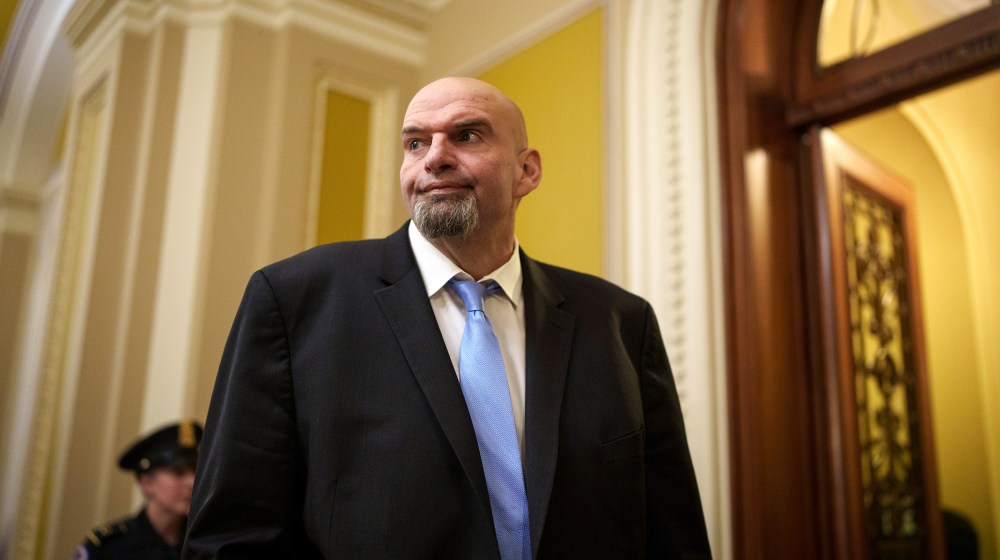
When I saw images of Pennsylvania’s Sen.-elect John Fetterman roaming the basement of the Senate Tuesday, though, I knew this format would not work for him, or for the journalists who want to interview him.
Fetterman, a Democrat, suffered a stroke earlier this year, has an auditory processing order, and he needed closed captioning to conduct interviews and participate in his debate against Republican opponent Mehmet Oz.
Pennsylvania Democratic Sen.-elect John Fetterman walking through the Senate basement into the Capitol. pic.twitter.com/ZKIvy4nIyi
— Jennifer Shutt (@JenniferShutt) November 15, 2022
In response to a tweet from my friend and colleague Igor Bobic, who said Fetterman didn’t answer when Bobic asked if he’d be allowed to wear his trademark hoodie on the Senate floor, Fetterman’s adviser Rebecca Katz tweeted, “He is still recovering from a stroke and has lingering auditory processing challenges. The way Hill reporters are used to yelling questions at senators will not work here.” During the campaign, Oz’s team said he wouldn’t be able to use the device on the Senate floor, even though Senate chamber’s regulations likely would allow him to do so.
To their credit, some reporters, like Shira Stein at the San Francisco Chronicle, asked useful questions, like if it would be helpful to have written down questions for Fetterman to read.
Would it be helpful to have qs written down and allow him to read? Or is he not going to take hallway qs while he recovers?
— Shira Stein (@shiramstein) November 15, 2022
But others, like conservative journalist Derek Hunter, responded by saying things like: “All questions are to be written down & submitted in advance. They will be returned once his wife has had time to answer them.”
I could envision my colleagues in the Capitol press corps rolling their eyes and maybe thinking that to treat Fetterman differently would amount to giving a pass to a public figure. The idea that we should somehow accommodate a public official may feel antithetical to our prescribed adversarial relationship with elected officials. But it’s not.
By not accommodating Fetterman, or any other person with a disability, journalists would be preventing the public from getting the answers they deserve about their elected officials. If we continue to shout questions at Fetterman, not only would we be depriving the readers, viewers and listeners of our reporting of the information they need to know, but we’d be giving Fetterman a reason to dodge our questions and given him the opportunity to correctly accuse us of not accommodating him.
The most unfair thing to do in this situation would be to treat him the same way we treat everybody else. That would essentially allow him to escape the journalistic grilling everybody else gets by accusing us of unfairness.
During his debate with Oz, Fetterman did not answer why he changed from a position of being opposed to fracking to being in favor of it. His failure to answer did not owe to his difficulty speaking or his difficulty processing speech, but to the fact that he did not have a sufficient explanation for his shifting position. As a journalist, I would only have a problem with a politician not answering when I know he’s understood me, not when I’m not sure he has. The fact that so many of my colleagues did not immediately adapt in our coverage of Fetterman — such when one reporter responded to Katz’s tweet by asking, “Who’s yelling?” — is testament to the dearth of journalists with disabilities in the Washington press corps. A journalistic mindset that holds that fairness means treating everyone the same is emblematic of a more general disregard for disabled people that prevents even the most accomplished among them from requesting the accommodations they need. The only way for journalists to get those answers is to adapt our methods to better accommodate disability.
I have met incredibly accomplished people with disabilities whom employers, educators and service providers chose not to accommodate because they were “not disabled enough,” and I’ve seen public establishments exclude people with disabilities because they think they are “too disabled.” Frustratingly, nondisabled people often think that they are doing people with disabilities a favor or performing an act of charity when they offer sufficient accommodations when, in truth, they are doing the absolute minimum. These ideas severely restrict whom we consider capable of participating in public life and say that certain people do not deserve to hold office. As reporters, we already accommodate plenty of other disabled members. We would not demand Sen. Tammy Duckworth — who uses a wheelchair — to climb up the stairs while we speak with her and former Capitol Hill reporter Meredith Shiner noted that she used to make sure to speak into former Sen. Tom Harkin’s “good ear” so he could give a better answer. Ultimately, though, this is not about Fetterman. Now that he’ll be a senator, he should be forced to explain his policy positions and answer for his votes to the people of Pennsylvania and across the United States. But the only way for journalists to get those answers is to adapt our methods to better accommodate disability. I should add that I do not think all of my colleagues on the Hill are bad people. Far from it. Society conditions us to equate disability with deficiency or negativity. Unlearning takes time and patience and a willingness to learn — which is to say, all the traits that make a good journalist. Our yelling our questions out at Fetterman wouldn’t be fair to him or those depending on our reporting. It would also mean we weren’t doing our jobs.
Eric Garcia is an author and senior correspondent for The Independent. 


