








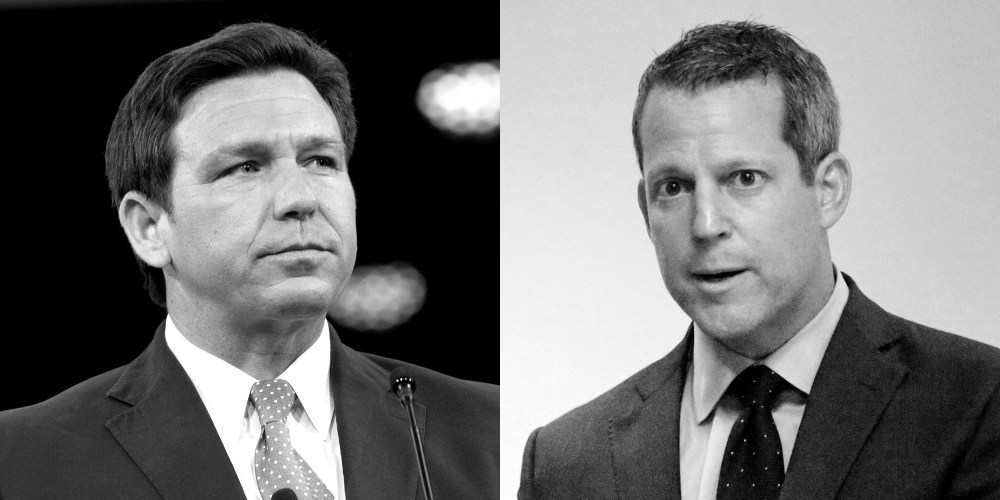
Florida Gov. Ron DeSantis’ removal of a political adversary this month and his replacement of him with an ally raises serious questions about the rule of law in Florida — particularly given the context, in which DeSantis, a Republican, was attacking his opponent, a Democrat who has twice been elected prosecutor, by claiming the local official was neglecting his duty.
The move by DeSantis to suspend Andrew Warren based on the prosecutor’s stated support for transgender children and abortion rights should worry all supporters of democracy.
The suspension of Hillsborough County State Attorney Andrew Warren based on his stated support for transgender children and abortion rights should worry all supporters of democracy. If we’ve learned nothing else about our democracy in recent years, we’ve learned that we must take seriously elected officials who formally act to overturn the will of the voters.
Warren has filed a lawsuit decrying his suspension, arguing not only that DeSantis’ move exceeded the governor’s powers under Florida’s constitution, but that it also violates the First Amendment. He wants a federal judge to order DeSantis to reinstate him.
That’s exactly what should happen. Democracy doesn’t work if elected officials can yank other elected officials from office whenever one disagrees with the other’s views.
In an environment in which a former president refuses to acknowledge he lost the 2020 election and has elected officials and candidates advancing such lies, a governor looking for new and politically advantageous ways to ignore the voters and punish his political foes shouldn’t be taken lightly.
Warren argues in his lawsuit that he is fighting to ensure “that the First Amendment still applies even though DeSantis is Governor of Florida” and that the “Constitution of Florida means what the courts say it means, not whatever DeSantis needs it to mean to silence his critics … and subvert the will of the voters.”
It was concerning enough in 2017 when former Florida Gov. Rick Scott took death penalty-eligible cases away from another locally elected prosecutor, Aramis Ayala, because she was refusing to seek the death penalty. In a 5-2 decision, the Florida Supreme Court ultimately upheld Scott’s move, because, the majority said, the governor’s authority to reassign cases to advance “the ends of justice” was established in state law. But the two dissenting justices argued that the case was about the “independence of duly elected State Attorneys to make lawful decisions within their respective jurisdictions.” The decision, though, was a limited one that by and large left Ayala in charge of her office.

Here, however, DeSantis has turned that logic on its head. Rather than take cases away from Warren’s office, DeSantis is taking the office away from Warren — and from the voters of Tampa. Warren was re-elected in 2020 on a platform of supporting criminal justice reform efforts to reduce incarceration — a fact that reinforces what an extraordinarily anti-democratic act DeSantis has undertaken.
DeSantis didn’t point to any specific cases in his order. Instead, he pointed to two statements that Warren joined in opposing prosecuting cases involving gender-affirming care or abortion and to a set of what DeSantis called “presumptive nonenforcement” policies established in Warren’s office. (Warren’s lawsuit calls them “Presumptive Non-Prosecution” policies.) DeSantis argued that these statements and policies — and not any specific cases — were sufficient for him to find “neglect of duty” and “incompetence” by Warren in applying a provision of Florida’s constitution that authorizes suspending some officials in certain cases.
In Wednesday’s filing, however, Warren said that was bunk — and urged a court to agree.
Warren was re-elected in 2020 on a platform of supporting criminal justice reform efforts to reduce incarceration. As Warren’s lawyers put it simply, “The Presumptive Non-Prosecution Policies speak for themselves and are not absolute.” They create presumptions — and are “not a universal or ‘blanket’ policy.” That’s important, and it came up in DeSantis’ suspension order, because the Florida Supreme Court made it clear in Ayala’s case that her “blanket policy” against seeking the death penalty provided a basis for Scott’s intervention. More central to the national debate over democracy is Warren’s response to DeSantis’ attacks on his joining the statements. Noting that no Florida law bars transgender care and that no abortion-related cases have been referred to the Tampa prosecutor’s office during his tenure, Warren’s lawyers say DeSantis suspended him “[a]s a result of his decision to continue to speak out on issues his constituents elected him to pursue.” This, they argue, “would likely deter a person … from the exercise of First Amendment rights.” As Miriam Krinsky, the former federal prosecutor who heads Fair and Justice Prosecution, the group behind the joint statements, told me Wednesday, “Warren was doing exactly what one would hope an elected prosecutor would do — taking seriously his role as a minister of justice to speak out on criminal justice issues of national concern [and] being transparent with his community about how he sees these issues.” Candidates are elected in this country at different levels of government by different groups of people to represent various community, state or national interests. At times, federal policy pre-empts state actions. At other times, state laws control local actors. But a clear-eyed look at the reasons DeSantis gave for suspending Warren makes it clear that this is little more than political retaliation for Warren’s policy disagreements with DeSantis. The state’s high court has made it clear that DeSantis could reassign any categories of cases in which Warren refused to act. DeSantis did no such thing, because, as noted, there are no cases to reassign. Instead, he is mad at Warren for what he has said, and he is trying to punish Warren and exert his own will on the voters of Hillsborough County. The courts shouldn’t allow this subversion of democracy, and the voters — in and out of Florida — shouldn’t forget that DeSantis has tried it.
Chris Geidner
Chris Geidner is a journalist and MSNBC columnist whose Law Dork newsletter covers the Supreme Court, law and politics. His more than two decades in journalism include widely recognized coverage of LGBTQ issues, the criminal legal system and other complex legal and political questions. Geidner also contributes to Grid and Bolts and previously worked as the Supreme Court correspondent and legal editor at BuzzFeed News, as well as for The Appeal and Metro Weekly. 


