








Polling for the upcoming midterm election has been teetering back and forth between which party will win the most seats, but the prevailing sentiment is that Democrats are in big trouble due to Republican-driven narratives on inflation, gas prices and crime. “Fearing a New Shellacking, Democrats Rush for Economic Message,” read a recent New York Times headline for an article that cites a Democratic pollster expressing worry that party support from the summer is “evaporating.”
The Democratic margin of young women ages 18 to 29 who say they’re likely to vote jumped 9 points from the spring until now. And the most important issue to a plurality of these voters? Abortion.
But while polling shows an airtight margin in Tuesday’s election, it mostly fails to account for turnout: Younger voters have registered this midterm cycle at rates matching or exceeding 2018’s historic levels, and the concern among young women, specifically of having less bodily autonomy than their mothers and grandmothers, is what’s driving it.
But I’ve noticed a hesitation to recognize this potential impact. On Oct. 31, Georgia election official Gabriel Sterling tweeted: “The single largest age group registered in Georgia is the 18-24 year olds with 853,426 registered. However, only 65,605 have voted. That is 7.68% of the youngest voters voting.”
Follow our 2022 midterm elections live blog at msnbc.com/midterms for the latest results, news and expert analysis in real time.
According to Tom Bonier, the CEO of the Democratic political data services firm TargetSmart, there’s a possible explanation for that gap. “Most of the pollsters have been asking ‘How do you plan to vote?’ or ‘When do you plan to vote?’ and the young voters have the highest share of saying ‘On Election Day,’” he told me. He added, “When you look at the New York 19 special election, the Kansas primary, some of these higher turnout elections we’ve had in the last couple of months, the younger voters were more likely to vote on Election Day than older voters.”
Despite this encouraging data and the potentially major story it tells, there’s been hesitation by pundits to recognize it as a legitimate factor in the midterm elections. It’s what I’ve dubbed the “Hillary effect”: Pollsters and political prognosticators who went full “I’m with her” in 2016 and were mortified when Donald Trump won are afraid to put stock in the ability of women to be the decisive variable in an election. It was seen as embarrassing to be a cheerleader for women — especially one specific, polarizing woman — and in turn, the mostly male, mostly white political forecasting establishment has found itself in the midst of a yearslong, gendered course correction.

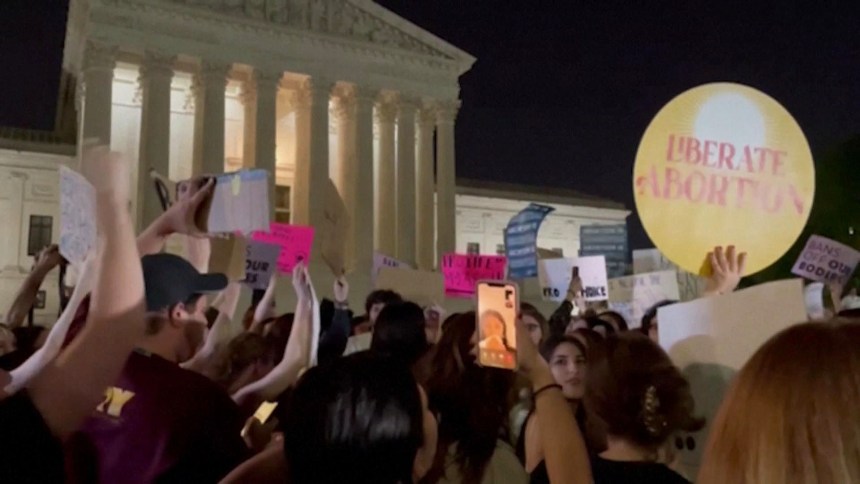
Before the Supreme Court’s ruling on Dobbs vs. Jackson Women’s Health Organization, voters under the age of 25 accounted for 21% of new voter registrants nationally, according to stats from TargetSmart. But since then, overall their share rose to 26%, and an astounding 31% since the beginning of October. Data from the nonpartisan Center for Information & Research on Civic Learning and Engagement at Tufts University confirms the same trends. “The surge in youth registration has been driven by young women,” says Bonier, who was compelled to dig into the voter registration data after the surprising outcomes in the N.Y. 19 special congressional election and the Kansas state primary over the summer.
On the ballot in Kansas was an amendment to the state Constitution that would remove language enshrining abortion rights, and the vote was a resounding “no” that crossed party and gender lines. But when Bonier took a closer look at the registration data, a more specific story emerged: He found that 70% of Kansans who registered to vote after the Dobbs decision were women with a median age of 23. And in September, after further analysis, he found the data was predictive of turnout. “In the August vote on abortion rights in Kansas, women under the age of 25 turned out at a higher rate than all men (45% to 43%),” he said.
70% of Kansans who registered to vote after the Dobbs decision were women with a median age of 23.
It was entirely possible that Kansas was a fluke, with the immediate momentum of Dobbs behind it. But after analyzing the registration data from across the country since then, he found the trend held.
“Prior to Dobbs, there was a negative gender gap among new registrants under the age of 25, with men outnumbering women by 2 points,” he told me. “In the two weeks after Dobbs, the gender gap among young voters reversed substantially to 7 points — a 9-point swing. Since that time, the gender gap has persisted at a 3 point margin.”
The trend particularly held in battleground states: Arizona saw an 8-point gap among new registrants under 25 immediately following Dobbs. Similarly, Michigan and North Carolina both showed a 9-point gap, Ohio with 11, and Pennsylvania with a 24-point gender gap in registration since abortion rights were upended, per data shared with me by TargetSmart.
A recent Harvard Institute of Politics poll found that youth voters are even more likely to vote than the national average. “Battleground state polling is far from settled, I’m not sure if we will see a Red Wave or Blue Wave on November 8 — but we will see a Gen Z Wave,” institute polling director John Della Volpe said in an email. While the poll notably found that youth voter turnout is set to match or exceed 2018’s record-breaking levels and that these voters prefer Democratic control of Congress 57% to 31%, what most intrigued me was a stat that comported with the voter registration data: The Democratic margin of young women ages 18 to 29 who say they’re likely to vote jumped 9 points from the spring until now. And the most important issue to a plurality of these voters? Abortion. A mid-September poll fielded by PerryUndem, a nonpartisan public opinion research firm, dug in further to the mindset of these motivated young women voters. It found 76% of women under 30 “can envision a scenario in which abortion is the best option for them,” and 68% say “lack of abortion rights and access is a big problem in our society.” And 81% say the Supreme Court’s decision made them think about “losing several freedoms.” “This policy change has affected many young women’s thinking at a core level,” Tresa Undem, co-founder and partner PerryUndem, told me. “Many have thought about the risk of death if they become pregnant. Dobbs has made many not want to have kids. Some are considering an invasive surgery as a direct result. So that’s what’s behind any spike in registration. It’s who’s most personally impacted by any reproductive health policy.” If young women turn out in the volume that they registered, their power as a voting bloc could help protect a nation from the slew of cultural and socioeconomic challenges found to result from a lack of access to abortion care. Let’s hope they make it. CORRECTION (Nov. 5, 2022, 11:18 a.m. ET): A previous version of this article misstated the age of women voters referred to in a poll by PerryUndem. The poll refers to women under 30, not women under 20.
Marisa Kabas
Marisa Kabas writes about politics, media and gender and their many intersections. Her work has appeared in Rolling Stone, HuffPost and The New Republic, and she writes a newsletter called The Handbasket. She is based in Brooklyn, New York. 

