








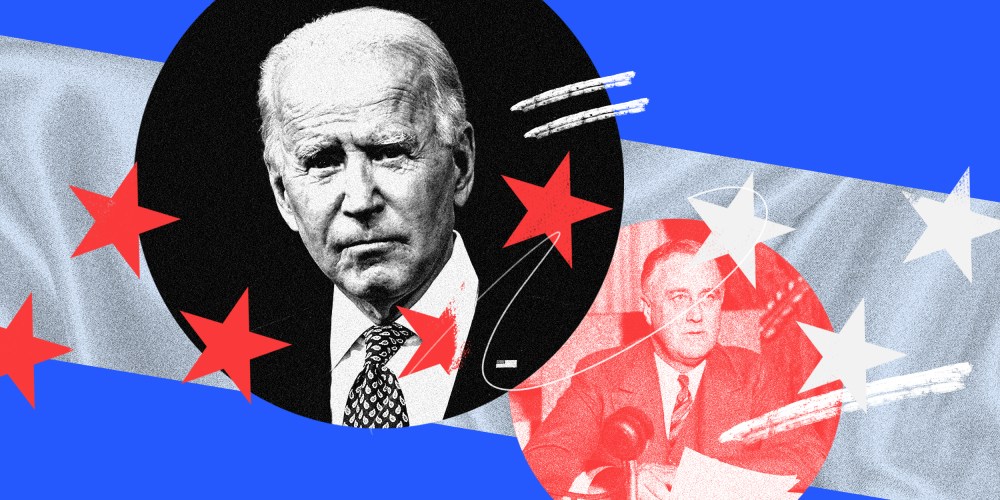
Ahead of President Joe Biden’s 100-day mark, the FDR comparisons abound. Jonathan Alter, author of a book on Franklin Delano Roosevelt’s own first hundred days, called Biden “FDR’s heir” in a New York Times op-ed. David Gergen, former adviser to Republican and Democratic presidents alike, said the 46th president “bears some important similarities” to the 32nd. During the election campaign, Biden’s aides even told New York magazine their candidate was planning an “FDR-size presidency.”
But that’s not the whole picture. Even Gergen conceded that “Biden is no Roosevelt” — not yet, at least. Whether he actually lives up to that mantle will depend not just on how well Biden leads but on how well he listens to the voices urging him toward a more progressive future.

Just by the numbers, Biden hasn’t matched FDR’s opening intensity. Roosevelt pushed 15 major bills through Congress in a frenzy of activity between March and June 1933. Since January, Biden has passed, well, one. Don’t get me wrong: The $1.9 trillion American Rescue Plan is the most ambitious and progressive legislation of my lifetime. Who would have imagined Biden would try to emulate Roosevelt or Lyndon B. Johnson in his first three months?
More important than the quantity of bills passed, though, is the quality. Both of those Democratic presidents delivered lasting institutional change — think Social Security, Medicare, Medicaid. Biden has yet to be able to say the same.
So let’s look beyond the first 100 days. Biden could still emulate FDR in another crucial way. It is said that a group of civil rights activists and labor leaders, including A. Philip Randolph, once met with Roosevelt prior to the start of World War II to insist he use the power of the presidency to take action against discrimination in the workplace. “You’ve convinced me,” FDR responded, having listened to them lay out their demands. “Now go out and make me do it.”
The story is almost certainly apocryphal (though, to be fair, singer Harry Belafonte claimed to have heard a version of it from Eleanor Roosevelt herself.) True or not, the point of the story is clear: Politicians inside the system need allies outside of it; outsiders willing to publicly pressure them and, on occasion, provide cover for bold, outside-the-box moves. To quote essayist Ta-Nehisi Coates: “Politicians respond to only one thing — power. This is not the flaw of democracy, it’s the entire point. It’s the job of activists to generate, and apply, enough pressure on the system to affect change.”
Some on the left have argued the story of FDR’s response to Randolph has been misinterpreted because “politicians, as a rule, do not like being pressured by movements they cannot control and often lash out at those who demand that they take more principled or politically risky stands,” as Dissent put it.
This was definitely how Biden behaved, at times, during the Democratic primaries. He never pretended to be at the head of a transformational movement, a la his former boss, Barack Obama. He didn’t enter office backed by a loyal cult, as his predecessor, Donald Trump, did.
Yet he and his administration have spent these first 100 days embracing the progressive wing of his party, along with labor unions, youth groups, climate campaigners and sundry activists. “Progressives say they’re being included, heard and respected by the Biden White House,” Politico reported in February.
Compare and contrast this outreach with the Obama era, in which White House press secretary Robert Gibbs dismissed people on the “professional left” who “ought to be drug-tested,” and White House chief of staff Rahm Emanuel denounced liberal activists as “f—ing retarded.”
Biden, on the other hand, proudly invoked Vermont Sen. Bernie Sanders’ support for the American Rescue Plan in the immediate aftermath of its passage through the Senate. His chief of staff, Ronald Klain, has been dubbed the “left whisperer,” having become “a point of rapid response for many on the left who are angling to get within earshot of the president,” The Daily Beast wrote.
Real access has been matched by real impact. Does anyone really believe the Biden who launched his presidential campaign in 2019 looking for a “middle ground” on climate issues would have committed to cutting U.S. carbon emissions in half by 2030 without pressure from groups like the Sunrise Movement?
During the Democratic primaries, the youth-led environmental group gave Biden’s climate plan an “F.” Since Biden’s inauguration, however, the group has been pushing at an open door in the White House. “I feel like we’re getting a little bit spoiled for future presidents,” Varshini Prakash, the movement’s co-founder, told the Washington Post in April. “I think it’s pretty wild that there’s a [White House] chief of staff who you can email who actually gets back to you.”

Outside pressure works in myriad ways. Not only have activists pushed the centrist Biden toward more progressive goals on everything from the climate to infrastructure, they have also forced the administration to change course on certain issues, often reversing bad decisions or policies in the process.
On March 7, White House communications director Kate Bedingfield told CNN the president’s “preference is not to end the filibuster. He wants to work with Republicans, to work with independents.” One week later, Klain told me Biden “believes if we could leave the filibuster in place, that’s what he prefers.”
The Biden administration has proved itself to be open to outside pressure and willing to do, or at least seem to be doing, the right thing.
Yet just two days after that, with a growing chorus of voices in Congress as well as progressive activists in groups like Indivisible demanding action on the filibuster, Biden himself was telling ABC News he was actually in favor of reform and suggesting the re-introduction of the so-called talking filibuster: “That’s what it was supposed to be.”
By the following week, people close to Biden were telling Axios the president is “fully prepared to support the dashing of the Senate’s filibuster rule to allow Democrats to pass voting rights and other trophy legislation for his party.” Why? “He loves the growing narrative that he’s bolder and bigger-thinking than President Obama,” per Axios. Another example: Around noon on April 16, the Biden administration revealed that it planned on sticking to the historically low refugee cap of 15,000 set by the Trump administration, breaking an earlier pledge to increase it. Within hours, and in the wake of a backlash from liberals, the White House had backed down, with press secretary Jen Psaki announcing the president would set “a final, increased refugee cap for the remainder of this fiscal year by May 15.” “The about-face on Friday came after the initial White House decision was panned by Democrats, refugee advocates and human rights groups,” NPR reported, which also referenced a letter to Biden signed by more than 35 progressive lawmakers that called the proposed refugee cap “unacceptably draconian and discriminatory.” Last week, there was radio silence from the administration on the Covid-19 crisis in India, as both cases and deaths exploded in the world’s biggest democracy. Then, an outcry on Twitter plus loud interventions from prominent public health experts were followed by the national security adviser and the secretary of state issuing statements on a Saturday, the White House outlining a plan of action to help India on Sunday and a decision to release 60 million doses of the AstraZeneca vaccine to the rest of the world on Monday. See? Pressure works. This is a million miles away from a Trump administration that treated climate activists and labor organizers as the enemy. The Biden administration has proved itself to be open to outside pressure and willing to do, or at least seem to be doing, the right thing. Criticism and questioning from the left is “very fair,” a White House official volunteered to me recently. “We must be bold and also bring everyone along.” Remember the words of Prussian statesman Otto von Bismarck: “Politics is the art of the possible.” Medicare for All? Canceling student debt? Legalizing marijuana? None of it is impossible under a Biden presidency. None of it is out of bounds with an administration that is willing to engage with, and be lobbied by, the left. It won’t be easy. And there is much work to be done. But what these first 100 days of President Biden have taught us is that there is no need for despondency or defeatism. To quote political organizer Jonathan Smucker: “When you say, ‘They’ll never do anything for us,’ what you’re really saying is, ‘Our movements are too weak to make them deliver.’” So the 100-day message for progressive activists, organizers and movements in the Biden era? Make. Him. Do. It.
Mehdi Hasan
Mehdi Hasan is host of "The Mehdi Hasan Show" on Peacock and an MSNBC political analyst. He is a former senior columnist for The Intercept, for which he launched the "Deconstructed" podcast. He was also the presenter of "UpFront" and "Head to Head" on Al Jazeera English. He is the author of two books and the winner of the Society of Professional Journalists' 2018 Sigma Delta Chi Award for Online Column Writing. 


