








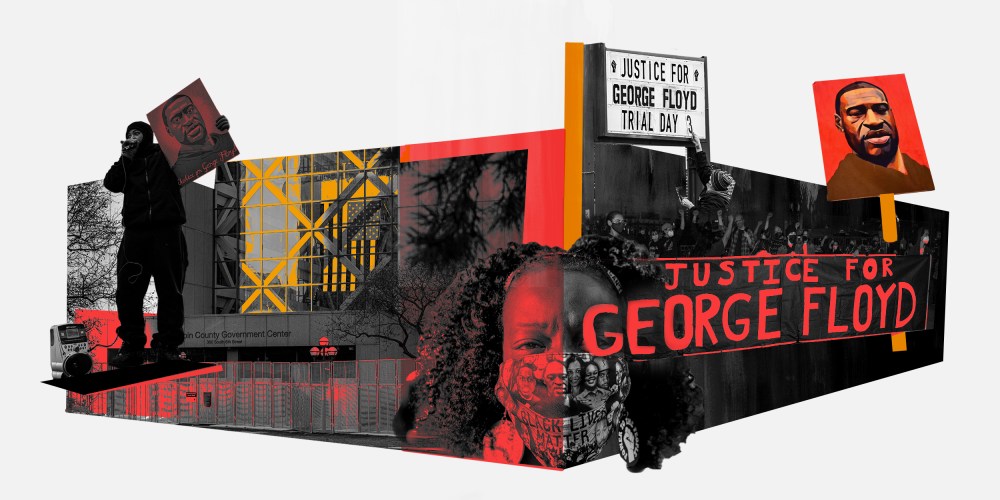
Jury selection in the case of the death of George Floyd, the 46-year-old Black man who died after being forcefully detained by a then-Minneapolis police officer, is now entering its third week. The judge on March 19 announced the defense will be allowed to present the jury with evidence from a 2019 arrest of Floyd which they say has information of his alleged drug use, which they believe pertains to his 2020 arrest. The defense maintains that Floyd’s drug use contributed to his death.
I keep coming back to one question: “What more do they need?”
As I watch these events surrounding yet another violent death of yet another Black man at the hands of police, I keep coming back to one question:
“What more do they need?”
It was a plea I heard from a young Black man standing on the corner of East Lake Street and Minnehaha Avenue in Minneapolis. It was the night of May 28, 2020, three days after the death of Floyd. The police officer accused of killing Floyd by kneeling on his neck for about nine minutes had been posted at the Minneapolis Third Police Precinct station, next to where the young man and I stood.

The discussion wasn’t long or detailed, but the context was clear. Volleys were flying between protesters and the handful of police left to guard the otherwise abandoned precinct. Protesters threw rocks and bottles at the police; police threw flash-bang grenades into the crowd.
On the opposite corner stood the burned-out remains of an AutoZone. And on the corner where we stood, a liquor store burned. It had been looted first, as had the Target store across the street and several stores in the neighborhood. There were no police anywhere except on the other side of the barricade at the police station, and they wouldn’t be there for much longer. Soon, Minneapolis police would lose control over the station, and be forced from it. But that was still a few hours away.
This is a test of the system.
The question on my lips that night was, why? Why the destruction around us? Neighborhood businesses up in flames — what was the connection between the death of Floyd three days earlier and this? The young man knew my question; he could see it in my eyes before I said it out loud. And he answered it with his own:
“What more do they need?”
He was asking what more reason did the Hennepin County district attorney need to bring charges against four police officers who, by that time, had been implicated in the death of Floyd, but neither charged nor arrested.

Derek Chauvin, the former officer who knelt on Floyd’s neck before he lost consciousness, now faces charges of second- and third-degree murder and second-degree manslaughter, and three other officers have been arrested, taken off the force, and are scheduled to be tried separately later this summer.
But on May 28, no such arrests or charges had yet been made. And the mystery, to this young man, and to pretty much everyone around me, was how little evidence police seemed to need to justify apprehending, and possibly killing, a Black man, yet how much evidence the justice system could have against police officers for killing a Black person and still not act on it.
Society wasn’t holding up its end of the bargain with Black people, so with what rules, exactly, were Black people compelled to comply?
While the world pondered that question, that little corner of Minneapolis burned. Society wasn’t holding up its end of the bargain with Black people, so with what rules, exactly, were Black people compelled to comply?
This is why the trial of Chauvin on the death of Floyd will end up being far more than the trial of one police officer in the death of one man. This is a test of the system. Black people have for years pointed out that killings by police are merely contemporary lynchings, extrajudicial killings meted out without legal deliberation or adjudication.
To some, without experience or firsthand knowledge of these interactions, it sounded unlikely. And then videos started to appear. And we watched police snuff the life out of Black people suspected of committing petty crimes or, in many cases, no crimes at all. But they were dead. And there was evidence.

I’m not a lawyer, nor am I on the jury. All I know about the death of Floyd is what the entire world knows: After his arrest, Floyd complained about being unable to breathe. The three other officers who were on the scene have also been charged with aiding and abetting in the death, with Chauvin putting his knee on Floyd’s neck, a hand in his pocket. Despite telling police what has been documented as more than 20 times that he couldn’t breathe, and despite onlookers pleading with police to let him breathe, there Chauvin remained for several minutes.
Shouldn’t human life, not just a squeezed bottom line, be enough to encourage law enforcement to uphold justice? Floyd told police, “I can’t breathe, please, the knee on my neck, I can’t breathe, sir.” He begged for Chauvin not to kill him. Then he lost consciousness. Still, Chauvin didn’t rise. When bystanders protested, Chauvin pulled out mace. When they asked police to check Floyd’s pulse, a fellow officer did, and found none. Still, Chauvin did not rise. An ambulance arrived. Chauvin still did not rise. In the end, after medical technicians found Floyd to be unresponsive, Chauvin stood up. Derek Chauvin had had his knee on George Floyd’s neck for about nine minutes. George Floyd died with Derek Chauvin’s knee on his neck, and it was all captured on video. What more do they need? The city of Minneapolis seems to have enough evidence. As jury selection in the trial of Chauvin got underway, Minneapolis settled a lawsuit brought by Floyd’s family for $27 million, one of the largest such settlements in U.S. history. The judge has denied the defense’s request to move the trial based on its argument that the settlement “tainted the jury pool.” Shortly thereafter, I spoke with one of the Floyd family attorneys, L. Christopher Stewart, who has represented the families of other Black men who died at the hands of police, including Rayshard Brooks in Atlanta in 2020, Alton Sterling in Baton Rouge, Louisiana, in 2016, and Walter Scott in North Charleston, South Carolina, in 2015. Stewart told me that settlements of this size serve a bigger purpose than compensating a family for the loss of their loved one. “The biggest thing this settlement does is it changes the evaluation process of what an African American life means in a civil rights case … cities are going to have to consider: ‘If my officers brutalize people or do things that are against policy and procedure, we’re going to have to take care of that.’ So, now they are going to implement new policies, make sure police chiefs are doing their job, and get serious about it because it’s costing them money.” In the end, a civil settlement may be a deterrent. But it isn’t justice or accountability, and it doesn’t tell Black people that the laws they are compelled to obey will protect them from arbitrary death at the hands of police. With time, it may tell them that money can compel institutions like law enforcement to force reform; but we know that even that only comes after society reaches a boiling point like the pitch of last summer, and only after an untimely death like Floyd’s garners the publicity to force a public reckoning. And shouldn’t human life, not just a squeezed bottom line, be enough to encourage law enforcement to uphold justice? This case is now in the hands of the justice system. And the question in the trial of Chauvin remains: What more do they need?
Ali Velshi is the host of “Velshi,” which airs Saturdays and Sundays on MSNBC. He has been awarded the National Headliner Award for Business & Consumer Reporting for “How the Wheels Came Off,” a special on the near collapse of the American auto industry. His work on disabled workers and Chicago’s red-light camera scandal in 2016 earned him two News and Documentary Emmy Award nominations, adding to a nomination in 2010 for his terrorism coverage. 


