








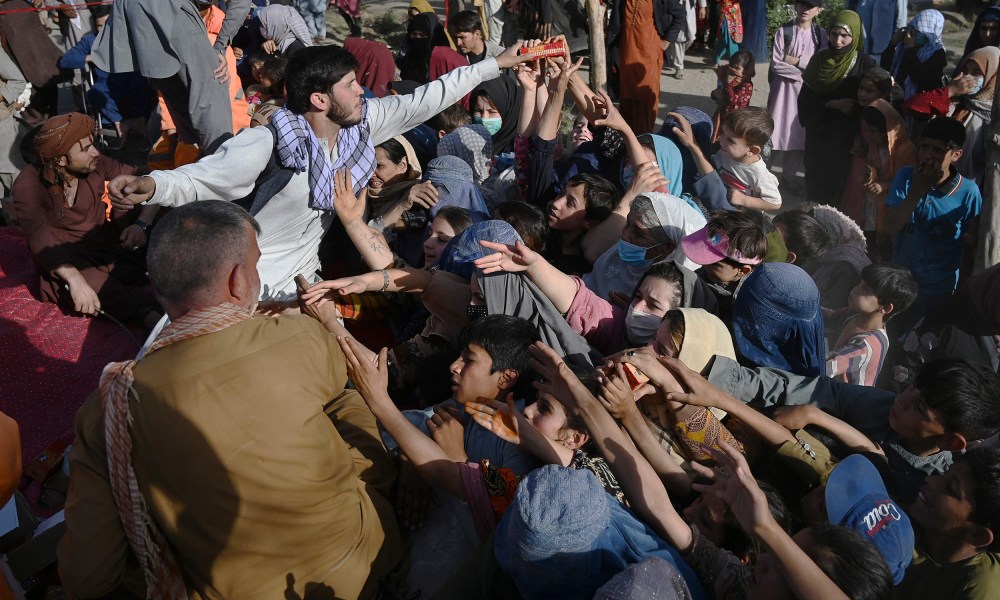
As the U.S. completes its withdrawal from Afghanistan, Taliban fighters are seizing territory across the country so rapidly that even many experts who study the region are shocked. The militant Islamist group has taken at least 17 provincial capitals in the last week and controls more than two-thirds of the country.
The fighting has caused more than 1,000 civilian casualties in the last month, and hundreds of thousands of Afghans have been displaced since May. The U.S. is evacuating personnel from the U.S. embassy in Kabul, which by some intelligence estimates could fall in 90 days. After two decades of U.S. occupation, it’s looking like the campaign to stamp out the Taliban is being reversed in mere months.
The astonishing pace of the Taliban’s recapturing of territory has prompted stern criticism from advocates of the U.S.-led occupation, and some news media outlets are framing the withdrawal as a potentially disastrous political mistake for President Joe Biden, who intends, for now, to stick to completing the withdrawal by the end of the month.
The unfortunate disaster we’re seeing right now underscores how much the U.S.’s extended occupation of the country was always a mistake.
It’s safe to predict that Biden will take heat — likely from both parties — as the situation in Afghanistan worsens, and that a narrative that the U.S. is withdrawing too early from the country could gain momentum among his critics.
But this narrative must be rejected. Because if anything, the unfortunate disaster we’re seeing right now underscores how much the U.S.’s extended occupation of the country was always a mistake.
The war in Afghanistan is the longest war in American history, and the U.S. has spent a greater sum of money on nation-building there than it has spent in any other country. Over 70,000 Afghan and Pakistani civilians have died as a direct result over the war, and over 2,000 U.S. military personnel have been killed. And yet the very group that the U.S. sought to destroy with its invasion is resuming power before America can even step out the door. That should prompt some deeper reflection on what the hell was happening over there all this time. Among other things, it reveals the fundamental hubris of the U.S. belief that it could turn Afghanistan into a different country by controlling the security situation and throwing tons of money at it.
Consider why Taliban fighters have had such tremendous success in seizing capital after capital and town after town in the first place. Yes, the Taliban are known for being well organized and can leverage decades of experience fighting against powerful outsiders. But as Adam Weinstein, a research fellow at the Quincy Institute who focuses on security, trade and rule of law in Afghanistan and Pakistan, told me, the issue here is not that the Afghan security forces are being decimated by Taliban fighters; rather, they’re simply not fighting. “They worry if they put up a strong resistance, the central government won’t have their back,” Weinstein said.

Waves of surrenders to the Taliban are at the heart of why this is all happening so quickly. As Vanda Felbab-Brown, director of the Initiative on Nonstate Armed Actors at the Brookings Institution, told me, for many years now Afghan security forces have been striking “deals of accommodation” with the Taliban, doing things like tipping off Taliban units about airstrikes and letting them clear out of an area in exchange for getting to avoid a fierce Taliban retaliation.
The reason for this is not Afghan apathy toward the Taliban, but low morale and a lack of confidence that they’ll be properly supported by their own government. Without the assurance of proper food and supplies, air support and reinforcements, the Afghan security forces don’t have much motivation to fight difficult, costly battles against Taliban fighters. And U.S. policy has a huge role to play in this.
“We created a military machine that begins to stall as soon as you remove the U.S. military,” Weinstein explained. The security apparatus in the country has long involved an overreliance on U.S. support and a small set of Afghan special forces; the former is going away, and the latter cannot win the war against the Taliban without a motivated, well-supported army.
This is just a symbol of a larger problem of reckless mismanagement. Every American president since George W. Bush, who began the war, has tried to deny that the occupation was about nation-building — but that’s exactly what’s been happening, in a haphazard, poorly organized way.
“I don’t think the Taliban as such has wide support, but neither does the government — what most people want is stability and peace.”— Anand Gopal.
The U.S. has spent $133 billion on reconstruction, aid and the Afghan security forces — adjusted for inflation, that’s more than America spent rebuilding Western Europe through the Marshall Plan after World War II. But experts across the political spectrum — even those who think the U.S. should stay in Afghanistan — will readily admit that the money has been poorly spent, with funds going to corrupt elite partners in Afghanistan, bizarre infrastructure priorities and a security force that lacks the reliable support of the state.
This is to say nothing of the extraordinary human toll of U.S.-led airstrikes in Afghanistan, which have terrorized and killed thousands upon thousands of civilians, many of whom were children. Seeing the Taliban immediately retake power suggests a double tragedy: they didn’t just die unjustly, but perhaps they died for no reason at all. It is difficult to ascertain mass political preferences among ordinary Afghans since polling in conflict zones is notoriously challenging, but experts say that peace is valued over any given side in the war. Anand Gopal, the author of “No Good Men Among the Living: America, the Taliban and the War Through Afghan Eyes,” was embedded in Taliban-controlled territory in the Helmand province last month, and told me that after decades of civil war, preferences for governance style in the country aren’t neatly ideological. “I don’t think the Taliban as such has wide support, but neither does the government — what most people want is stability and peace,” he said. He pointed out that internal displacement is being driven by avoidance of warzones, not people fleeing the Taliban per se; many Afghans, he said, have been migrating into Taliban-controlled territory. “Most people would prefer to live under single rule versus being caught between two sides,” he said. A major Washington Post investigation from 2019, which obtained government interviews with top experts and policymakers on Afghanistan discussing what went wrong with the war, shows how widely understood it was that the U.S. never really knew what it was doing beyond use of force. “We just don’t have a post-conflict stabilization model that works,” Stephen Hadley, who served as White House national security adviser under Bush, told government interviewers in 2015. “Every time we have one of these things, it is a pickup game. I don’t have any confidence that if we did it again, we would do any better.” Hadley was discussing the invasion and occupation of Afghanistan in that interview, but the same could be said of countless other countries the U.S. has invaded since World War II. And of course in the other major war of the post-9/11 era, the U.S.’s catastrophic occupation of Iraq not only failed and needlessly killed hundreds of thousands of Iraqi civilians, but backfired by creating a chaotic power vacuum that the Islamic State militant group stepped into. “The chaos that follows intervention and the chaos that follows withdrawal are rooted in the same fundamental mistake — that the U.S. thinks it can use its military to shape conditions abroad in countries that it occupies.” Weinstein said. “The last 20 years shows that that’s difficult.” As Afghanistan worsens, it’s important to remember that America has a terrible and bloody track record of thinking it has the right and the capacity to reshape other poor, geopolitically useful countries as it wishes. It has neither. What we’re seeing in Afghanistan right now is heartbreaking. It would be even more heartbreaking to repeat the mistake of thinking another decade of imperialistic occupation is the solution.
Zeeshan Aleem is a writer for MS NOW. Sign up for his newsletter. 

