








Democrats are optimistic that the Violence Against Women Act could be ready to sign on President Obama’s desk within days.
Since House Republicans released their own version of the bill on Friday, two versions of the legislation have been floating around Congress. But Tuesday night, House Republicans announced that they will allow a full vote on the Senate version if their version doesn’t get enough votes. The Senate bill passed with bipartisan support in the upper chamber by a vote of 78-22. Every woman in the Senate, Democrat and Republican, voted for it to pass.
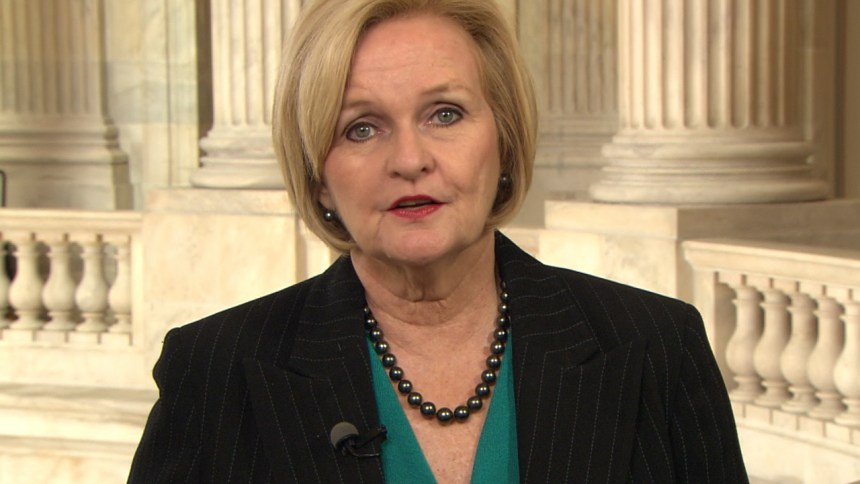
Sen. Claire McCaskill (D-Mo), a strong supporter of the bill, told msnbc’s Alex Wagner that she’s “confident” the Senate version will make it through the House:
“The House Republicans let this bill die last year. They didn’t think it was that important. And as somebody who was a prosecutor on the front lines when this legislation was passed, I know how many lives it has saved. So I am thrilled that they have relented and they are in a moment of sanity and pragmatism and public safety, that they are going to let this strong bipartisan bill that came out of the Senate come for a vote, and I am confident it will pass.”
The Violence Against Women Act was first passed into law in 1994 and was co-authored by then-Senator Joe Biden. It grants domestic violence and sexual assault victims access to safety services and increases criminal justice efforts against their abusers. Domestic violence rates have dropped by 58% since the law was passed. The law expired in 2011 and the last Congress failed to renew it.
The new Senate bill would expand protections to 30 million women and contains $659 million in assistance over five years. The cost is actually actually down 17% from the last time the bill was reauthorized in 2005.
One of the key issues between the House and Senate bills is the debate about giving Native American tribal courts the authority to prosecute non-Native American men who commit violent acts against Native American women on reservations. Statistics show that more than 80% of sexual assaults against Native American women are committed by non-Native American men. One in three Native American women is raped or sexually abused, according to the Department of Justice.
Unlike the Senate bill, the House bill never specifically mentions coverage for LGBT Americans.
“I think most Americans want protections for victims of domestic violence no matter where they are, no matter what they look like, and no matter who they love,” said McCaskill. “And I think this is a really important acknowledgement by the Republicans that they need to get off the extreme fringe on these issues and join most of us in America that understand that the protection of the law in this instance shouldn’t just be for some in this country, it should be for everyone.” TPM reports how Democrats expect the vote to play out: “After the House finishes debating the GOP-version of the bill on Wednesday and Thursday, it will get a vote, but will fail to muster enough votes for passage due to conservative and Democratic opposition. So the Senate-passed bill will get a vote instead, and Democrats as well as a faction of more moderate Republicans will carry it to victory. Then it will go straight to President Obama’s desk for his signature.” Earlier this month, 17 Republican representatives sent a letter to House Speaker John Boehner and Majority Leader Eric Cantor asking for a bipartisan solution. “I think this is John Boehner trying to manage a very difficult caucus,” said McCaskill. “But at the end of the day, the best news of this week is that for the majority of women in this country, elections matter.”
Kailani Koenig Recommended


