The Rachel Maddow Show WEEKNIGHTS 9PM ETMorning Joe WEEKDAYS 6AM ETDeadline: White House with Nicolle Wallace Weekdays 4PM ETThe Beat with Ari Melber Weeknights 6PM ETThe Weeknight Weeknights 7PM ETAll in with Chris Hayes TUESDAY-FRIDAY 8PM ETThe Briefing with Jen Psaki TUESDAYS – FRIDAYS 9PM ETThe Last Word with Lawrence O’Donnel Weeknights 10PM ETThe 11th Hour with Stephanie Ruhle Weeknights 11PM ET
Excerpt: Dr. Chopra on living and eating with greater awareness
In his new book Dr. Deepak Chopra gives us a manual for "higher health," focusing on answering the deeper questions as to why people over-indulge.
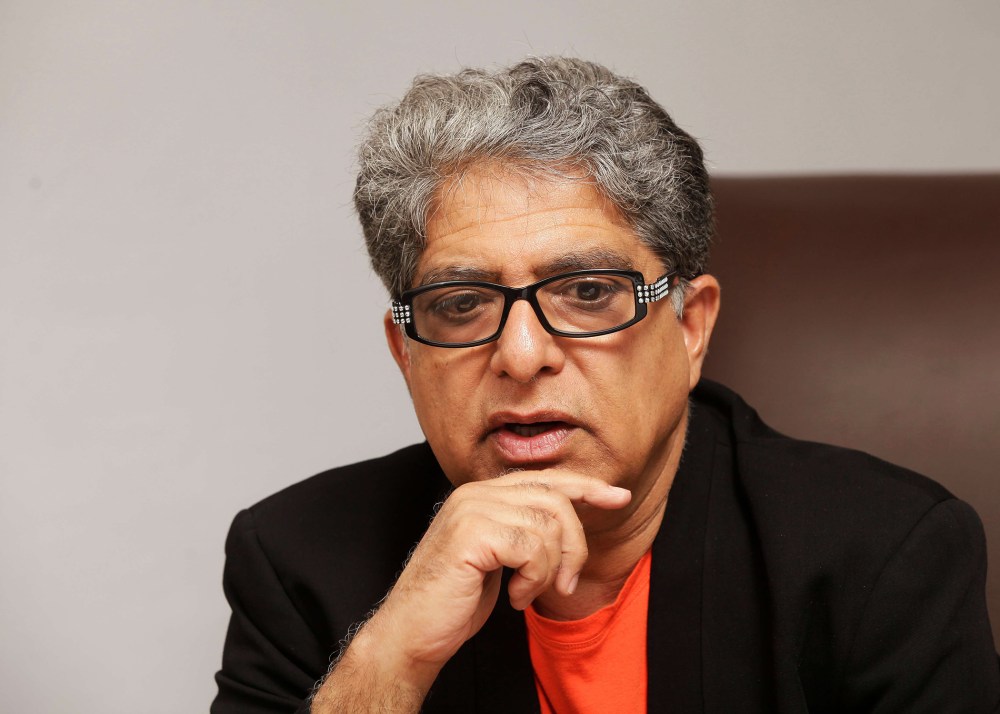
Deepak Chopra gestures during an interview in Bogota, Columbia, May 23, 2012.CEET
By
Allison MacDonald
With a political system — or at least one political party — that indulges in even its most unhealthy cravings, the question of self-control is one of powerful implications, at both the personal and national level.
In his new book, “What Are You Hungry For?” Dr. Deepak Chopra gives us a manual for “higher health” that focuses on answering the deeper questions as to why people over-indulge when it comes to eating.
In “What Are You Hungry For?”, Chopra provides insight and advice for how to eat and live with greater awareness.
The following is an excerpt from “What Are You Hungry For?”
Eating, Weight, and Hunger
If you want to return to your ideal weight, two choices face you. You can go on a diet or do something else. This book is about that something else. Dieting involves the wrong kind of motivation, which is why it rarely leads to the desired goal. You are taking the route of self-denial and doing without. Every day on a diet involves struggling against your hunger and fighting for self-control. Is there a more unsatisfying way to live?
Weight loss needs to be satisfying in order to succeed—this is the “something else” that works after dieting has failed. If you bring the body’s hunger signals back into balance, your impulse to eat becomes your ally instead of your enemy. If you trust your body to know what you need, it will take care of you instead of fighting back. It’s all about getting the messages straight that connect mind and body.
Medically, I was trained to analyze hunger in terms of the rise and fall of certain hormones. Hunger is one of the most powerful chemical messages sent by the body to the brain. It shouldn’t happen that a person can feel hungry right after eating a meal or that having a snack in the afternoon should lead to a second snack or a third. But I’ve experienced these things—as have millions of people—which means that the experience of hunger can exist even when the need for food doesn’t.
It’s this experience of hunger that you need to change when you find yourself overeating. Cravings and false hunger aren’t the same as giving your body the fuel it needs. Your body isn’t like a gas-guzzling car. It’s the physical expression of thousands of messages that are being sent to and from the brain. In the act of eating, your self-image is involved, along with your habits, conditioning, and memories. The mind is the key to losing weight, and when the mind is satisfied, the body quits craving too much food.
A mind-body approach will work for you because it asks you for only one thing: Find your fulfillment. To be fulfilled is something that food alone can’t do. You must nourish
• the body with healthy food
• the heart with joy, compassion, love
• the mind with knowledge
• the spirit with equanimity and self-awareness
With awareness, all of these things become possible. But if you neglect them, they move further and further out of reach.
It sounds like a paradox, but to lose weight, you need to fill yourself up. If you fill yourself up with other kinds of satisfaction, food will no longer be a problem. It was never meant to be. Eating is a natural way to feel happy. Overeating isn’t. For centuries life has been celebrated at feasts, and some of these celebrations, such as wedding banquets and retirement dinners, can be the highlight of a person’s life. What child doesn’t brighten up when the birthday cake appears? But the delight that food brings makes overeating a peculiar and unique problem. Feeling happy, which is good for you, slides into something that’s bad for you.
At this moment you fall somewhere on the sliding scale that connects food with happiness:
Normal eating —-à Overeating —-à Cravings —-à Food Addiction
Eating normally feels good.
Overeating feels good in the moment but leads to bad results in the long run.
Giving in to cravings doesn’t feel good at all—remorse, guilt, and frustration set in almost immediately.
Being addicted to food brings suffering, declining health, and total lack of self-esteem.
The slippery slope to becoming overweight starts with something that’s actually positive: the natural goodness of food. (You can’t say the same about drugs and alcohol, which can be toxic substances even when a person isn’t addicted to them.) Food nourishes us, and when eating goes wrong, we are torn between short-term pleasure (such as a delicious bite of chocolate ice cream) and long-term pain (the many drawbacks of being overweight for years at a time).
So why does normal eating start to slide into overeating? The simple answer: lack of fulfillment. You start overeating to make up for a lack somewhere else. Looking back on my medical residency, when I was still in my twenties, I can see now how bad eating habits insinuate themselves. I’d come home from a grueling shift at the hospital feeling stressed out. My mind was still filled with a dozen cases. Some patients were still in jeopardy. What awaited me at home was a loving wife and a home-cooked meal.
In terms of getting enough calories, sitting down to dinner met all the requirements. You had to look at the human situation to see the hidden problems. I had hit the coffee machine and grabbed snacks on the run at work. From lack of sleep I didn’t really notice what I was eating. The minute I walked in the door I usually had a drink, and there was a half-empty pack of cigarettes lying around somewhere.
In the seventies I was a normal working male following the same habits as every other young doctor I knew. I counted myself extremely fortunate to have such a loving wife and two beautiful babies at home. But the ravenous way I dug into a nourishing home-cooked dinner, combined with all the other signs of stressed eating, was setting a pattern that was desperately wrong. Ironically, even back then I considered myself pretty aware.
What turned the corner was becoming much more aware—the solution I’m proposing in this book. No matter how much it gets abused, the body can restore balance. The first rule is to stop interfering with nature. In its natural state, the brain controls hunger automatically. When your blood sugar falls below a certain level, messages are sent to an almond-sized region of the brain known as the hypothalamus, which is responsible for regulating hunger. When it receives messages of decreased blood sugar, your hypothalamus secretes hormones to make you feel hungry, and when you’ve eaten enough, the hormones reverse, making you no longer hungry. This feedback loop between blood and brain operates on its own, as it has for millions of years. Any animal with a spinal cord (vertebrate) has a hypothalamus, which makes sense, because hunger is so basic.
But in humans, hunger can get interfered with quite easily. The way we feel emotionally can make us ravenous or unable to eat at all. We can be distracted and forget to eat, or we can be obsessed and think about food all day. However, we are always in search of satisfaction. There are lots of things you can fill up on besides food. Desire comes from need, starting with the most basic ones:
Everyone needs to feel safe and secure.
Everyone needs to feel nurtured.
Everyone needs to feel loved and appreciated.
Everyone needs to feel that their life is relevant and meaningful.
If you have filled these needs, food will be just one delight out of many. But countless people turn to overeating to substitute for what they really want. It becomes a game of switch-up, and often they don’t even see what’s happening. Is that the situation you find yourself in? Here are some common indicators.
You don’t feel secure unless you are dulled by eating too much. Dullness brings a kind of calm that lasts a short while.
You don’t feel nurtured except when your taste buds are overstimulated with sugar, salt, and fat.
You don’t feel loved and appreciated, so you turn eating into “giving myself some love.”
Your life lacks meaning, but at least when you eat, the emptiness inside can be ignored for a little while.
If you stop focusing so hard on diet and calories, the story of overweight in America is the story of missed fulfillment. We have the best foods in the world at our disposal, but we gorge on the worst. We have blessed opportunities to grow and evolve, but instead we feel empty.
My goal is to bring you to a state of fulfillment. Once that begins to happen, you will stop eating for the wrong reasons. The solution is simple but profound: To lose weight, every step of the way must be satisfying. You don’t have to psychoanalyze yourself; you can stop obsessing about your body and dwelling in disappointment and frustration. There is only one principle that applies: Life is about fulfillment. If your life isn’t fulfilled, your stomach can never supply what’s missing.
Reprinted from the book What Are You Hungry For? The Chopra Solution to Permanent Weight Loss, Well-Being, and Lightness of Soul by Deepak Chopra. Copyright 2013 by Deepak Chopra. Published by Harmony Books, an imprint of the Crown Publishing Group, a division of Random House LLC, a Penguin Random House Company.