








For years, Republicans on Capitol Hill have tried to stay on President Donald Trump’s good side, defending his policies and avoiding criticism of even his most controversial actions.
In recent weeks that dynamic has shifted, with lawmakers criticizing Trump’s opposition to the release of the Jeffrey Epstein files, his recent military action in Venezuela and the Justice Department’s investigation into the chair of the Federal Reserve.
Although the GOP conference remains strongly in Trump’s corner overall, the rumblings come as Republicans have lost special elections and off-year races by wider-than-expected margins and remain down in the polls heading into the fall midterms, leading a record number of incumbents to retire.
The issues that have flared up show some potential fault lines that Republicans will have to navigate in the next few years. On the Epstein files, that was defending Trump’s personal controversies. On Venezuela, it’s military intervention and isolationism. And on the Fed, it’s the party’s ties to Wall Street.
The announcement of an investigation of Fed Chair Jerome Powell sparked the most immediate reaction.
The announcement of an investigation of Fed Chair Jerome Powell over the weekend sparked the most immediate reaction, as a handful of Republicans ranging from Trump critics to longtime loyalists raised concerns about the development, with some worrying that it was an attempt to undermine the central bank’s independence — a major issue for bankers and other corporate leaders.
In a sign of the outrage, some GOP lawmakers are taking their frustrations a step further.
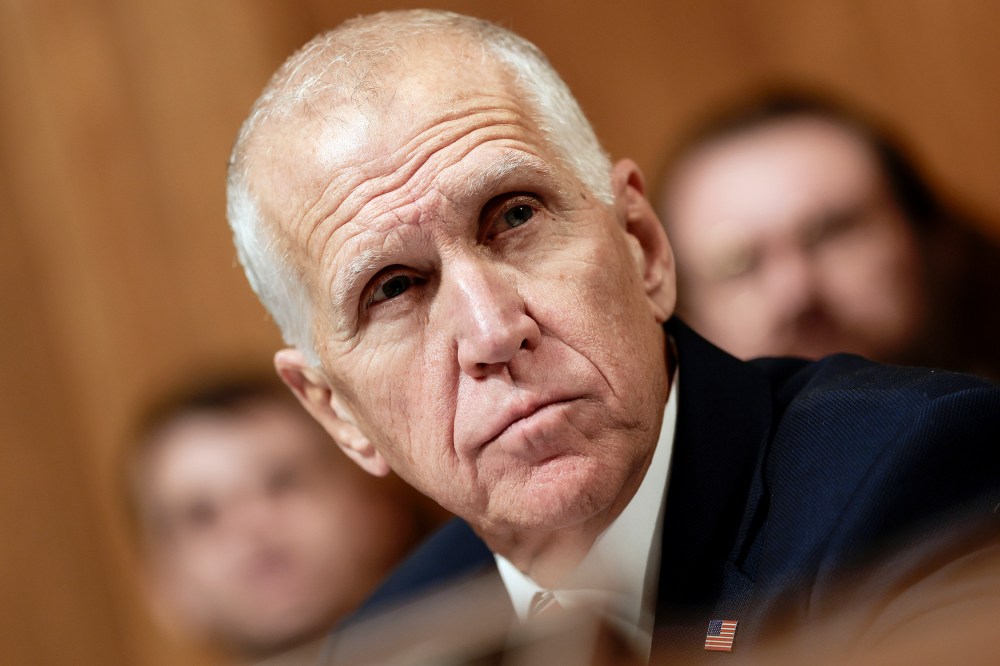
Republican Sen. Thom Tillis of North Carolina vowed to oppose any nominee to the Fed board “until this legal matter is fully resolved,” including for the chair spot, which will open in May when Powell’s term is up. In a statement, he said the investigation raises questions about the “independence and credibility” of the Department of Justice.
Republican Sen. Lisa Murkowski of Alaska, an influential voice among GOP centrists, backed Tillis’ decision, writing in a statement that her colleague was right to block Fed nominees.
“The stakes are too high to look the other way: if the Federal Reserve loses its independence, the stability of our markets and the broader economy will suffer,” she added.
The Fed flare-up came less than a week after five Senate Republicans voted with Democrats on Thursday to advance a resolution to rein in Trump’s power in Venezuela, a direct rebuke of the administration’s airstrikes in Caracas and arrest of the country’s president, Nicolás Maduro.
Republican Sens. Murkowski, Susan Collins of Maine, Rand Paul of Kentucky, Todd Young of Indiana and Josh Hawley of Missouri — the last of whom is a close ally of Trump’s — all voted to open debate on the legislation, teeing up a final vote on the war powers resolution.
In a social media post, he said the five senators “should never be elected to office again.”
The successful 52-47 vote drew intense ire from the president. In a social media post, he said the five senators “should never be elected to office again.” He also personally called the defectors, during which “more than one senator” was berated by the president, a source familiar with the tone of the calls told MS NOW on background in order to discuss the private conversations.
The source described the president as sounding “very upset, angry, yelling.”
Hours after the war powers resolution vote, the House held a pair of votes to overturn vetoes the president had issued days earlier. While both efforts fell short of the two-thirds threshold needed to reverse Trump’s rejection, the vote tally revealed a contingent of Republicans willing to break from the president.
Thirty-five Republicans voted to overturn Trump’s veto of a measure supporting a clean water project pipeline in Colorado, including Rep. Lauren Boebert, R-Colo., who blasted the president for blocking her bill. Twenty-four Republicans voted to overturn Trump’s veto of a bill to widen land for the Miccosukee Tribe of Indians in Florida.
Those instances, to be sure, are not the only moments of GOP push-back. In arguably the most striking break from Trump, Republicans overwhelmingly voted in November to force the release of the Epstein files, a move the president had lobbied against. But while these moments have shown a greater resistance to Trump among Republicans, there are other signs that he retains a strong hold on the party. Case in point: Shortly after the vote on Thursday, Hawley said he supported advancing the war powers resolution because “my read of the Constitution is that if the president feels the need to put boots on the ground there in the future, Congress would need to vote on it.” On Monday, though, he sounded like he might be changing his mind when asked if he would consider voting against the resolution when it came for a final vote later in the week. “Listen, I said on whatever day that was, Thursday, that if there were facts that I wasn’t aware of, I’m open hearing them,” Hawley told reporters. “And I will say that I thought the secretary of state telling me today, point-blank, that they don’t have ground troops on the ground, or there in Venezuela, they don’t want to put them in, they’re not planning to do so, and they will follow both the relevant statute and the Constitution if it should become necessary.” A reporter asked if that meant his current position is uncertain. “The interaction has been really positive,” he said of communication with the administration. “I will say the last couple of days. I mean, they’ve been, they’ve made a big effort.” Kevin Frey contributed to this report. This is a preview of MS NOW’s Project 47 Newsletter. As President Trump continues implementing his ambitious agenda, get expert analysis on the administration’s latest actions and how others are pushing back sent straight to your inbox every Tuesday. Sign up now.
Mychael Schnell is a reporter for MS NOW. Recommended


