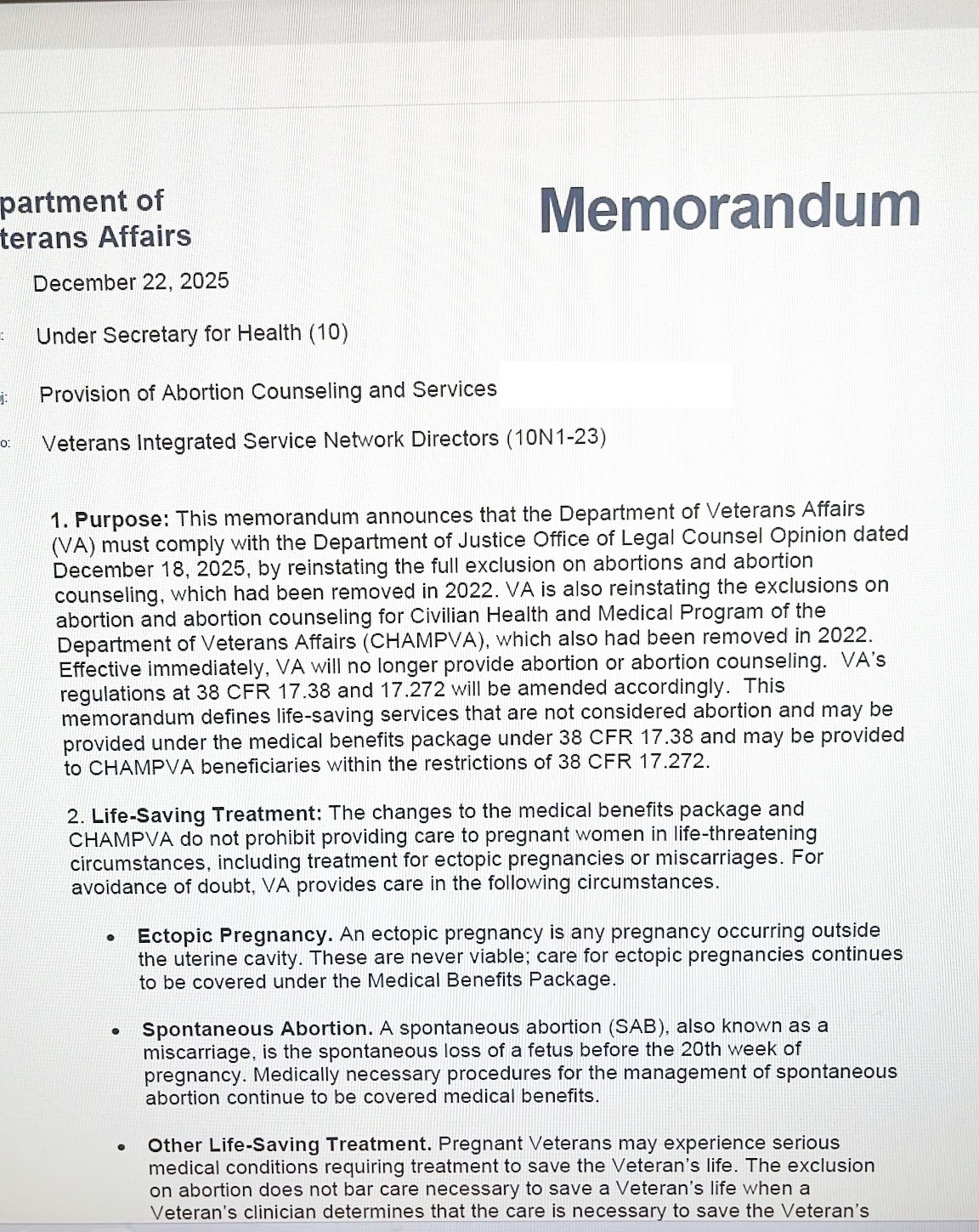
The Department of Veterans Affairs has implemented an abortion ban after the Department of Justice issued a memo last week that prohibited the VA from providing abortion services to veterans and their dependents who become pregnant as a result of rape or incest or in cases when their health is endangered by carrying a pregnancy to term.
The memo, issued December 18 and authored by Joshua Craddock, deputy assistant attorney general of the DOJ’s Office of Legal Counsel, states that the Biden-era rule that allowed the VA to provide limited abortion counseling and services to more than 9 million veterans and their beneficiaries is not valid.
Screenshots of what appears to be an internal memo sent Monday to the leaders of the VA’s 18 regional care systems by the VA’s under secretary of health — obtained by the national legal nonprofit Democracy Forward and provided to MS NOW — state that the VA must comply with the DOJ memo effective immediately. The directive also states that the changes to the VA policy “do not prohibit providing care to pregnant women in life-threatening circumstances, including treatment for ectopic pregnancies or miscarriages.”
The government argued in its proposed rule to implement the ban, issued in August, that the VA “has never understood this policy to prohibit providing care to pregnant women in life-threatening circumstances” and said “for the avoidance of doubt” this exception would be spelled out in the new policy.
Pete Kasperowicz, press secretary for the VA, confirmed to MS NOW in a statement Tuesday morning that the VA is no longer providing abortions as a result of the memo.
“DOJ’s opinion states that VA is not legally authorized to provide abortions, and VA is complying with it immediately,” Kasperowicz said. “DOJ’s opinion is consistent with VA’s proposed rule, which continues to work its way through the regulatory process.”
Kasperowicz did not immediately respond to further questions.
The VA’s compliance with the memo speeds up what would have otherwise been a lengthier implementation of the ban. After the proposed rule was published in the Federal Register in August — the first step in the federal rule-making process — that triggered a 30-day public comment period that attracted more than 24,300 comments. The next step in that process is the publication of the final rule in the Federal Register, and the implementation of the ban, at the earliest, 30 days later. But the final rule has still yet to be published in the Federal Register.
VA data shows that women are the fastest-growing group of veterans, with more than 2 million living in the U.S., and that about one in three women report experiencing sexual assault or harassment during their military service. As of last year, more than half of women veterans of reproductive age lived in states that ban abortion or are likely to, according to the National Partnership for Women and Families — meaning VA health care plans provided some abortion services they would otherwise have been unable to get in-state.
Abortion rights advocates slammed the news on Tuesday.
“The Trump administration is confirming what we’ve always known: its promise to leave abortion to the states was a lie. No one is safe from their anti-abortion crusade, not even our nation’s veterans,” said Fatima Goss Graves, president and CEO of the National Women’s Law Center, in a statement.
Katie O’Connor, director of the federal abortion policy at the National Women’s Law Center, called the VA’s insistence that abortions have always been allowed in life-threatening circumstances “intentionally vague.”
“A life exception is never going to be enough to save lives,” she said, adding that the lack of clarity puts doctors and patients in difficult positions. “Denying veterans essential health care and abortion access – even in cases of rape or serious health risk – after they have sacrificed so much for our country is callous and inhumane,” wrote Skye Perryman, president and CEO of Democracy Forward, in a statement. Lindsay Church, co-founder and executive director of the nonprofit Minority Veterans of America, called the VA ban “a direct attack on veterans’ freedoms, including our right to make our own health care decisions.” The latest news follows a proposed rule, filed by the Trump administration in August, to reverse a Biden-era rule from September 2022 that was part of a bid to safeguard abortion access after the Supreme Court overruled Roe v. Wade that June. The Biden administration’s rule said the VA could provide abortion services when pregnancies were a result of rape or incest or when the life or health of the pregnant person would be endangered. At the time, then-VA Secretary Denis McDonough called it “a patient safety decision.” The Trump administration’s filing of the proposed reversal unleashed a torrent of opposition from abortion rights supporters, who said it would amount to one of the strictest nationwide abortion bans, given its potential impact in states where abortion is not otherwise banned. More than a dozen states currently ban abortion in almost all circumstances. Abortion opponents, on the other hand, praised the move and said that the Biden-era rule amounted to federal overreach. The Trump administration’s abortion ban for veterans has been a long time coming: Project 2025, the more than 900-page extremist guidebook to the second Trump term, recommended that the VA reverse the policy, and current VA Secretary Doug Collins has been vocal about his opposition to abortion, signaling at his confirmation hearing earlier this year that he intended to change the policy.
Julianne McShane is a breaking news reporter for MS NOW. Recommended