








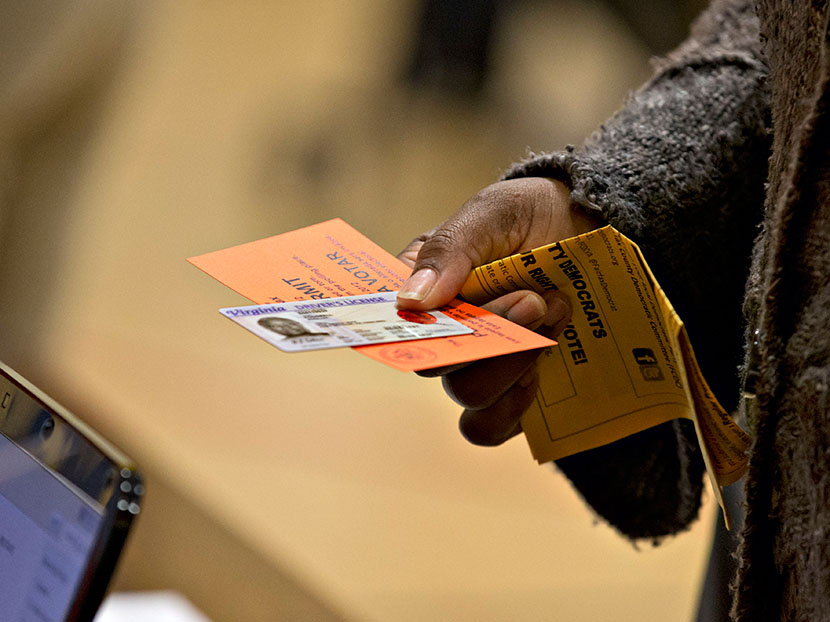
One voter ID law denounced as a “poll tax” looks to be back in force. And several others are gathering steam.
Those are the early consequences of Tuesday’s Supreme Court decision eviscerating the Voting Rights Act. In the 48 hours since the ruling was announced, Republicans in several states have said they’ll move ahead with voter ID laws that disproportionately affect blacks and Hispanics. And other states look poised to join them.
In another sign of the ruling’s impact, President Obama suggested the landmark civil rights law might have played a role in his own historic election. “I might not be here as president had it not been for those who courageously helped to pass the Voting Rights Act,” President Obama said at a news conference in Senegal, where he’s on a state visit, adding that he believes the court “made a mistake” in weakening the law.
The court struck down as unconstitutional the formula by which Congress decided which areas of the country are covered under Section 5, which subjects to federal scrutiny any election changes made by certain jurisdictions with a history of race bias in elections. That means those areas—which contain a total of roughly 80 million people—are now free to change their election rules without federal oversight, unless Congress acts to fix the formula.
Texas is ground zero for measuring the impact. Just hours after the ruling was announced, Attorney General Greg Abbott said the state’s voter ID law “will go into immediate effect.” The law—the strictest in the country, and described by Attorney General Eric Holder as a “poll tax”—had been blocked last year under Section 5, after a federal court found it discriminated against blacks and Latinos, who, numerous studies show, are more likely than whites to lack ID. On Thursday, the Supreme Court officially threw out that ruling.
Voting rights advocates haven’t given up on blocking the law. On Wednesday, they charged in a new lawsuit that it violates a Voting Rights Act provision that the Supreme Court left intact, which bars deliberate racial discrimination in voting.
Related: That was quick: Texas moves ahead with discriminatory voting laws
Democrats had feared that Texas Republicans might also respond to the Supreme Court ruling by reviving a partisan redistricting plan passed in 2011 and blocked by Section 5 after a court found that it, too, deliberately discriminated on the basis of race. Reinstating the map would have meant that Sen. Wendy Davis—who became a new progressive star after her 13-hour filibuster Tuesday night to block a strict abortion bill—faced a far tougher re-election fight next year. But on Wednesday, Gov. Rick Perry signed a compromise plan drawn up by a court last year and used in last fall’s election, suggesting the GOP had decided to cut its losses on the issue.
It’s not just the Lone Star State. In North Carolina, which was covered in part under the Voting Rights Act, the lead sponsor of a proposed voter ID law said Tuesday he’d move ahead with the measure as a result of the ruling. And Mississippi Attorney General Delbert Hosemann indicated the same day that a voter ID law passed last year and awaiting federal approval could now move forward.
In South Carolina, the Supreme Court’s ruling may allow the state to enforce an existing voter ID law more strictly. Last year, a federal court, citing Section 5, blocked the law for the November election. It said the measure could go into effect in 2013, but only because the state promised to broadly interpret a provision making an exception for voters without ID, allowing them to vote if they affirm they weren’t able to obtain one. The court added that if South Carolina wanted to interpret the provision more narrowly, making it harder for those without ID to vote, it would need federal sign off under the Voting Rights Act.
Adam Piper, a spokesman for South Carolina Attorney General Alan Wilson, told msnbc that the assurance the state gave the court about its interpretation of the provision “still applies.” Nonetheless, now that federal sign-off is no longer needed, state officials can likely interpret it however they choose in the future.
In a statement issued Tuesday, Wilson lauded the ruling. “Today’s decision means the voting rights of all citizens will continue to be protected under the Voting Rights Act without requiring a different formula for states wishing to implement reasonable election reforms, such as voter ID laws similar to South Carolina’s,” he said.
Related: Supreme Court guts landmark civil rights law
Then there’s Virginia, which recently passed its own voter ID law, scheduled to go into effect next year. Opponents of the law had held out hope that it might be blocked under Section 5. Now that’s moot, the measure appears likely to be in force for next fall’s midterms. “We will be working with the Attorney General’s Office to determine what, if any, impact the decision will have on the implementation of this legislation in July of 2014,” Paul Shanks, a spokesman for Gov. McDonnell, said in a statement. It’s even possible, though unlikely, that the demise of Section 5 could embolden Republicans to revive a scheme to rig presidential elections by changing the way Virginia awards its electoral votes. As msnbc reported in January, the plan—which would split up electoral votes based on the popular vote in each congressional district—likely would have run afoul of Section 5, by reducing the voting power of racial minorities. McDonnell, though, has poured cold water on the idea. Those looking to make voting more difficult aren’t the only ones to respond energetically to Tuesday’s ruling. Voting rights advocates in Congress pledged to begin working on legislation to create a new formula for coverage under Section 5. In a statement provided to msnbc Wednesday, Rep. Jim Sensenbrenner, the Wisconsin Republican who led the 2006 effort to reauthorize the law, pledged to “work in a bipartisan fashion to update Section 4 to ensure Section 5 can be properly implemented to protect voting rights, especially for minorities.” President Obama, Minority Leader Nancy Pelosi, and Senate Judiciary chair Pat Leahy are among the powerful Democrats to echo that view. And Thursday, a progressive group affiliated with the Democratic campaign committee for state legislative races announced the launch of a 50-state effort to “confront and defeat efforts to suppress the vote.” Research assistance by John Axelrod
Zachary Roth Recommended


