








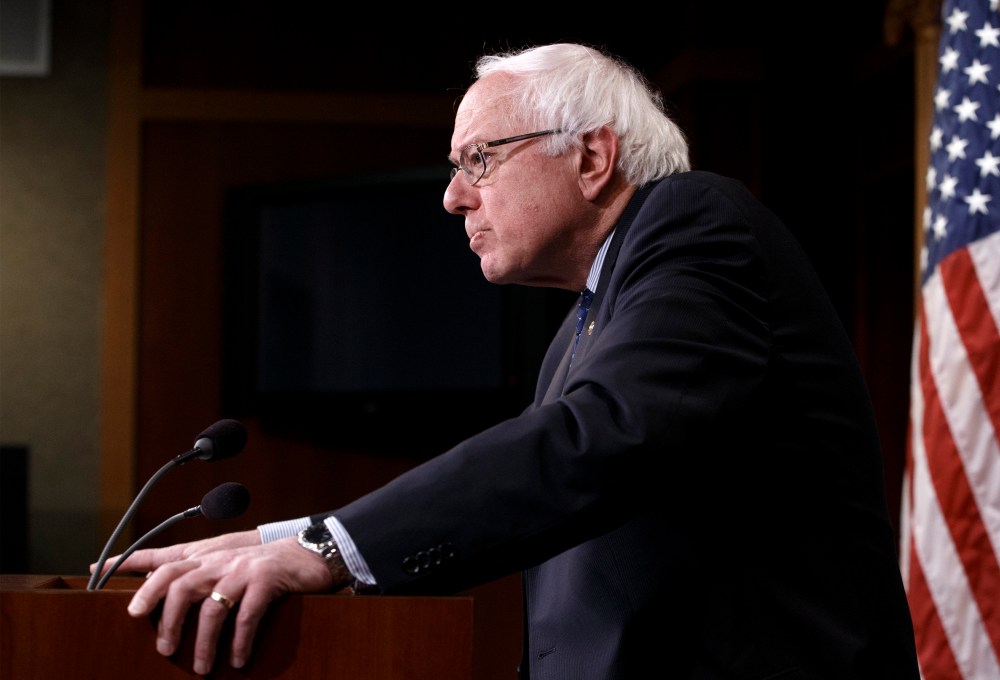
Sen. Bernie Sanders is not interested in being Ralph Nader or Dennis Kucinich.
At an appearance at the Brookings Institution Monday to discuss the Vermont independent senator’s potential 2016 presidential run, the names of the two failed presidential candidates loomed as he explained his refusal to be a protest candidate.
“Let me make it very clear. I will not be a spoiler,” he said in a response to a question about whether he’s worried about becoming the “son of Nader.” “I don’t want to run a futile campaign. If I run, I want to run to win.”
The senator, who currently has support from only 3% or 4% of Democrats against likely front-runner Hillary Clinton, knows he would have a difficult go of it, but insisted he’d only run if there’s an outpouring of support.
But Sanders said he is drawing inspiration from the campaigns of more successful candidates like Franklin Roosevelt, as well as that of Jesse Jackson, who came farther than any African-American candidate during runs in 1984 and 1988, though he didn’t win ultimately.
“Jackson ran brilliant insurgent campaigns in which he did far better than people expected — and broke down barriers which enabled Barack Obama to win in 2008,” Sanders told msnbc via a spokesperson. “In 1936, FDR ran a brilliant and widely successful campaign in which he, very straight-forwardly, took on the ‘economic royalists,’” Sanders added.
RELATED: Bernie Sanders steps up: I am not Hillary, ‘trust me’
Here’s what’s going into his decision-making process.
First, he needs to see real support on the ground. “To do it well, we would have to put together the strongest grassroots movement in the modern history of this country, with millions of people saying, ‘You know what? Enough is enough, we’re all going to take on the billionaire class,’” Sanders said at Brookings.
The senator was greeted warmly on recent visits to Iowa and New Hampshire, where he promoted his 12-point economic plan, which calls for breaking up big banks, adopting single-payer health care, making education far less expensive, and expanding Social Security.
%22I%20don%E2%80%99t%20want%20to%20run%20a%20futile%20campaign.%20If%20I%20run%2C%20I%20want%20to%20run%20to%20win.%22′
He’s not yet convinced the support is there for a run. “Maybe the game is over. Maybe they have bought the United States government. Maybe we’ve gone off the edge. I don’t know,” he said.
Next, Sanders needs to see some real fundraising support.
Tad Devine, who ran Al Gore’s 2000 presidential campaign and is now advising Sanders, estimates Sanders needs $50 million to run a serious campaign in the early phase of the primary.
That breaks down to $22 million in paid advertising to introduce Sanders and his message to voters in the first four nominating states, and then another $28 million for everything else, with a particular focus on grassroots organizing.
Sanders noted that the average donation to his Senate campaign was just $45, so it will likely take millions of supporters for him to raise enough cash. He may start testing his ability to raise money soon through his PAC and Senate campaign, which has $4.5 million in the bank that could go towards a presidential effort. There’s also a personal consideration. The senator travels home to Vermont almost every weekend, but would have to start spending more of that time in Iowa and New Hampshire. “I am giving serious thought” to running, he said Monday. “Don’t tell my wife that — she doesn’t necessarily agree.” He was joking, but family objections have kept plenty of would-be candidates out of the race. RELATED: Bernie Sanders remakes Budget Committee in his image In addition, Sanders would have to build a robust infrastructure to harness and build the grassroots support he says he needs to succeed — and that takes time. “He has the message, the question is whether he has the mechanism,” Devine explained, acknowledging that “the clock is ticking” on building an operation. Sanders aims to practice a kind of “coalition politics,” which he said was instrumental to his successful mayoral bud. Both Sanders and Devine said they did not expect Sen. Elizabeth Warren to run for president, but added that they harbor no ill will towards activists trying to draft her. “If they’re going to hold a lot of people in place for a while in free parking, and then Bernie can go collect the rent later, that’s fine with me,” Devine said. Even if he does raise $50 million, and does see an unprecedented level of grassroots support, he would still have a hard time beating Clinton. Nonetheless, Sanders is not afraid to lose in pursuit of some higher goal. After all, he lost two senate runs, two governor runs, and one House campaign before making it to the Senate — and the stage at Brookings on Monday.
Alex Seitz-Wald Recommended


