








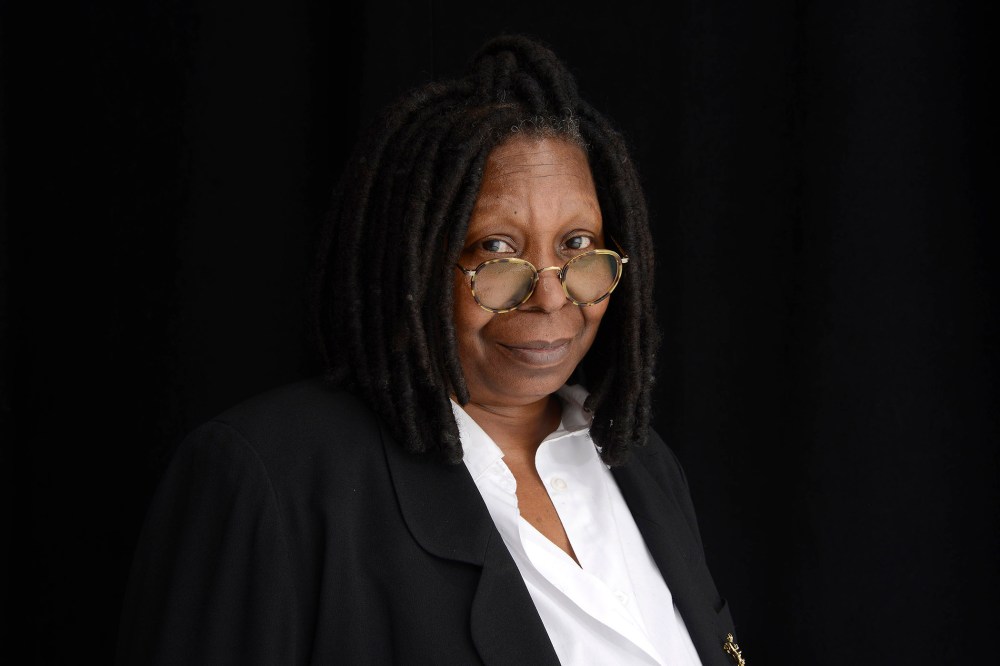
Actress Whoopi Goldberg’s decision to enter the medicinal marijuana business could end up impacting much more than her bottom line.
The Oscar winner and current co-host of “The View” announced Wednesday that she was partnering with Om Edibles founder Maya Elisabeth to roll out a series of new marijuana-infused products including a balm, a tincture, a bath soak and sipping chocolate, aimed at women suffering from menstrual cramps. The Whoopi & Maya brand will be available to consumers in California who are legally licensed to purchase medical marijuana products. MSNBC reached out Elisabeth and Goldberg for comment on their new venture but has not heard back at this time.
While Goldberg is not the first celebrity to lend their name to a cannabis product — legendary stoner comedian Tommy Chong has his own line of legal weed paraphernalia, for instance — she is the the most mainstream name to date, who isn’t necessarily associated with drug culture, to take the plunge. Her decision to lend her name to these products is also significant because so few people of color have been able to puncture the sellers market in this burgeoning industry.
RELATED: Whoopi Goldberg resurrects ‘African-American’ vs. ‘American’ debate
“I think it’s huge,” Art Way, the state director of the Drug Policy Alliance in Colorado, told MSNBC on Wednesday. “It helps the industry and only brings more credibility to the industry.” He believes that Goldberg could help erase the “respectability politics” stigma around legal drug selling which does exist in some segments of the black community.
According to BuzzFeed, fewer than three dozen of the over 3,000 legal marijuana dispensaries (or 1 percent) in the U.S. are owned by African-Americans. The reasons behind this phenomenon are diverse — it’s difficult to obtain bank loans to go into the marijuana business, it’s still considered a risky venture, there is paranoia about embracing an industry that is still perceived as criminal in many parts of the country and more religiously conservative members of the black community still promote the concept of marijuana as a kind of gateway drug to more dangerous substances.
“African-Americans know that whenever something is in a gray area of the law they will feel more vulnerable, and for good reason since statistically minorities are more likely to be targeted or seen as suspects,” Ethan Nadelmann, the executive director of the Drug Policy Alliance, told NBC News last year. “It may be that the general element of racism and racial disproportionality in law enforcement around drugs can make minorities queasy about entering an area which is not fully legal.”
Historically, African-Americans have disproportionately been arrested and prosecuted for possessing marijuana, but now that legal weed has gained a foothold in Colorado, there has been a palpable change in the relationship between law enforcement and drug users of color, according to Way.
“The law enforcement culture can no longer use the smell of marijuana as a ticket to engage in all kinds of intrusive behavior,” he said. “You’re still going to have continued disparities, but overall its been a great benefit to thousands of people in the state of Colorado primarily black and brown men.”
Still, as far as Goldberg is concerned, her products have practical goals, not politically motivated ones. “For me, I feel like if you don’t want to get high high, this is a product specifically just to get rid of discomfort,” she told Vanity Fair on Wednesday. “Smoking a joint is fine, but most people can’t smoke a joint and go to work.” “This, you can put it in your purse,” she added. “You can put the rub on your lower stomach and lower back at work, and then when you get home you can get in the tub for a soak or make tea, and it allows you to continue to work throughout the day.” She now joins legendary hip-hop potheads Snoop Dogg and Wiz Khalifa as a famous black face of weed culture. “I think getting involved with the boutique industry from the ground floor is appealing to celebrities,” Way said. He added that their celebrity contributions to the legalization cause will make it harder to “turn back the clock” on advances made under the Obama administration. “The sky is the limit when it comes to medical marijuana, we’re learning more and more everyday,” he said. “It just speaks to the wonders of this plant.”
Adam Howard Recommended


