








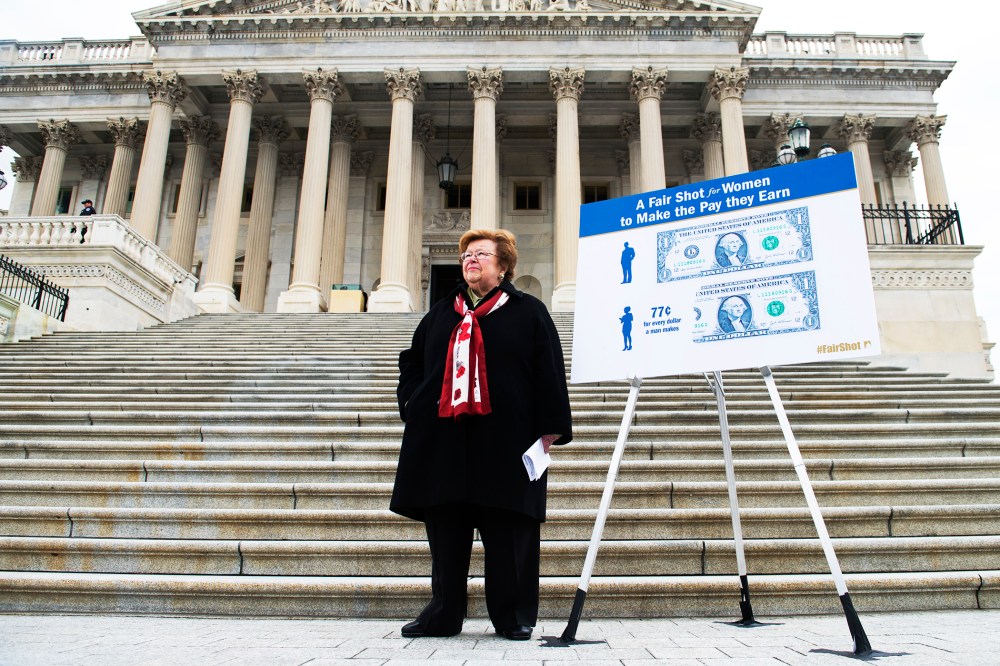
As President Barack Obama issues two executive actions intended to bolster pay equity for women, while encouraging the Senate to pass the Paycheck Fairness Act, you’re likely to hear the following defenses from Republicans: The pay gap is a myth, largely determined by women’s choices, paying women less for the same job is already illegal, and these laws will only encourage frivolous lawsuits. Just ask Texas Gov. Rick Perry, who recently called the focus on equal pay “nonsense,” or Wisconsin Gov. Scott Walker, who called it “bogus.” Or Kentucky Sen. Mitch McConnell, who said, after every single Senate Republican opposed the Paycheck Fairness Act in 2012, “We don’t think America has any problems related to too little litigation.”
Here’s why they’re wrong.
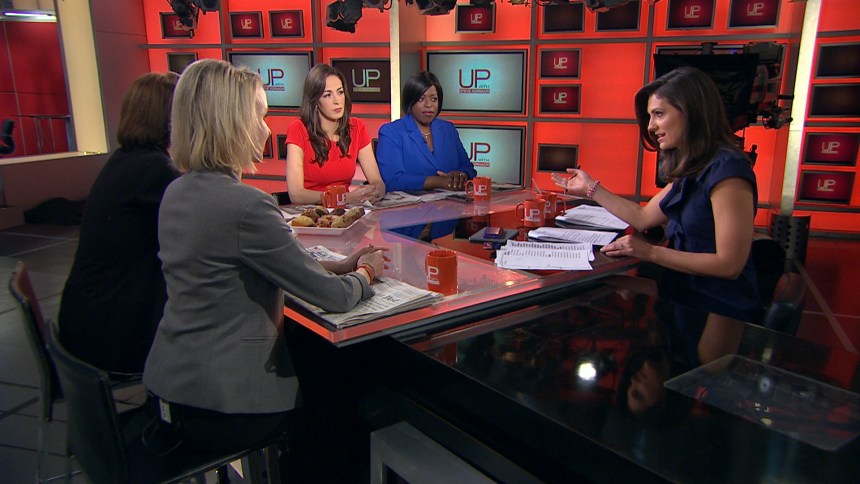
Not all of the pay gap can be explained by women’s choices, and many of those choices are made under discriminatory constraints. Conservatives often attack the “77 cents on the dollar figure” because it doesn’t account for the fact that women are concentrated in lower-paying jobs or may work fewer hours. But as White House economic adviser Betsey Stevenson recently explained in an interview with msnbc, “Some of women’s choices come because they experience sexism. Some of women’s choices come because they are disproportionately balancing the needs of work and family. Which of these choices should we consider legitimate choices, and which of them should we consider things that we have a societal obligation to try to mitigate?” She added, “Much of what we need to do to close that gap is to change the constraints that women face. And there are things we haven’t tried.”
When all other factors are identical, the gap shrinks but does not disappear. A study by the American Association of University Women found that among recent college graduates with matching credentials, a quarter of the pay gap, or 5%, remained. Ten years later, it grew to 12%. Meanwhile, pay gaps widen in situations where there is overall income inequality – including in this country, where women make up nearly two-thirds of minimum wage workers and are underrepresented in the highest-paying fields, such as technology and finance.
Plenty of women don’t even know they’re being discriminated against. Obama’s executive actions address what economists suspect is partly driving the pay gap: lack of good information about how much everyone is making. Lilly Ledbetter, the Goodyear Tire worker whose loss at the Supreme Court helped famously change the law to extend the time window for suing over wage discrimination, was prohibited from discussing wages with her co-workers. She only learned she was being paid less than her male counterparts when one of them left her an anonymous note.
Secrecy around pay tends to benefit the already privileged, in particular white men, who may feel confident asking for more, may be implicitly valued more by management, or may have an inside track on the information. African-American women make 62 cents, and Latina women only 54 cents, for every dollar earned by a white man. “Very few people have enough information to know that they’re making less, much less bring a pay discrimination charge,” says Fatima Goss Graves of the National Women’s Law Center.
As such, Obama’s executive order prohibits federal contractors from retaliating against workers who share pay information. The president is also instructing the Department of Labor to start collecting aggregate data from the same contractors on how much they pay their employees by sex and race. Together, those contractors employ nearly a quarter of the workforce.
The hope is that employers will realize they may be exercising unconscious bias – or even if it is conscious bias, that the public data will shame them into doing better. “Both of these policies are letting the market do better on its own before it needs to get to the point of costly litigation,” Stevenson said on a call with reporters Monday.
Even if women do know they’re being discriminated against, it’s never been harder to sue. “Most women do not want to sue their employers,” Deborah Thompson Eisenberg, a law professor at the University of Maryland, testified before the Senate last week. “They want the law to express a stronger commitment to equal pay for equal work so employers will have an incentive to pay them fairly without the need for litigation.” After all, suing can be tantamount to “career suicide” – and it carries a lot of stress and risk.
“I often say to my clients, if you thought you were in a hostile workplace when you showed up at your job, when you look at the data you’ll see it’s an even more hostile environment in court,” said Cyrus Mehri, founding partner at Mehri & Skalet, which has litigated many employment discrimination cases. “There’s no question that there’s under-enforcement, not over-enforcement, of the law. Plaintiff’s lawyers turn down many, many cases that have merit, because they have to be so strong that they can withstand all the hurdles along the way.”
Even if a lawyer does take on an employee’s case on contingency, employers begin at a huge advantage: They have all the information, and many more resources. In an Equal Pay Act claim, or a sex discrimination claim brought under Title VII of the Civil Rights Act, the employee has to find a “comparator,” another employee – say, a man — at the same company, whose job is the same and who has similar qualifications, but who is getting paid more. But proving that they are equivalent can be an uphill battle. “Some courts have interpreted ‘substantially equal work’ so narrowly that it’s really difficult to make a claim,” said Eisenberg. The Paycheck Fairness Act would broaden the pool a little.
The burden then shifts to the employer to show there’s a legitimate reason for paying the two people differently. But in many cases, employers have been able to vaguely blame “the market” or argue that because the woman was poorly paid in her previous job, it isn’t discrimination. The Paycheck Fairness Act would raise the standard for those justifications to make sure they actually had to do with the job being done. Even if women do sue, it’s never been harder to win. The idea that women are cashing in on phony pay discrimination claims couldn’t be further from reality. In fact, the cases that are brought are tough to win, and getting tougher. According to Eisenberg’s research, from 1990 to 1999, employees won a little more than half of all equal pay claims. But from 2000 to 2009, that dropped to about a third. And in that same decade, courts granted summary judgment — i.e. a ruling without a trial — to employers in such cases 72% of the time. That matches the grim overall picture for any kind of employee civil rights claim, according to an empirical study in the Harvard Law and Policy Review. It found that compared to other plaintiffs, the odds were stacked against employees making discrimination claims at every stage of litigation. (The win rates were slightly better when a jury was making the call.) And the numbers became a self-fulfilling prophecy: Lawyers are ever more reluctant to take a case they’re likely to lose. Since 1999, the authors found a “startling drop” in the number of such cases filed in federal court. That’s not because discrimination has disappeared: The number of pay discrimination claims brought to the federal Equal Employment Opportunity Commission has barely budged in the same time frame. And that’s just the women who knew they were being discriminated against. Why are the courts so hostile? It may be because their criteria are poorly matched to the realities of the modern workforce. Former federal judge and Harvard law professor Nancy Gertner has written that “just as the social-psychological literature is exploding with studies about implicit race and gender bias — in organizational settings, in apparently neutral evaluative processes, and among decision-makers of different races and genders — federal discrimination law lurches in the opposite direction, often ignoring or trivializing evidence of explicit bias.” The data also shows how much conservative, Chamber of Commerce types have triumped over the judiciary. That’s partly, but not wholly, because the Bush administration did such a good job of appointing such judges. Obama’s judicial picks, few of whom have experience in such civil rights claims, aren’t encouraging to advocates who specialize in these cases. “Packing the court with corporate lawyers does little to protect Title VII or employees’ access to the courthouse door,” wrote Cyrus Mehri and Ellen Eardley in an issue brief for the American Constitution Society. The bottom line is clear: Existing laws are a weak tool to fight actual pay discrimination, either as a deterrent or in court. Or as Eisenberg puts it, “I can tell you from my practice experience that the Equal Pay Act is kind of considered a dead letter.”
Irin Carmon Recommended


