








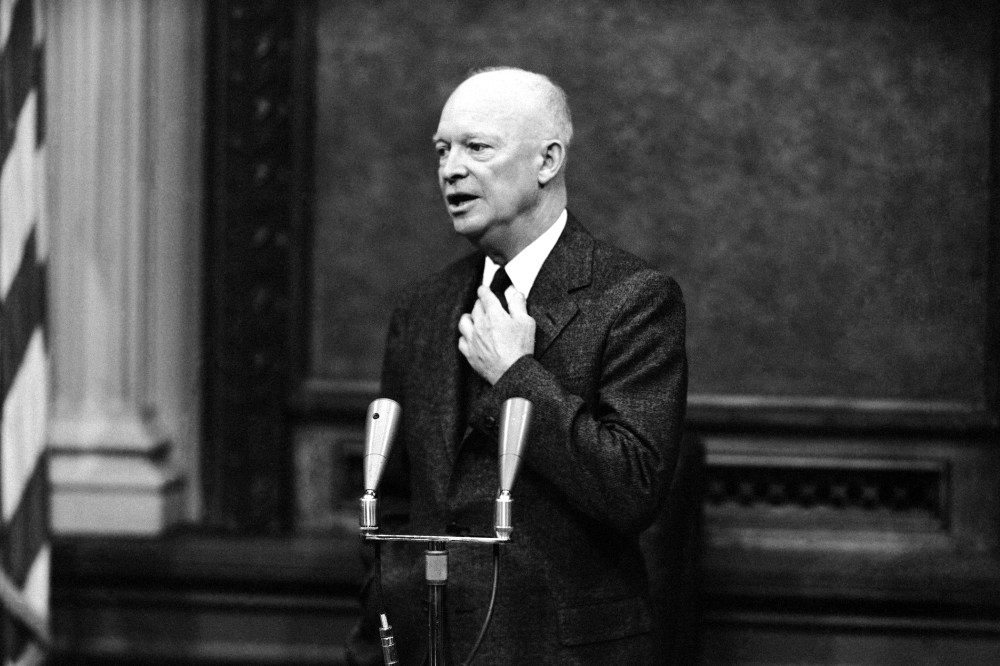
Sixty years ago, with its historic ruling in Brown v. Board of Education, the U.S. Supreme Court outlawed segregation in public schools. President Dwight D. Eisenhower didn’t sound too happy about that.
“The Supreme Court has spoken and I am sworn to uphold the constitutional processes in this country; and I will obey,” Eisenhower said shortly after the ruling.
Despite his own Justice Department having sought this ruling, to most observers, it didn’t sound like Ike was much of a fan. And to the South, it signaled that the popular president and war hero wasn’t ready to fight for integration.
Ike’s frosty response to Brown has always cast a shadow over the progress he made on civil rights. After all, he worked to desegregate the nation’s capital and fulfilled his predecessor Harry Truman’s order to desegregate the military.
The liberal federal judges Eisenhower appointed would serve as a bulwark against the segregationists later appointed by President John F. Kennedy, who was beholden to southern senators from his party. But as a strong believer in federalism, Ike was reluctant to use federal power to intervene on behalf of civil rights in the states, and his civil rights accomplishments were ultimately dwarfed by another successor, Lyndon Johnson, who during the 1950s served as Ike’s nemesis in the Senate as Eisenhower sought the first civil rights bills since Reconstruction. Tepid measures, they would nevertheless pave the way for Johnson, who as president would defy his own racist history and sign civil rights laws much broader than those Eisenhower had proposed.
In two terms as president, Eisenhower combined what was, at the time, the strongest record on civil rights since Reconstruction with a baffling rhetorical deference to white supremacists and a cold relationship with civil rights leaders.
“He made substantial progress in the area of civil rights, more than any other individual president between Lincoln and Johnson,” said Michael Mayer, a history professor at the University of Montana. “But compared to Johnson? No.”
Eisenhower opposed discrimination but seemed to sympathize far more with the white southerners whose lives would be disrupted by the end of Jim Crow than blacks dwelling under its boot heel. He was an incrementalist skeptical of federal power who often repeated the ideological belief that laws could not shape culture, despite pursuing laws that would extend–albeit modestly compared to Johnson-era efforts–federal authority to protect Americans’ civil rights. Eisenhower would say, “You cannot change people’s hearts merely by laws.”
Whether or not civil rights laws could change hearts and minds, properly enforced they could stay fists, guns, nooses and mobs. They could secure the right to cast a ballot. They could integrate restaurants and train cars, parks and schools.
Eisenhower chose liberal Republican Earl Warren to be chief justice of the Supreme Court. It was Warren who cobbled together the unanimous Brown ruling, which destroyed the legal basis for Jim Crow by finding that “separate education facilities are inherently unequal.”
Historian David Nichols, who defends Eisenhower’s civil rights record in his book A Matter of Justice, blames Warren for ruining Ike’s reputation on civil rights. Eisenhower thwarted Warren’s ambitions to step down as Chief Justice and run for president, and Nichols believes Warren never forgave him.
Before the Brown decision was reached, Eisenhower invited Warren to dinner at the White House. Eisenhower, Warren would later recall, told him that white southerners “are not bad people. All they are concerned about is to see that their sweet little girls are not required to sit in school alongside some big overgrown Negroes.”
Nichols writes that “no words damaged Ike’s reputation so much” as Warren’s story. But Eisenhower himself later remarked that the Warren appointment was “the biggest damned-fool mistake I ever made.” He told a speechwriter, Emmet John Hughes that Brown “set back progress in the South at least fifteen years.”
Though in 1967 Eisenhower would say that “there can be no question the judgement of the court was right,” in the six years following Brown, Lyndon Johnson biographer Robert Caro wrote, Eisenhower would never “publicly support the ruling; not once would he say that Brown was morally right[.]” Privately, Eisenhower would write before Brown was decided that that “improvement in race relations is one of those things that will only be healthy and sound if it starts locally. I do not believe that prejudices, even palpably unjustified prejudices, will succumb to coercion.”
It seemed to escape Ike that coercion was exactly what Jim Crow was. Whether or not prejudices could succumb to coercion, equal treatment of blacks under the law could and would, albeit imperfectly to this day, be enforced by the vigorous use of federal power Eisenhower would repeatedly claim he didn’t believe in.
Thanks to the Supreme Court’s waffling proclamation that integration should advance “with all deliberate speed,” progress in integrating schools would not occur until Johnson took office— a process today being dramatically reversed. Historians write that Eisenhower’s ambivalent response to Brown would give aid and comfort to the segregationists who vowed “massive resistance” to school integration.
“Eisenhower’s lack of enthusiasm for Earl Warren’s decision certainly did not help the cause of school desegregation,” said Tomiko Brown-Nagin, a professor at Harvard Law School.
Eisenhower was, like many other whites at the time, uncomfortable with other aspects of black equality. As Warren’s anecdote reveals, miscegenation was a preoccupation; Ike would later tell Jet correspondent Simeon Booker that even former NAACP leader Walter White agreed that blacks and whites should not intermarry. Booker retorted that White’s daughter had done just that.
Worse for Ike’s reputation was that he maintained a chilly relationship with civil rights leaders and seemed aloof in responding to the racist violence that rocked the South before and after Brown. In 1955, after black teenager Emmett Till was lynched in Mississippi for supposedly whistling at a white woman, his mother Mamie Till wrote Eisenhower asking for support. He did not respond, even as Till’s murder helped mobilize blacks around the country. The FBI, Booker wrote, had told Ike Mrs. Till was a tool of communist subversion.
Ike offered only mild, abstract support for black activists integrating lunch counters (though that was more than many of his Democratic counterparts) and did not hold a serious policy meeting with black civil rights leaders until his second term. When Martin Luther King Jr. wrote Eisenhower asking he “lend the weight of his great office” to ameliorating the “state of terror” in the South, Eisenhower said, “I don’t know what another speech would do about the thing right now.” This was a war, and America’s greatest war hero was rhetorically absent. Eisenhower’s failure to speak out left civil rights leaders with the impression that Ike didn’t care much about mobs harassing black children, black churches being burned, and black activists being murdered. “President Eisenhower was a fine general and a good, decent man,” NAACP head Roy Wilkins would say, “but if he had fought World War II the way he fought for civil rights, we would all be speaking German now.” Eisenhower’s ambivalence about Brown was tested by the crisis in Little Rock in 1957, when Arkansas Governor Orval Faubus deployed the state’s National Guard to prevent Central High from being integrated. Though often remembered as a heroic moment for Eisenhower, he was more reluctant to do what was necessary to enforce Brown than is often acknowledged. Ike first tried to negotiate with Faubus, and when that failed he sent in the 101st Airborne to establish order and protect the nine black students integrating the school from a racist mob. It took weeks for Eisenhower to finally decide that “mob rule cannot be allowed to override the decisions of our courts.” Eisenhower would always maintain that he had sent troops to enforce a court order, not to compel integration. “It is merely incidental that the problem grew out of the segregation problem.” “He had a lot of political reasons not to want to act vigorously. Constitutionally, he was obligated to act much more vigorously than he did,” said Kevin Boyle, a professor of history at Northwestern University, who observes that Republicans were beginning to make inroads into the white South. “You don’t really negotiate over someone who is defying the United States Constitution, and that’s what Orval Faubus was doing.” Jet correspondent Booker would recall that only white soldiers were sent. “In one more bizarre concession to the radical, rowdy, and often violent segregationists of Little Rock, the pride of the integrated U.S. Army was being re-segregated for this mission. The apparent but unspoken rationale was to avoid further inflaming the passions of the mob,” Booker wrote in his memoir, Shocking the Conscience. The order to leave soldiers behind came from the Eisenhower administration itself–a note on White House stationery, believed to be written by staff secretary Gen. Andrew Goodpaster, reads “Some clrd soldiers in A/B outfit. Keep in camp As matter of expediency.” That decision was emblematic of the Eisenhower approach — principled incrementalism in doing the right thing combined with mystifying deference to white racism. “Virtually every mainstream politician of both parties in the 1950s believed in and hoped for incremental change, and the movement had reached a point where it was looking for something way more substantive than that,” Boyle said. “The movement was way out ahead of them, and it would remain that way until Johnson.” The Republican Party would resist Ike’s pleas to maintain his legacy, nominating Barry Goldwater in 1964, who opposed the use of federal power necessary to end Jim Crow. Democrats have little reason to lionize Ike and remind everyone of how bipartisan the fight for civil rights once was, except to contrast him positively with the GOP’s turn to the right. The conservative movement was for the most part implacably opposed to the fight for civil rights, and its capture of today’s Republican Party means Ike is usually only invoked to hide that opposition. Ike’s sympathy for white southerners and his coolness to black activists meant he never drew the affection of the black community like Kennedy, who didn’t deserve it, and Johnson, who did. Eisenhower’s centrism no longer exists; today the term almost always describes bipartisan deference to corporate and financial elites. Half a century later, Ike’s legacy is an orphan.
Adam Serwer Recommended


