While Donald Trump remains the clear front-runner in the Republican primary, according to national polls, the big question is how or if this changes once the field winnows?
We are able to empirically evaluate this question by examining the “second choice” question we included in our most recent NBC News|SurveyMonkey Weekly Election Tracking poll for the week of February 8 to February 14, conducted online of 13,139 adults, including 11,417 who say they are registered to vote.
When we ask registered Republican and Republican-leaning voters about their second choices, the results show that Ted Cruz and Marco Rubio are in the best position to gain supporters if and when voters decide to make a switch. Cruz is the second choice of 18 percent of registered Republicans, while Rubio is the second choice of 17 percent.
Trump, despite leading the latest national NBC News|SurveyMonkey poll with 38 percent of the vote, only receives 12 percent of second-choice votes. These numbers suggest that as more candidates drop out of the race, Cruz and Rubio will make relative gains on Trump. However, a deeper candidate-by-candidate examination is needed to fully understand the dynamics of voters’ second choices.

Fortunately, our weekly tracking poll interviews such a large number of Republican voters that we can take a closer look at how the race may change candidate by candidate. In other words, we can look at where the support would likely go today if a particular candidate were to leave the race.
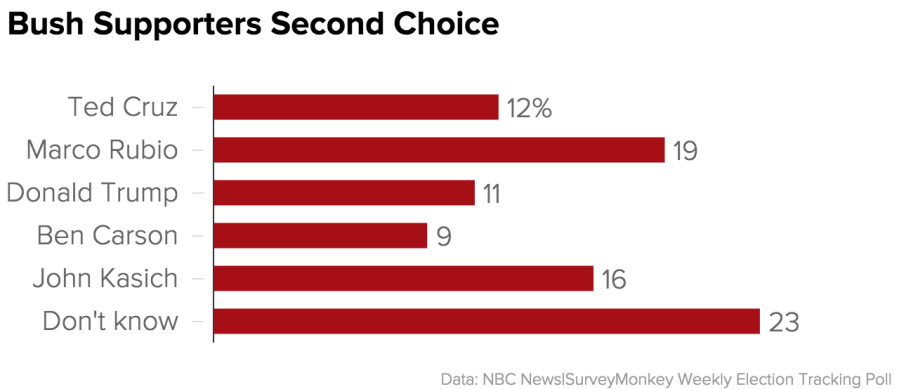
Jeb Bush supporters, who currently make up around 4 percent of registered Republicans nationally, would disproportionately move into the Rubio camp, with 19% selecting the Florida senator as their second choice. John Kasich is the next most popular, with 16% of Bush supporters selecting him. This fits into the narrative that the establishment vote will likely stay with establishment candidates. However, a plurality of Bush supporters don’t know who they would vote for if they could not vote for Bush, which may represent an opportunity for other candidates.
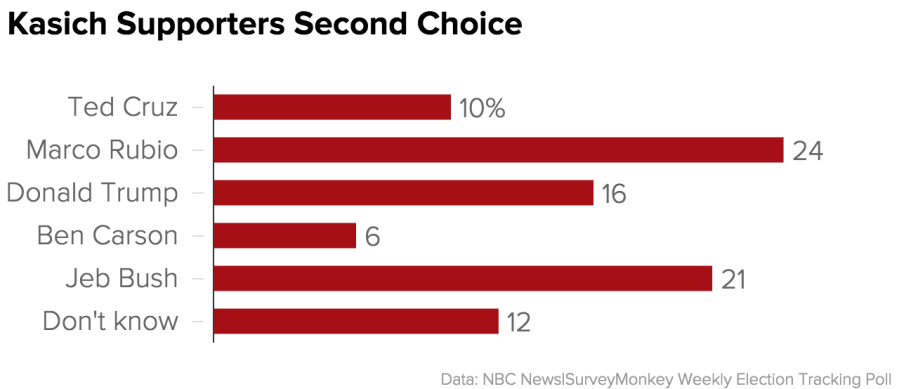
Kasich’s supporters – who currently make up 7 percent of registered Republicans – follow a similar pattern. Rubio again would benefit the most if Kasich were to drop out. Our poll shows that 24 percent of Kasich supporters would currently back Rubio if they could not vote for the Ohio governor, while 21 percent would back Bush.
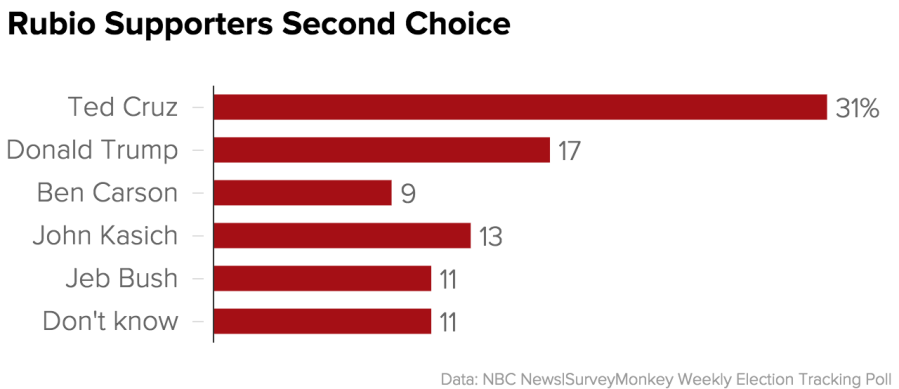
These numbers for Bush and Kasich appear to support the narrative that Rubio, Bush and Kasich are drawing from a similar well of voters. Rubio dropping out would help Cruz the most (31 percent of Rubio supporter’s list Cruz as their second choice), followed by Trump at 17 percent.
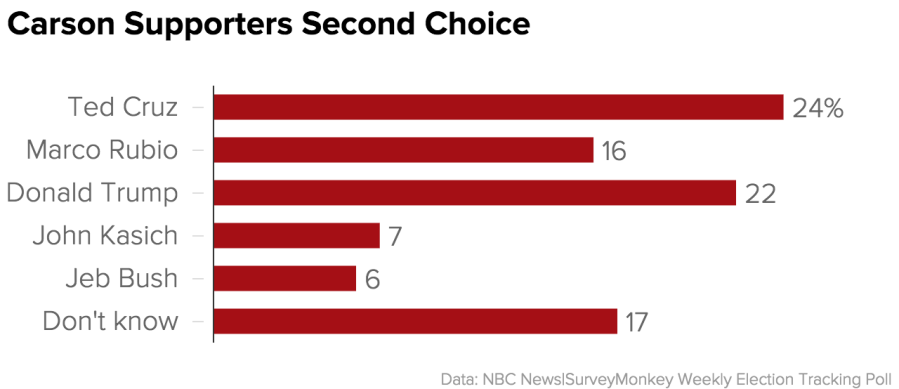
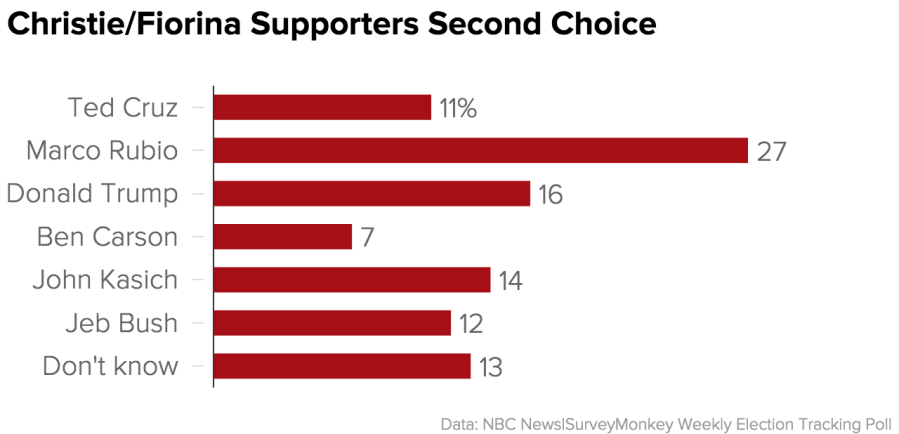
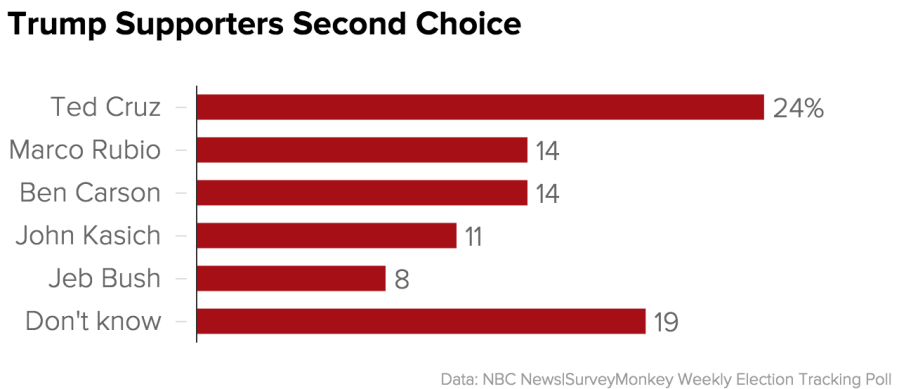
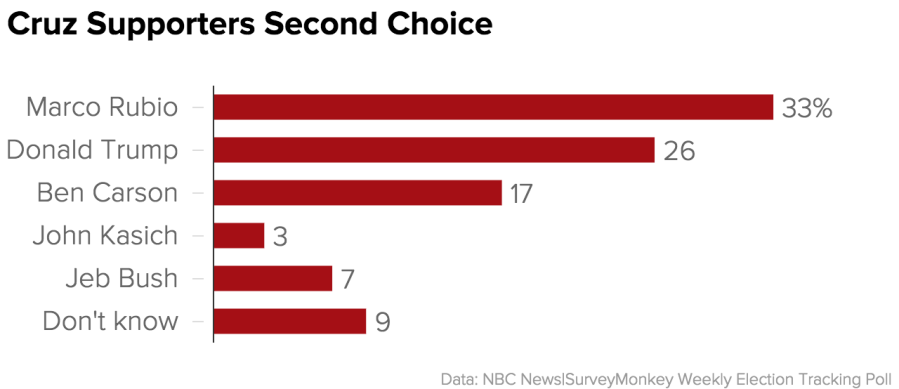
Ben Carson’s supporters do not seem to follow the same pattern. Cruz is the second choice of the plurality of Carson supporters (24 percent), with Trump a close second at 22 percent. The second choices of Chris Christie and Carly Fiorina supporters are no longer an abstract question, as both candidates have dropped out of the race. Our data from last week suggest that a plurality of these voters (27 percent) will move to Rubio’s camp, while the rest will spread evenly between Bush, Kasich, Trump and Cruz. These voters, however, are a relatively small prize. Christie and Fiorina supporters made up only 3 percent of registered Republicans in our most recent poll. Among the three front-runners, Cruz would benefit from either Rubio or Trump exiting the race, as he receives the plurality of second-choice support from both groups of supporters. If Cruz was to leave the race, Rubio would benefit the most. However, despite the increasingly adversarial relationship between the two candidates, nearly 26 percent of Cruz supporters would still support Trump if Cruz dropped out. The NBC News|SurveyMonkey Weekly Election Tracking poll was conducted online from February 8, 2016 through February 14, 2016 among a national sample of 13,129 adults aged 18 and over, including 11,417 who say they are registered to vote. Respondents for this non probability survey were selected from the nearly three million people who take surveys on the SurveyMonkey platform each day. Results have an error estimate of plus or minus 1.1 percentage points. A full description of our methodology and the poll can be found here.
Susan Del Percio is a Republican strategist and a political analyst for MS NOW.
Josh Clinton
Marc Trussler Recommended