








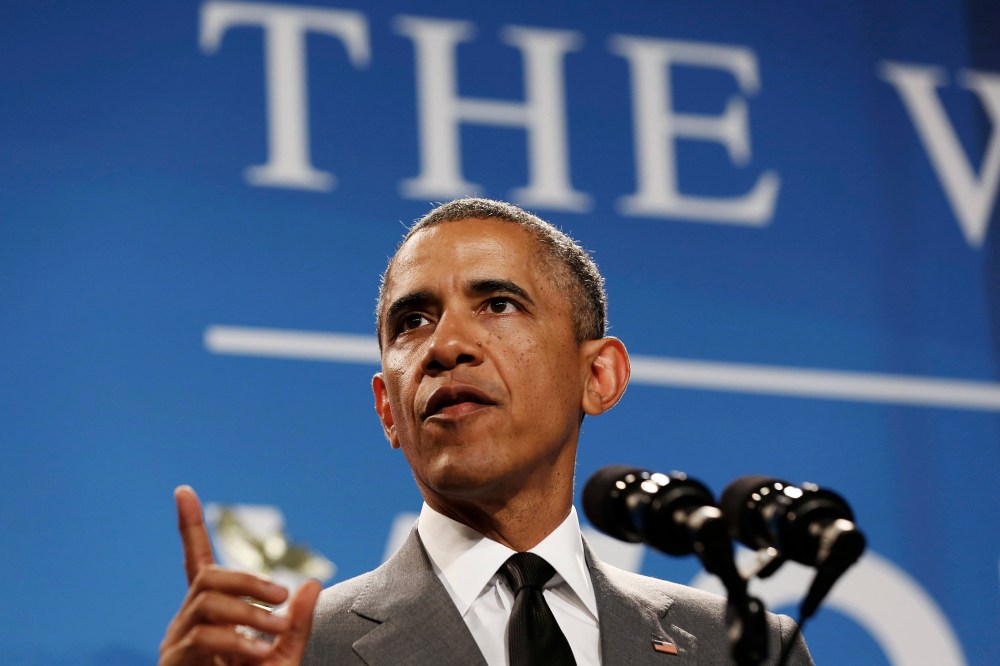
President Barack Obama delivered a rousing speech in favor of progressive family policies Monday, declaring that paid family leave and affordable childcare “are not frills, these are basic needs.”
Speaking to a rapturous crowd at the first-ever White House Summit on Working Families Monday afternoon, Obama noted that “too often these issues are thought of as women’s issues, which I guess means you can kind of scoot them aside a little bit. “ But, he said, “Anything that makes life harder for women, makes life harder for families, and makes life harder for children.”
Obama added, “This is about you too, men.” He conceded that there is a double standard for men’s participation in parenting, where men get cheered for attending parent-teacher conferences while women’s professional commitment gets questioned for doing the same.
He also pointed out that the United States is the only developed country without mandated paid maternity leave.
Obama will sign a presidential memorandum directing federal agencies to expand flexibility policies, call on Congress to pass the languishing Pregnant Workers Fairness Act to expand workplace accommodations, and direct Labor Secretary Thomas Perez to allocate $25 million towards childcare for people who want to attend job training programs.
White House senior advisor Valerie Jarrett noted in an interview with msnbc last week that the current composition of Congress means broader national action on these issues remains a pipe dream.
“You’re seeing employers recognize the importance of this on their own, putting in practices that provide for this, but we would certainly like to have a conversation about that at the federal level,” Jarrett said.
But as The Washington Post notes, the president hasn’t formally supported the national paid family leave that has been introduced in Congress, however doomed, though he has allocated money in his proposed budget to support local initiatives. Jarrett stressed the Paycheck Fairness Act, which failed to clear a Republican filibuster in the Senate in April.
The balance of the day was devoted to breakout sessions on issues like compensation, young women’s leadership, and caregiving, featuring activists and business owners from around the country.
The economic policies under discussion were explicitly described as women’s issues, part of a general push to expand their political definition beyond reproductive rights and violence against women. “We talk about the glass ceiling but you know what, it is the sticky floor that is the problem for so many minimum wage workers,” said senior White House advisor Valerie Jarrett in her opening remarks.
In the opening plenary, Jill Biden noted in her speech that the issue of caregiving transcends mothers caring for small children. She spoke of the “sandwich generation,” which often raises children at the same time as caring for ailing parents. %22Anything%20that%20makes%20life%20harder%20for%20women%2C%20makes%20life%20harder%20for%20families%2C%20and%20makes%20life%20harder%20for%20children.%22′ Vice President Biden talked about how even as his female policy staffers sometimes needed flexibility to care for their families, “They’re the reason I was able to write the domestic violence law in the first place,” referring to his signature legislation while in the Senate, the Violence Against Women Act. “You cannot talk about opportunity for women,” said Biden, “without talking about violence against them, the domestic violence.” Obama has often used the show “Mad Men” to refer to retrograde workplace policies, so there to illustrate the point was a star of the show, actress Christina Hendricks. She said of her character, a single mother, “She has faced discrimination in every aspect of her job, simply because she’s a woman …The only place for a story like Joan’s should be on TV.” Women — and in particular women of color and unmarried women — are an important constituency for Democrats, in this fall’s midterms and beyond. Obama nodded to this, even as he said that the motivation for the summit was his personal commitment to the issues. “Somebody asked, well, it’s well known that women are more likely to vote for Democrats,” Obama said. “To which I said, ‘Women are smarter.’”
Irin Carmon Recommended


