








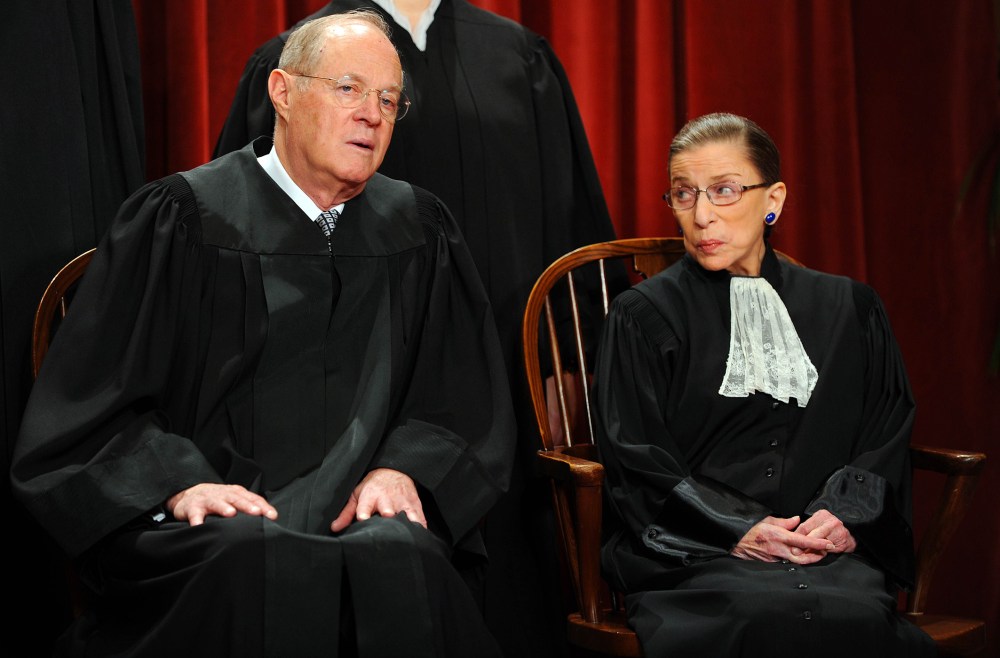
With the death of Justice Antonin Scalia, opponents of abortion lost a real champion on the Supreme Court. But when it comes to Whole Woman’s Health v. Hellerstedt, the hugely consequential abortion case to be heard on March 2, Scalia’s absence hasn’t changed an essential calculation. All arguments will still be firmly aimed in the direction of Justice Anthony Kennedy. And for the man behind the court’s last two highly conflicted Supreme Court opinions on abortion, that is always a tricky proposition.
Texas, like many of its neighbors, has imposed on abortion clinics new standards that are so difficult for the clinics to meet that a majority of them will be or have been forced to close. Doctors must have admitting privileges at local hospitals, something they say many hospitals have been reluctant to supply out of opposition to abortion or fear of controversy. Abortions must take place in an ambulatory surgical center, a cavernous, multimillion-dollar facility for a procedure that involves no incision and in many cases involves taking a couple of pills.
RELATED: Most Louisiana abortion clinics could close unless SCOTUS steps in
“Our strategy hasn’t changed,” said Stephanie Toti, the Center for Reproductive Rights attorney who will argue before the Supreme Court next Wednesday. “All along, it’s been our strategy to show that these laws are a sham.”
The state of Texas claims it is within its legal rights to regulate clinics for the sake of women’s health. The abortion clinics that brought the case counter that the low complication rate and existing regulations show the new law isn’t needed. “If these facilities were providing substandard care that posed a threat to patient health or safety, then Texas would be justified in shutting them down,” attorneys for the clinics wrote in a brief to the court. “But they have a long record of providing safe abortion care, which [Texas officials] do not dispute.”

On a nine-member court, Kennedy voting with the four other Republican-appointed judges would set a precedent that would effectively decimate abortion access across the country. A four-four tie limits the impact to the 5th Circuit Court of Appeals, which approved the law and said that Texas only had to show that its law met a very low legal bar. But even a relatively blunted decision, while sparing the rest of the country from abortion restrictions that have been blocked by judges elsewhere, would shutter abortion clinics across the Deep South. Under that scenario, three quarters of clinics in Texas and Louisiana and the last clinic in Mississippi are all expected to close. Millions of women would have to travel several hundred miles more to end their pregnancies, an expensive and time-consuming hurdle many may not be able to meet.
Will Kennedy — who joined the court’s two now-retired moderates, Sandra Day O’Connor and David Souter, to find a middle ground on abortion in 1992 — go for it? The answer to the question depends on which version of the justice shows up to the conference vote.
The Kennedy Texas is hoping for: The one who authored Gonzales v. Carhart in 2007. Kennedy’s last abortion opinion, upholding the federal Partial Birth Abortion Ban, evinced a profound horror at abortion, albeit a specific later procedure. The opinion was rife with grisly details about how the abortion procedure was performed, using the loaded words “baby,” “a child assuming the human form,” and “unborn child” for the fetus. Not for nothing did Texas begin its brief to the court by citing Kermit Gosnell, the Pennsylvania doctor who ran a gruesome and dangerous clinic and was convicted of several murder and manslaughter charges, to justify its law.
That Kennedy also deeply mistrusted abortion providers and doubted they had their patients’ best interests at heart. Justice Ruth Bader Ginsburg, in her furious dissent in that case, wrote in dismay that Kennedy “refers to obstetrician-gynecologists and surgeons who perform abortions not by the titles of their medical specialties, but by the pejorative label ‘abortion doctor.’” Those “abortion doctors,” Kennedy argued, would withhold from their patients the terrible truth of the later abortion procedure, so the only option was to allow Congress to ban it.
RELATED: Shuttered: The end of abortion access in red America
Ginsburg wasn’t alone in seeing some sexist paternalism in Kennedy’s language about women needing to be protected from their own decisions, but it could work in Texas’s favor. The primary justification the state offers for the law is that it protects women, not that it protects fetuses by preventing abortions.
Texas also says that Kennedy’s decision in Carhart means that judges can’t look at abortion laws closely enough to assess for themselves what is actually medically accurate. “The Court has made clear that such decisions belong to legislatures,” the state’s attorneys wrote in their brief. The American Medical Association (AMA) and the American College of Obstetricians and Gynecologists officially oppose the law, saying it makes women less safe, but the state has provided its own experts to support the law. The Kennedy the abortion clinics are hoping for: The one who in June gave supporters of abortion rights some encouragement when he voted to keep the clinics open while the litigation proceeded, showing he took seriously their claims that enforcing the law would cause them irreparable harm. More meaningfully, the abortion clinics hope for the Kennedy who had a chance to overturn Roe v. Wade in 1992 and instead co-authored Planned Parenthood v. Casey. That Kennedy signed onto a plurality opinion that declared, “The ability of women to participate equally in the economic and social life of the Nation has been facilitated by their ability to control their reproductive lives.” That case set a new standard for abortion laws: States can restrict the procedure, even try to talk women out of having one, as long as they don’t pose an undue burden on the decision. RELATED: Opinion: SCOTUS case could have devastating impact on Latinas in Texas The Casey opinion also included this potentially crucial language: “Unnecessary health regulations that have the purpose or effect of presenting a substantial obstacle to a woman seeking an abortion impose an undue burden on the right.” The Kennedy the clinics hope for may be persuaded by the AMA’s position that such restrictions endanger women by making legal abortion harder to access. (The influential group initially supported the Partial Birth Abortion Ban, the law at issue in Carhart. An independent inquiry found the move to have been made improperly as part of a political deal.) “The AMA is a somewhat stodgy institution, and they haven’t always been willing to take positions in cases involving abortion,” said Priscilla Smith, a scholar at Yale Law School who argued the Carhart case before the court. “That they’re doing so here demonstrates how extreme these regulations are.” Several district courts, including the one in Texas, as well as in Alabama and Wisconsin, have held after a trial that the state’s evidence in support of the regulations relied on discredited sources. The best case scenario for the clinics is that Kennedy is still attached to another aspect of Casey, which holds that a state can only try to talk women out of abortions, not stop them from getting them altogether. A decade ago, in Gonzales v. Carhart, Kennedy emphasized that the court wasn’t overturning Casey, which is why Texas hasn’t officially asked him to do so this time around. But as Cornell law professor Michael Dorf pointed out, the standard Texas argues the court should apply to abortion is actually what the dissenters in Casey wanted. One of those dissenters, of course, was Scalia. He wrote then that he did not understand what the “undue burden” standard even meant. He predicted it would “prove hopelessly unworkable in practice.” As appeals courts across the country split on the laws at issue in Whole Woman’s Health, even Scalia’s usual opponents could get behind that one. For now, each side has to convince Kennedy that “undue burden” means their side prevails — at least until the prospect of a ninth justice becomes reality.
Irin Carmon Recommended


