








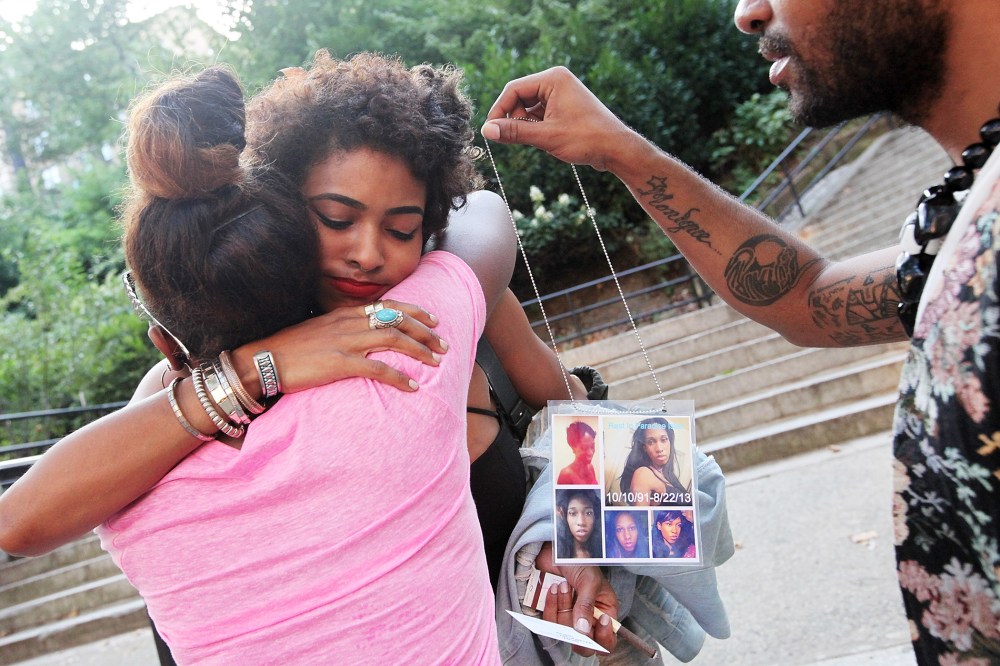
An awful trend of violence against transgender women of color has bled into 2015, yet there’s been little mainstream media attention to their deaths. It’s left some activists to question whether the Black Lives Matter movement inspired by the killings of Trayvon Martin, Michael Brown and Eric Garner actually includes all black lives.
On Sunday, a 25-year-old man turned himself into police following the death of Michelle Vash Payne, 33, who was found fatally stabbed at the scene of a Los Angeles house fire. Less than a week earlier, 24-year-old Ty Underwood, a black transgender woman, was fatally shot while driving near her home in North Tyler, Texas. Ten days before that, meanwhile, 30-year-old Lamia Beard, also a black transgender woman, was found dead from a gunshot wound in Norfolk, Va.
Related: What’s to come for #BlackLivesMatter?
Little is known about the circumstances surrounding these killings. But certain LGBT advocates see some troubling similarities among their stories: all of the victims were young, black, mis-gendered in news reports, and relatively invisible to national media outlets and social justice groups. It’s a significant departure from the swell of activism and headlines following the recent deaths of Martin, Brown, and Garner – three black, heterosexual, cisgender men – as well as Leelah Alcorn, a white, transgender teenager.
“The mere fact that there has been no national outcry for the brutal murders of 3 Black Trans Women (or the 12 trans women of color brutally murdered in 6 months) is tragic,” said Lourdes Ashley Hunter, national director of the Trans Women of Color Collective, via email. “The silence and lack of action on behalf of the Black Trans Community from mainstream media and social justice organizations sends a strong message that Black Trans Lives do not matter.”
3 black trans women killed in the last 2 weeks in the US. LGBT Orgs quiet. If 3 cis white gay men were killed over homophobia would be dif
— Sophia Banks (@sophiaphotos) January 30, 2015Transgender people make up just 2 to 5% of the national population, according to the Transgender Law and Policy Institute, and an even smaller percentage are transgender women of color. Yet these individuals face disproportionate levels of homelessness, poverty, HIV, discriminatory policing, and hate violence. As Hunter pointed out, at least 12 transgender women of color were murdered in the U.S. last year, according to the Human Rights Campaign. And in 2013, the National Coalition of Anti-Violence Programs (NCAVP) reported that 67% of those killed in LGBT or HIV-motivated crimes were transgender women of color.
Osman Ahmed, NCAVP research and education coordinator at the New York City Anti-Violence Project, says that “there is no simple answer” for why transgender women of color face such widespread abuse. But, he said, “one of the leading causes is transphobia intersecting with racism in this country.”
Photos: Portrait of a trans community
And yet, despite these high rates of violence, no slain transgender woman of color has ever received the same level of attention as Martin, Brown or Garner — a fact that has caused some to wonder whether the Black Lives Matter movement would more aptly be titled, “Cisgender Black Male Straight Lives Matter.” Similar questions have come up when considering the reaction to the death of Alcorn, a white 17-year-old transgender girl who committed suicide in Ohio last fall. While Alcorn rose to national prominence, few people would likely recognize the names of Tiffany Edwards, Cemia Dove, Betty Skinner, or Brittney Nicole Kidd-Stergis — four transgender women of color who were killed in the same state as Alcorn last June.
%22What%E2%80%99s%20happening%20with%20the%20trans%20women%20of%20color%20cases%20is%20that%20they%E2%80%99re%20happening%20under%20the%20cloak%20of%20darkness%2C%20and%20so%20it%E2%80%99s%20not%20as%20amplified.%22′
There are, however, critical elements that distinguish the transgender women of color cases — and perhaps explain the lackluster response to their deaths. The NCAVP’s Ahmed pointed out that the killings of Martin, Brown and Garner were at the hands of a vigilante and police officers, which helped to fuel the national outcry. By contrast, none of the recent transgender women of color killings involved law enforcement.
Furthermore, Garner’s death was caught on tape, allowing his last words — “I can’t breathe” — to echo across the country. Equally devastating and public were Alcorn’s last words — “fix society” — which she left behind in an online suicide note that exposed many of the hardships transgender people face while growing up. Danielle Moodie-Mills, an advisor for LGBT Policy & Racial Justice at the Center for American Progress, told msnbc the relative silence surrounding the killings of transgender women of color is more of a reflection on what it takes to grab national attention, rather than evidence of the Black Lives Matter movement’s shortcomings. “What’s happening with the trans women of color cases is that they’re happening under the cloak of darkness, and so it’s not as amplified,” said Moodie-Mills. “Their bodies are being found days later or weeks later. It’s terrible the kind of publicity and awareness we need. Something has to happen in broad daylight for us to be outraged.” But, continued Moodie-Mills, LGBT equality is very much a part of the Black Lives Matter movement. In fact, she pointed out, the hashtag was actually founded by three black lesbians, while the Black Life Matters “Freedom Ride” from New York to Ferguson was organized by gay people as well. Trans Women of Color Collective’s Hunter is a member of Black Lives Matter’s leadership team. “The narrative that is painted by mainstream media will have you to believe that Black Trans Women are not part of the movement which is simply not true,” said Hunter. “Black Lives Matter and Trans Women of Color Collective have been working intently for the past 3 months to center the narratives of those most disproportionately impacted by structural oppression in our social justice efforts.” Still, more work undoubtedly needs to be done in terms of translating those LGBT leadership voices to the ground and elevating the lives of transgender women of color taken by violence. To do that, advocates say, requires a significant amount of education for the media on how to properly report issues related to gender identity; training for police officers so that they can protect transgender people, rather than criminalize their behavior; and most importantly, a concerted push to bring more transgender voices out of the shadows. “Black Trans Women are the experts of their experience,” said Hunter. “There are too many people making decisions for our lives and none of them live our experience.”
Emma Margolin
Emma Margolin is a reporter at MSNBC.com. Recommended


