








The young Jerry Parr had set his heart on becoming a Secret Service agent from an early age. When he was nine he’d talked his dad into taking him to the movie Code of the Secret Service, whose hero, Lieutenant Brass Bancroft, a dashing agent and ace pilot, was played by a busy young actor, Ronald Reagan. This was Reagan’s fourteenth movie after only two years in Hollywood, and he would appear as Brass Bancroft four times altogether. According to the buildup, Brass and his fellow agents were required to be “dauntless in the face of danger” and “fearless in the face of death.”
Hoping to keep audiences hooked on the series, publicists at Warner Bros. came up with the idea of starting a Brass Bancroft fan club, which they called the “Junior Secret Service Club.” Anyone joining it would receive a membership card signed by Ronald Reagan. Nine-year-old Jerry Parr had been so enthusiastic about Code of the Secret Service he went back to see it again and again.
In 1962, at the age of 32, after stints with the Air Force and a public utility company in Florida, Parr became a Secret Service agent. Seventeen years later, he was put in charge of presidential protection as head of the Secret Service White House detail.
Inspired so many years before by Ronald Reagan, in ways that wound up giving shape to his life, Jerry Parr, a little over four decades later, now was about to return the favor.
History often produces strange parallels. In March 1981, another moviegoer, twenty-five-year-old John Hinckley, would also reveal himself to have been greatly influenced by a film, and to be equally motivated to act out what he’d seen on the big screen. A depressed college dropout, whose wealthy family was in the oil business, Hinckley seemed to fail at everything he tried. Repeatedly viewing Martin Scorsese’s grimly violent Taxi Driver—released originally in 1976—he became obsessed with one of its stars, Jodie Foster. She’d memorably played a preteen prostitute in the movie, but by Reagan’s election she’d entered college and was a freshman at Yale. Determined to make Foster notice him, Hinckley first moved to New Haven, writing and phoning her repeatedly. But when his attentions proved entirely unwanted, he began to envision impressing her by the magnitude of an extreme act he would plan and commit.
Since a central plotline of Taxi Driver had been the determination of a loner—Travis Bickle, played by Robert De Niro—to assassinate a politician, this was the course Hinckley decided upon in his quest to prove his devotion. After leaving New Haven, Hinckley first fixed on the idea of shooting Jimmy Carter. He followed Carter to Nashville but wound up getting arrested instead on a concealed weapons charge. After paying a fine of $62.50, he was released.
On March 30, 1981, at 2:30 in the afternoon, a lunch given by the National Conference of the Building and Construction Trades Department of the AFL-CIO in the International Ballroom of the Washington Hilton was just ending. The event’s speaker had been Reagan, who’d launched into his speech at 2:03 p.m. Among the topics were the deficit, his tax-cutting agenda, his determination to reduce federal regulations, and the intensive military buildup he planned. He also told the audience, “I hope you’ll forgive me if I point with some pride to the fact that I’m the first President of the United States to hold a lifetime membership in an AFL-CIO union”—which in his case was the Screen Actors Guild.
As soon as he’d finished speaking, Reagan left the building through a side entrance and approached his waiting presidential motorcade. Nearby, John Hinckley was lying in wait. Raising a .22-caliber revolver, he fired six shots. One hit James Brady, the president’s press secretary. Another wounded D.C. police officer Thomas Delahanty. A third struck Secret Service agent Timothy McCarthy. Although Hinckley missed hitting President Reagan directly, one of the bullets ricocheted off the presidential limousine and entered President Reagan’s lung, lodging approximately an inch from his heart.
Following the Secret Service rule of “cover and evacuate,” Jerry Parr, who’d been standing right behind Reagan, grabbed him and shoved him onto the backseat of the waiting limo, then jumped on top of him. “Let’s get out of here,” he yelled to the driver. “Haul ass!”
Reagan’s lips were turning blue. From his training, Parr knew this indicated bleeding in the lung. Recognizing the perilous situation, he knew it would waste precious time continuing on to the White House. “I think we should go to the hospital,” Parr told the president.
“Okay,” Reagan agreed. Though he’d recoiled at hearing the gunshots at the Hilton, he hadn’t even realized at first he’d been hit, and was obviously in shock, though alert.
Barely three minutes after leaving the Hilton, the speeding motorcade screeched to a halt in front of the emergency room doors at George Washington University Hospital. “This is the president!” yelled Parr.
Reagan was determined to walk through the doors of the hospital under his own strength. He even stopped to chat with people standing outside the building. But Reagan’s determination could carry him only through the hospital doors. Twenty feet inside, Parr saw his eyes suddenly roll back in his head and the president collapsed. Parr and another agent caught him before he reached the floor. The president had lost 50 percent of his blood supply through internal bleeding and now would require a surgeon’s skills to extract the unexploded slug resting precariously near his heart.
“Honey, I forgot to duck,” he confessed sheepishly upon spying his distraught wife, Nancy, who’d been rushed to his side. No one minded that he’d taken this one from Jack Dempsey, who’d said the same thing after losing the 1926 heavyweight title to Gene Tunney. He then topped it with his quip to the medical team about to operate on him. “I hope you’re all Republicans,” he said before succumbing to the anesthesia.
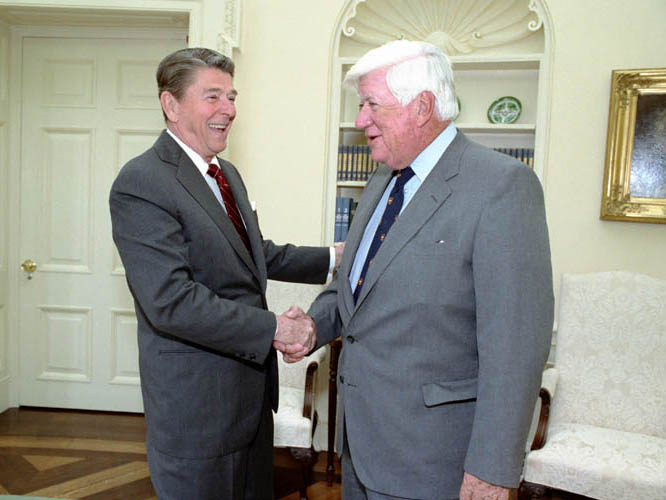
Jim Baker, ever strategic, had ruled that the first representative of official Washington to visit the convalescing president would be the leader of the opposition. After several days, Tip O’Neill was at Reagan’s bedside. “When the Speaker came in,” recalled Max Friedersdorf, “he nodded my way and walked over to the bed and grasped both the president’s hands, and said ‘God bless you, Mr. President.’ Friedersdorf had been posted in Reagan’s room to prevent unwanted guests from gaining access. “The president still seemed groggy . . . with lots of tubes and needles running in and out of his body. But when he saw Tip, he lit up and gave the Speaker a big smile. ‘Thanks for coming, Tip,’ he said. Then, still holding one of the president’s hands, the Speaker got down on his knees and said he would like to offer a prayer for the president, choosing the Twenty-third Psalm. ‘The Lord is my shepherd; I shall not want. He maketh me to lie down in green pastures . . .’” It seemed clear to Friedersdorf, witnessing the encounter, that Reagan, though weak, was paying attention. “He recited part of the prayer with the Speaker in almost a whisper.” Once they’d finished, the Speaker let go of the president’s hand, stood up, and bent to kiss him on the forehead.“ ‘I’d better be going,’ he told the patient.‘I don’t want to tire you out.’” During this privileged visit to GW Hospital, Tip saw firsthand the reality of Reagan’s condition. Like the rest of the country, he’d been led to believe the president was experiencing a robust recovery. Instead he found himself kneeling within inches of a seventy-year-old man lying there in great pain. The Speaker had been asked by the White House not to comment on the president’s condition. “I suspect that in the first day or two after the shooting he was probably closer to death than most of us realized,” he later said. “If he hadn’t been so strong and hardy, it could have been all over.” The week before the shooting, Reagan and Nancy had spent the evening at Ford’s Theatre. The benefit was for a cause important to Millie O’Neill, its chairwoman. The two couples sat together in the first row. Captured on videotape taken that night, the president and the Speaker can be seen laughing and enjoying themselves while a juggler-comedian performs with antic precision on the stage, his long knives whirling barely an arm’s length away in front of them. I can remember Tip talking in the office about his uneasiness at those knives flying so close. Yet Reagan had glimpsed a shadow there in Ford’s Theatre. “I looked up at the presidential box above the stage where Abe Lincoln had been sitting the night he was shot and felt a curious sensation. . . . I thought that even with all the Secret Service protection we now had, it was probably still possible for someone who had enough determination to get close enough to a president to shoot him.” O’Neill, who’d greeted Reagan at the street door that night, would say later that he, too, actually had had the same thought, undoubtedly inspired by the historic surroundings and suddenly realizing how vulnerable Reagan—as president—was. Adapted from Tip and the Gipper: When Politics Worked, by Chris Matthews
Chris Matthews Recommended


