








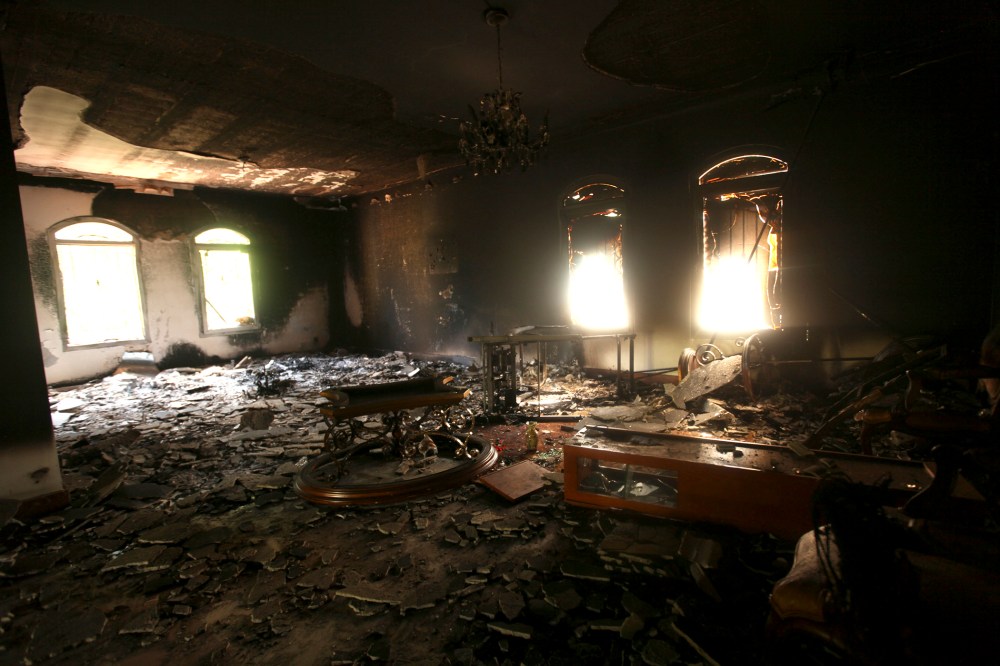
“Dear GOPers,” I tweeted on May 6, “Here’s a Benghazi Twitter challenge. Please state, in 140 characters or less, what it is you need an investigation to find out.” No replies (unless you count some sarcastic ones from liberals). Two days later I repeated the challenge and received precisely one serious answer, from GOP strategist Ron Christie: “How 4 Americans died in a pre-planned terrorist attack + what the Admin knew/did before/after the attack.”
@_orchid_blue How 4 Americans died in a pre-planned terrorist attack + what the Admin knew/did before/after the attack. #tcot #lnyhbt
— Ron Christie (@Ron_Christie) May 7, 2014So, first, thank you, Mr. Christie, for answering my challenge. But why this attack?
Deadly violence against U.S. diplomats, sadly, is a frequent occurrence. The State Department counts 86 “significant attacks” against diplomatic outposts just in 2012, the year of the Benghazi attack. The death toll from these 2012 attacks was not four, but 24. And this is not a new problem. Since 1970, there have been 521 attacks on U.S. diplomatic targets, killing 500 people. The deadliest of these was not Benghazi but a truck bomb explosion in Nairobi, Kenya that killed 213 people, 12 of them Americans. Since 1977, 66 American diplomats have been killed by terrorists.
If the House GOP truly cared about providing better embassy security, it would create a select committee to investigate this perennial problem, instead of creating one about Benghazi. The question of how to give adequate protection to diplomats stationed in dangerous places has vexed Democratic and Republican administrations alike. (Though it’s already been investigated plenty.)
%22If%20the%20House%20GOP%20truly%20cared%20about%20providing%20better%20embassy%20security%2C%20it%20would%20create%20a%20select%20committee%20to%20investigate%20this%20perennial%20problem%2C%20instead%20of%20creating%20one%20about%20Benghazi.%22′
But of course the GOP doesn’t care about that — as it showed in November when it pilloried Obama as he prepared to move the Vatican embassy, for security reasons, from Rome’s Aventine Hill to Via Veneto. (The House subsequently passed a spending bill blocking the move!) In fairness, this indifference has historically been bipartisan. For three years prior to the Benghazi attack, Congress, under both Democratic and Republican leadership, appropriated considerably less for embassy security than the White House requested.
Let’s turn now to the second part of Christie’s query: “What the Admin knew/did before/after the attack.” The “before” part of this question mimics Howard Dean’s famously unhinged allegation in 2003 that George W. Bush had been “warned ahead of time by the Saudis” about 9/11. Charles Krauthammer, a conservative columnist and licensed psychiatrist, advised Dean at the time to “check on thorazine supplies” because he was clearly suffering from “Bush Derangement Sydrome.” Krauthammer wrote much the same six years later about Van Jones, an Obama White House aide who got fired for spouting similar nonsense. You can’t say such things, Krauthammer wrote, “and be permitted in polite society … It’s beyond radicalism, beyond partisanship. It takes us into the realm of political psychosis.”
Yet today, Krauthammer is a leading light of the Benghazi truther movement. He urges the House Select Committee on Benghazi to ask, “Where and to what extent was there dereliction of duty as memos, urgent pleas and mounting evidence of danger were ignored and the U.S. ambassador was allowed to enter a deathtrap?” There was, of course, no specific evidence of an imminent attack. There was generalized concern not unlike that expressed to President Bush prior to 9/11. Stevens himself twice declined military assistance. As with Bush, we can certainly fault Obama and his secretary of state, Hillary Clinton, for failing to address this concern adequately, because people died as a result. (The death toll for Bush—nearly 3,000—was, of course, considerably higher.)
The final question on Christie’s mind (and also on Krauthammer’s) is what the Obama White House knew and did after the attack. The suggestion is that administration officials would have wanted to cover up any evidence of terrorist involvement because such involvement would contradict Obama’s campaign claim that al-Qaida was “on the run.” So the White House circulated a bunch of hooey about the crowd being inflamed by a crude anti-Islamic video that some nut had posted online. But The New York Times’s David D. Kirkpatrick, in a superb and exhaustive account this past December, confirmed that “anger at the video motivated the initial attack” and suggested the mastermind — to the extent there was one — was “an eccentric, malcontent militia leader” named Ahmed Abu Khattala. It’s far from clear that Khattala has any connection to al-Qaida. (Khattala has secretly been charged with playing a “significant role” in the attack, NBC News reported in August.) But let’s suppose there were a strong al-Qaida link, one sufficiently visible to be known to the Obama administration immediately after the attack. Do Krauthammer and Christie suppose the Obama White House would believe it could keep that secret? Moreover, why would Obama want to keep an al-Qaida link secret less than two months before an election? A political incumbent running for re-election only stands to benefit when his country comes under foreign attack. The opportunistic thing to do isn’t to hush it up, it’s to wave the bloody shirt and say “Politics stops at the water’s edge” or “You don’t change horses in midstream,” or some such cliché. Variations on this theme worked wonders for George W. Bush in 2004. There is, in fact, absolutely no reason to investigate Benghazi further except to rake Hillary Clinton, who may run for president in 2016, over the coals. It is, to paraphrase Krauthammer, a clear manifestation of Clinton Derangement Syndrome, a malady that, in one form or another, has afflicted much of the population for two decades. That Krauthammer and Christie are among the very few who can even tell you what the Select Committee should be looking for gives you some idea what a fraud it is.
Timothy Noah Recommended


