








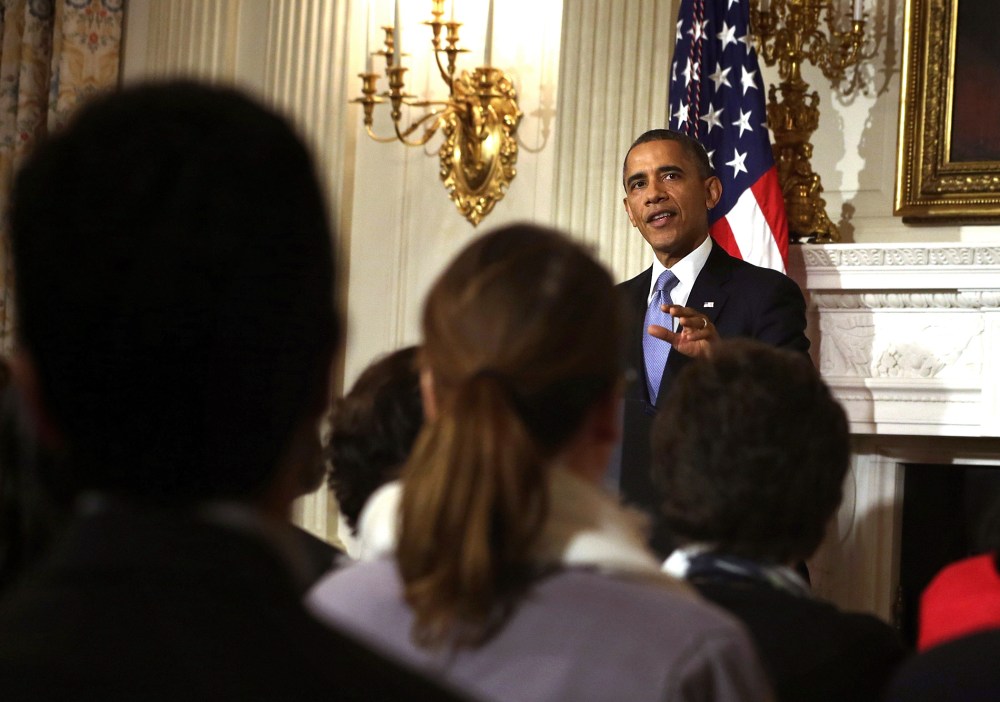
President Barack Obama stood his ground, forced Republicans into submission and overcame liberals’ worst fear–that he’d cave and head into the final three years of his second term weakened.
But is he any stronger for it?
Obama proved he can stop Republicans from getting their way, but it’s less clear if he is in a better position to get his own.
To get the next deals that he wants–like an ambitious immigration package or even a farm bill–don’t need a roadblock. They need a push.
So while the shutdown deal is a clear victory for the White House, the challenge of turning that win into momentum for his agenda is a reminder that this is still an era of bitterly divided government.
Case in point: Obama’s first words after the Senate approved the bill were a call for bipartisanship, but they were met with resentment from the House GOP.
“We could get all these things done, even this year, if everyone comes together in the spirit of how are we going to move this country forward,” Obama said.
Immediately, House Republicans balked at the comments, accusing the president of disrespecting them for speaking before their late night vote.
The morning after signing the bill to end the shutdown and lift the debt ceiling, Obama chided the “spectacle” of the showdown, insisting it had done “unnecessary damage” to the U.S.
“There are no winners here,” he said Thursday.
Still, some of the president’s supporters say he’s given himself more room to maneuver in the future.
“I think that it will strengthen his hand in terms of moving forward with the Congress in a way that is helpful, given his lame-duck status,” Anita Dunn, who served as communications director in the Obama White House, told MSNBC. “Because they’ll know there’s only so far they can push him.”
Obama’s determination not to reward GOP hostage-taking by making policy concessions surprised many Republicans, who said for weeks they expected him to cave—and based their strategy on that assumption.
The final deal looks like a clear vindication of Obama’s position. The plan funds the government through January 15 and extends the debt limit through February 7. It makes two relatively uncontroversial tweaks to Obamacare. Most important, it allows the White House to credibly claim it didn’t negotiate over raising the debt ceiling, avoiding setting what the administration considered a dangerous precedent.
Just as important as what’s in the deal may be how it was reached: It was hammered out by more establishment Republicans in the Senate, and passed through the House with mostly Democratic votes. Dunn said that dynamic, which sidelined House Tea Partiers, could tilt the balance of power within in the GOP—to Obama’s advantage.
“If those people, rather than being marginalized by their own political party, emerge in a stronger position, then that also helps set up the rest of the second term,” said Dunn, referring to Senate Republican dealmakers like Susan Collins and Lindsey Graham.
Dunn pointed to tax reform, infrastructure spending, and transportation as potential areas for progress. But for Obama to advance significant parts of his agenda, Republican leaders would have to abandon their strategy of flat-out refusing to work with him so as to deny him political victories. And some observers note that there are so few areas of agreement between the White House and Republican leaders that getting to yes on anything significant will be just as difficult as ever. “I’m not sure in terms of the agenda items the president is putting forward that there’s really much hope for common ground,” Peter Wehner, a top policy adviser to President George W. Bush, told MSNBC. “Even before this latest dust-up, they were just in different places.” In fact, said Wehner, it’s just as likely that the events of recent weeks will make future agreement even less likely. “If this whole fight over the shutdown of government and the debt ceiling has strengthened the Tea Party elements in whatever way–because they’re more angry or they feel more confident–then that makes those very, very slim chances for agreement with the president even slimmer.” Already, Redstate’s Erick Erickson, a leader of grassroots conservatives, is promising to support primary challenges against Republicans who backed down. “[C]onservatives will use this all as a millstone around the necks of those who caved,” Erickson wrote Wednesday morning. Electoral dynamics may make things harder, too. Senate Minority Leader Mitch McConnell is seen as a key potential negotiating partner for the White House. But facing a Tea Party-backed primary challenger in Kentucky next year, McConnell may have even less room to make nice with the president. Some progressives already question whether Obama won much of anything beyond temporary bragging rights in Washington. The current deal sets up new leverage points for Republicans in January and February. So the real test, said Roger Hickey, the co-director of the Campaign for America’s Future, will be whether Obama can hold the line at that point, by ending the sequestration cuts that are dragging down the economy, and resisting cuts to Social Security and Medicare. “All they did really is kick the can down the road a very short distance,” said Hickey. “Immediately, Obama has to start negotiating again with Boehner and all the crazies. And this time they’ll be more focused on something that actually could harm the economy.” Ultimately, said Hickey, Obama’s place in the history books will depend on whether he can bring down the stubbornly high unemployment rate. “He’s got to remind people that when the Republicans say let’s do more sequestration, or more cuts or deficit reduction, what they’re really talking about is killing the recovery. And that when the Republicans say ‘a responsible approach to entitlements,’ what that means is cutting your SS benefits. And if he can do that, then maybe he can win a permanent victory.”
Zachary Roth Recommended


