








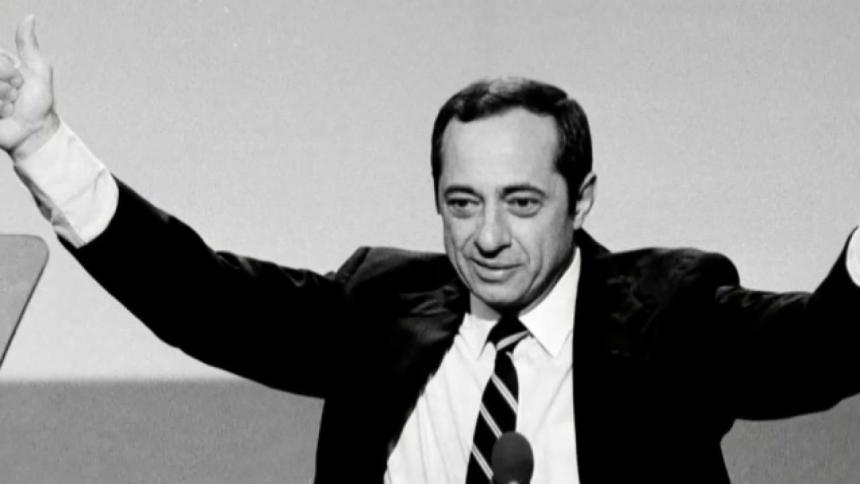
Former New York Gov. Mario Cuomo, who died on New Year’s Day at age 82, leaves behind a formidable political legacy – and a mystery for the ages: What if he’d gotten on that plane?
It was Dec. 20, 1991, a Friday, and the filing deadline for New Hampshire’s first-in-the-nation presidential primary was at 5 p.m. All eyes, though, were on Albany, New York where 10 weeks of torturous and highly public vacillation were for Gov. Cuomo finally coming to a head. In the statehouse, he and his team sought a last-minute resolution to a budget impasse that — the governor had suggested more than once – represented the only significant obstacle between him and a presidential candidacy. A few miles away, a private plane sat idling at Albany’s airport, ready to whisk Cuomo to the Granite State on a moment’s notice.
RELATED: Liberal lion Mario Cuomo dies at age 82
It was a drama that had kicked off in early October, when seemingly out of nowhere Cuomo had told a closed-door meeting of his donors at the Regency Hotel in Manhattan that he would think about running for president in 1992. With that one gesture, he effectively froze in place the Democratic field – and all of American politics – for the rest of the fall.
Sure, there were already six Democrats seeking the party’s nomination to oppose George H.W. Bush, including Bill Clinton, who we know today as one of American history’s most talented political salesmen. But Clinton was a dwarf in 1991, a little-known governor from a backwater state who most people figured was running for president for the exposure. To that point, the story of the presidential race hadn’t been who was running; it was who had taken a pass: Bill Bradley, Al Gore, Richard Gephardt, Lloyd Bentsen, Jay Rockefeller – basically, every A-lister on the Democratic side.
Bush was supposed to be invulnerable. In early ’91, he’d orchestrated the Gulf War, evicting Saddam Hussein from Kuwait and, it was said, helping the country kick its Vietnam syndrome once and for all. Massive parades and homecoming celebrations ensued, pushing Bush’s approval rating over 90% and leaving Democrats to pick from scraps. At that point, it was an open question whether the Democratic Party could ever win a national election again. Republicans had won at least 40 states in the past three White House races, and except for Jimmy Carter’s squeaker in 1976 (which had come to look more and more like a fluke), the GOP was undefeated since 1968. The Democrats, many concluded, were now simply a congressional party.
RELATED: Politicians react to Mario Cuomo’s death
But the economy was in trouble and Bush’s numbers were starting to erode. ’92 might not necessarily be a lost cause, Democrats began to say – if only we had a real candidate. That’s what made Cuomo’s October admission such a major event. The Mario Cuomo of 1991 wasn’t just a big-name Democrat – he was the big-name Democrat, a folk hero to the party’s beleaguered liberal base ever since his mesmerizing 1984 convention speech, a living, breathing reminder of the politically potent connection with ethnic Catholics that had powered the party in the days of FDR and LBJ – and that had frayed badly in the age of Reagan. To Democrats, the promise of Mario Cuomo was the promise of restoration. It was also the promise of victory. If they were going to break the GOP’s Electoral College lock in ’92, a Clinton or a Paul Tsongas or a Jerry Brown or a Bob Kerrey wouldn’t do it. They needed the stature of a Mario Cuomo.
He didn’t make it easy on them. For the rest of October, through all of November, and right up until that fateful Friday before Christmas, Cuomo issued a steady stream of utterly contradictory hints and head fakes. One day, it would sound like he was in. “What does my heart tell me?” he asked in late October. “Go out and tell them, Mario – take your best shot, whether you win, lose or draw.” But then nothing would happen. He talked of reaching a decision by the November election, and then by Thanksgiving, but those dates came and went. One of the party’s top strategic minds, James Carville, pronounced himself ready to help run a Cuomo campaign – then, after hearing not a peep from Albany, signed on with Clinton. Party leaders grew restless, and his would-be rivals, starved of media oxygen, became contemptuous.
As the New Hampshire deadline neared, Clinton said: “I always thought he’d run, and I always thought he’d wait until the last minute. He waited long enough to see which way the wind was blowing.”
But among rank-and-file Democrats, the appetite was strong. Polls showed Cuomo rocketing to the top of the pack if he entered, and when Bush’s approval plummeted into the 40s in December, a trial heat put Cuomo within 5 points of the president.
That’s when it started to look like Cuomo was actually going to do it. The Monday of that deadline week, his team dispatched an emissary to the New Hampshire Statehouse to retrieve the necessary paperwork. The next day, New York’s top Republican, Sen. Alfonse D’Amato, paid a trip to Albany to ridicule Cuomo’s inability to reach a budget deal – and to preview what Republicans would say if he went ahead and ran. “The more I hear their attack,” Cuomo said, “the more enticing it becomes.” By Thursday, there were stories about fundraising calls, out-of-state endorsements and rented office space in New Hampshire. On the day of the deadline, the New York Post quoted a top Cuomo aide saying, “It looks and smells like a go.” The Washington Post reported that “signs pointed to the governor becoming a candidate.” There was only one cable news channel back then, and throughout the day that Friday, CNN kept returning to a live shot of the idling plane. Any minute, Cuomo might board it, jet off to New Hampshire, and write his own chapter of history. But it never moved, and by mid-afternoon it was clear that it wasn’t going to. When he faced the press, Cuomo stuck to his script about the budget. If there’d been a deal, he said, “I would travel to New Hampshire today and file my name as a candidate.” But that was – and still is – a hard one to swallow. With all of his pride and conviction, Cuomo never seemed like the kind of guy who’d farm out a decision like that to a bunch of opposition party state legislators. Not that a truly satisfactory explanation has emerged these past 23 years. It remains one of those great conversation-starting what ifs? What if Cuomo had run? Would he have dominated the Democratic field and dethroned a weakened Bush? Or maybe that chronic indecision would have translated into a dysfunctional candidacy that would have wilted under a level of scrutiny Cuomo had never before faced? (My own guess is that Cuomo would have won the nomination, if only because his presence would have dramatically altered how Democrats would have interpreted the subsequent Gennifer Flowers/Bill Clinton scandal – a scandal in which Cuomo’s name played a role. But that’s another column for another day.) The theory I ultimately gravitate toward is that Mario Cuomo was attracted to the nobility of a lost cause. In 1977, he ran for mayor stoically voicing opposition to capital punishment even as the Son of Sam terrorized New York City. In 1984 at the Democratic convention, his keynote address served as a valentine to the New Deal in liberalism’s darkest hour. This is a man who could have looked at all those Democrats running away from George H.W. Bush and his 90% approval rating and decided that maybe this was a race that needed him. And this is a man who, upon realizing that he might actually win, could just as easily have decided he didn’t want the trouble.
Steve Kornacki
Steve Kornacki, author of "The Red and the Blue: 1990s and the Birth of Political Tribalism," is a national political correspondent for NBC News and MSNBC. Recommended


