








The arms race may have slowed since the Cold War, but the relentless spread of nuclear technology has made it all the more dangerous—especially in the Middle East.
Experts estimate that Israel now has 60 to 80 nuclear bombs, ranging from 20 kilotons to one megaton (1,000 kilotons) in destructive power. By the end of this decade, Israel could have 200 nukes in its arsenal, and Iran could have 20 smaller devices.
“The technology is spreading fast,” says Cham Dallas of the University of Georgia’s Institute for Disaster Management. “We can’t discount the likelihood that one of these devices will be detonated. It’s inevitable.”
Will the world be ready when it happens?
For all our efforts to prevent a nuclear incident, we’re still startlingly ill-prepared to manage one. To drive that point home, Dallas and four colleagues have meticulously simulated a nuclear skirmish between Iran and Israel. The results—published today in the journal Conflict and Health—are predictably horrifying.
More deadly than the Holocaust
Even a limited exchange would kill more people than the Holocaust in a matter of hours. But that’s not the only take-home. “The real question is whether the injury zones become death zones,” Dallas says. “That’s something we can influence even if diplomacy fails, but our leaders aren’t even addressing it.”
The new study employs methods used previously to simulate nuclear attacks on U.S. cities. By applying a weapon’s known destructive force in different virtual settings, researchers can calculate deaths and injuries for various possible scenarios. The 26 scenarios in this study ranged from devastating to apocalyptic, thanks mainly to the heat and explosive force of the weapons.
“In addition to the stunning human toll,” the authors write, “likely targeting of compact urban areas in both nations will result in devastating loss of critical industrial infrastructure and enormous economic decline.” That’s not to mention “mental health and societal chaos…as well as highly destabilizing ripple effects throughout the region and the rest of the world.”
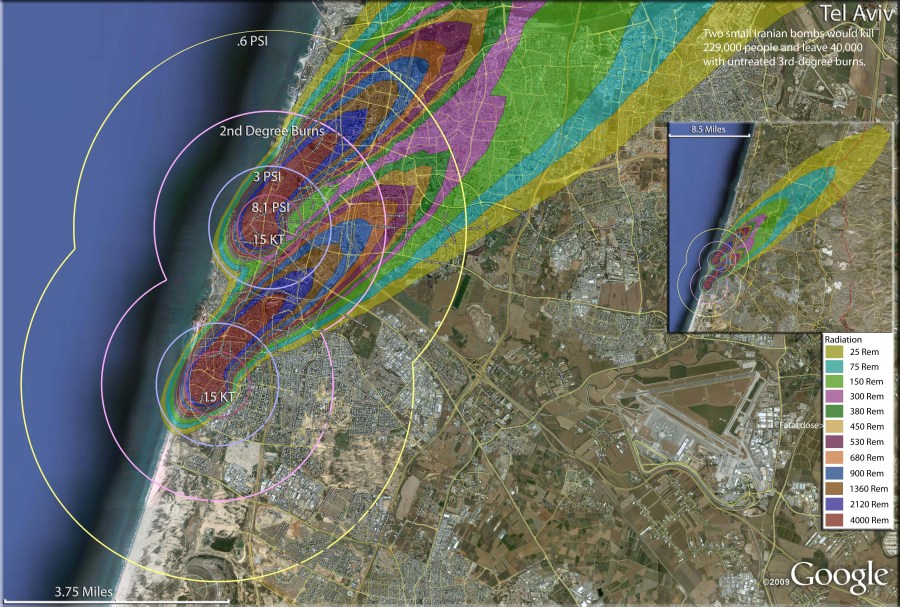
The two maps reproduced below (click to expand the images) show how the capitals of Tel Aviv and Tehran would fare in a limited nuclear exchange. The concentric circles represent different levels of thermal energy (fire and heat) and blast energy (exploding buildings and flying debris). The cigar-shaped plumes show the likely distribution of radioactive fallout.
Almost everyone in the zones marked “8.1 PSI” and “3 PSI” would die from burns and traumatic injuries, but many of those in the zone marked “second-degree burns” would survive the initial blast with grievous wounds. The radiation plumes would extend mostly into uninhabited desert.
But the likely retaliation would make these tolls look small. Israel could effectively obliterate 10 densely-packed Iranian cities by targeting each one with a single mid-size (100- to 500-kiloton) bomb. These “single-strike cities,” with populations ranging from 386,000 to 1.1 million, would instantly lose 79% to 96% of their populations, the simulations show.
Seven larger Iranian cities would suffer similar devastation—and 8 million collective deaths—if Israel hit each of them with two or three of those same mid-size bombs. And this is without any Israeli strike on Tehran.
Tehran is home to more people than the entire nation of Israel (8.3 million versus 7.2 million), and it’s uniquely vulnerable to a nuclear strike. Besides being compact and densely populated, it’s surrounded by mountains that would trap and reflect the energy released by a nuclear detonation.
If Israel struck Tehran with five 500-kiloton bombs, the simulation suggests that 7.1 million people (86% of the city’s population) would die immediately, leaving 790,000 burned, poisoned or injured. A response of even half that magnitude (five bombs, 250 kilotons each) would cut the death toll to 5.6 million but could leave 1.6 million injured survivors crawling through burning debris.
Any one of these incidents would be an epic humanitarian disaster, but the world sees its share of those. The 2004 tsunami claimed 280,000 lives in a matter of days, and the mortality estimates for Haiti’s 2010 earthquake run as high as 316,000. Both were surprises, and both exposed major gaps in international relief plans. A regional conflict like this one could expose something worse: a complete lack of preparedness to help the people who survive it.
Related: War expertise on display in care of Boston bombing victims No one doubts that surviving doctors, nurses and emergency responders would show up to care for wounded victims. But besides being overwhelmed, most would lack the skills and the tools to treat burn victims. “The surviving thermal burn patients, many of them with concurrent trauma injuries, will be in desperate need of medical care,” the authors write. “However, it is highly unlikely that these thousands of burn victims will receive any meaningful medical treatment.” Better medical preparedness needed More likely, the surviving medical professionals will treat familiar forms of trauma—the lacerations and broken bones—leaving those with burns to die slowly of infection. Burn treatment is a high-tech endeavor, normally pursued in well-equipped hospital units where each patient gets constant attention from several specialists. The authors of this study believe a lower-tech approach could save many lives after a nuclear attack. It would involve training armies of non-specialists in surgical debridement—the excision of dead tissue from heavily sedated patients—and the administration of burn medicines. No country could mount such a response as its civic institutions collapsed. But with adequate resources and authority, an international body could enlist and train armies of responders for just such an emergency. “These simulations show exactly what we need to prepare for,” says Dr. Frederick Burkle, the senior author of the study and a physician and disaster management expert at the Harvard Humanitarian Initiative. The UN is designed for such tasks, but its humanitarian response office has never had the resources or authority to plan an effective response. As Burkle noted in a recent Lancet commentary, it has long been “under-resourced, under-funded, and unable to compete with the dominant, often military-led contractors who generally respond to health disasters.” Iran’s leaders should read this study closely; it may temper their nuclear ambitions. But so should national and international policymakers. “We can’t afford to pretend this is never going to happen,” says Dallas. “Right now, the difference between our kill zones and our injury zones is almost meaningless. But we can do something about that. We can decide in advance whether those people live or die.”
Geoffrey Cowley Recommended


